
“Well all you ladies gather ’round
That good sweet candy man’s in town” — Mississippi John Hurt (1928)
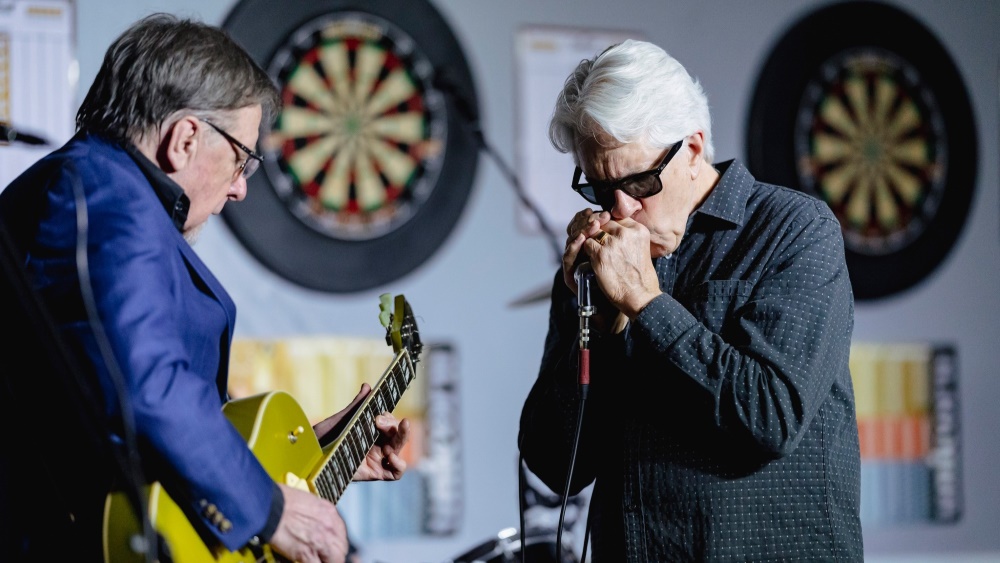
By day, David Rosenberg is a hard-working financial services professional. But at night, he’s a seasoned, committed bluesman known simply as “Candyman.”
A longtime blues harmonica player and enthusiast, Rosenberg is the leader of the local band known as Candyman & the Baltimore Show.
The band — which plays a high-octane fusion of Chicago blues, rock, soul, R&B and swing — also features Jim Seechuk on lead guitar and vocals, Jamie “White Lightnin’” Hopkins on bass and drummer Jimmy Brink.
They recently performed at Jilly’s Bar & Grill in Pikesville. For Rosenberg, the gig was a homecoming of sorts.
“I grew up in Westminster until I was 9, and then I lived in Pikesville, and I was away for a while,” he says. “So to have a gig right there on Reisterstown Road, it’s like coming full circle. After a long journey, it’s a return to where I grew up!”
Jmore recently caught up with Rosenberg, 75, whose band has been playing a flurry of local gigs in recent months, including a Baltimore Blues Society show in April at 9Five Kitchen & Bar, a new venue in North Linthicum.
Jmore: Are the blues keeping you busy these days?
Rosenberg: I’ve had more gigs this year than any other year. It’s just been terrific! It’s just so fulfilling. I’m loving it.
They say there’s nothing like playing for a live audience.
You become a junkie. If you only [perform] in your basement, you’ll never know how you’ll do live.
The corner started to turn for me in 2000 when I was living in Montgomery County. I got inspired and started playing at open mic nights, and then I took David Barrett’s Harmonica Masterclass for five straight days, from 9 in the morning until 7 at night. David Barrett said to me, ‘David, there are people out there who are technically proficient but who don’t have your feel. Get your ass out there with a band.’ He really kicked me in the butt, and I started taking the instrument seriously.
Then, when I moved back to Baltimore around 20 years ago, I played at the Cat’s Eye Pub [in Fells Point] with some great bands and learned a lot.
How did Candyman & the Baltimore Show come about?
Before the pandemic hit, I had some time on my hands and started playing with another guy as a duo at [the Village of] Cross Keys. Then we brought in other players and never really rehearsed, and we sounded pretty good and started gigging.
Then I formed this band, and we’ve been playing for less than a year. It’s the best band I’ve ever worked with. There’s so much chemistry and musicianship.
When did you start playing harmonica?
I went to [the University of Maryland] College Park, and we used to listen to vinyl all the time. Around ’68 or ’69, a guy crashed at my place. One night he was out and his harmonica was just laying on the nightstand. I happened to be listening to The Doors, ‘Roadhouse Blues,’ so I picked up his harmonica and started playing along. I was able to follow along and it was in the right key. I haven’t put it down since.
You never stopped?
For a while I thought it was a limited instrument and stopped. But then, in the mid-to-late ‘90s, I started hearing [harmonica virtuosos like] Charlie Musselwhite and Mark Hummel and Jerry Portnoy, and I got energized again.
Who are your some of your harmonica heroes?
It’s really hard to narrow it down. I think Kim Wilson is my favorite harmonica player.
William Clarke was great. Junior Wells – awesome. My top guys are probably Hummel, Mark Ford and Steve ‘West’ Weston. [Weston is] a player from Sweden – unbelievably good! He’s the best harmonica player for the kind of style I do. I also like Billy Branch and Mitch Kashmar.
How about the oldtime players?
What Little Walter did was so amazing. All of today’s masters, who are dwindling down, like Kim Wilson, they’ve taken his stuff to the next level. But Little Walter is still the father of the modern blues harmonica. Before him, most of the guys just played acoustically and not amplified.
You prefer amplified?
I get high from amplified. I get tone, textures. It’s just an endless journey. I never played that much acoustically. I always craved tone through the amplified style. It’s like a rabbit hole. An endless journey.
So how did you acquire that sweet nickname of “Candyman”?
Well, most Chicago bluesmen had a nickname or moniker – Willie ‘Big Eyes’ Smith, ‘Junior’ Wells, ‘Blind Lemon’ Jefferson, just to name a few. I never thought ‘Blind Lemon’ Rosenberg sounded too good. [Laughs]
I was in the candy business for about 20 years, and everywhere I went they used to call me ‘Candyman.’ So the name stuck, even after I left the business.
And you’re the leader of the band, even though you’re not the primary vocalist?
Yes, it was my vision. But I started to sing. I’m up to two or three songs a night. I have a vocal coach in Ruxton who’s amazing and works with all kinds of famous people.
But I’m front and center in this band because the harmonica is the lead instrument every night. You don’t see really good harmonica players with tone and technique these days. People, especially millennials, haven’t been exposed to it, so they don’t really care for the instrument. But people who love the blues like a harmonica-centric band.
Sounds like you don’t feel the harmonica gets the respect it deserves.
The problem is that people today don’t really see or hear it that much [in popular music], and it’s not very often done very well. So they go, ‘Really? That’s what you play? Not the piano or something else?’ It’s not a real instrument to them. It was a toy they might remember from their childhoods.
But once you get your technique and tone down, with a vintage microphone to choke the air, and through a vintage amplifier for harmonica, it changes the whole freakin’ instrument. Once they hear a good harmonica player play, they say, ‘I didn’t know that a harmonica could sound like that – almost like a saxophone.’
For more information about Candyman & the Baltimore Show, visit thebaltimoreshow.com.

The Jillian and Lindsay Wiener Short-Term Rental Safety Act requires rental companies to conduct annual fire inspections in Baltimore City and every Maryland county.
"Seeing the Essential" will showcase more than 100 art works collected for six decades by the local Jewish community philanthropists.
Reproductions of the murals, previously believed to have been lost, are now part of the Jewish Museum of Maryland's new permanent exhibition.
The donation will be directed to help foster research conducted by faculty at the University of Maryland School of Medicine and to advance innovative treatments.