
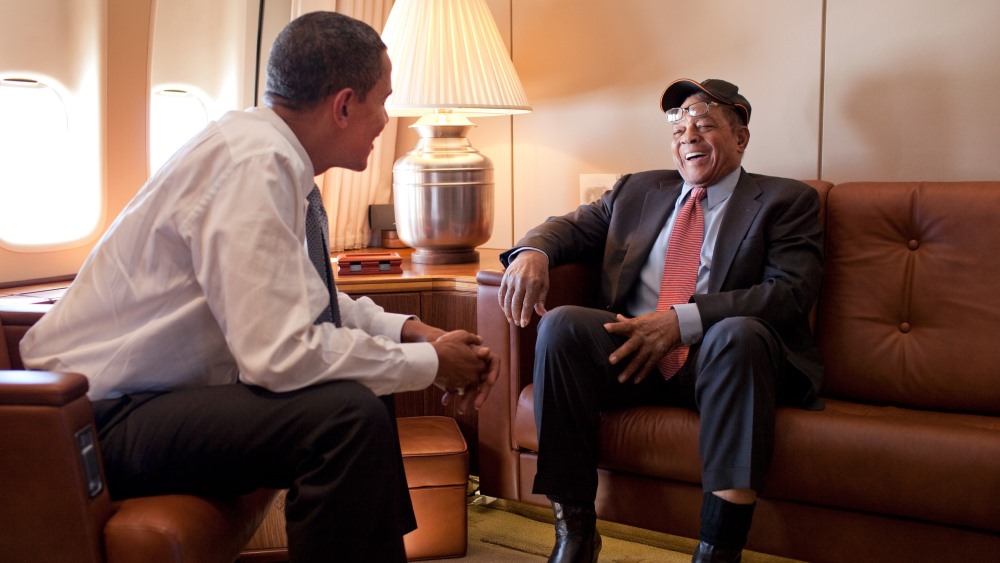
One sunlit September afternoon in 1954, Willie Mays made the most famous catch in history right there in Harvey Hyatt’s basement. Such a catch had never been seen in Harvey’s basement or anywhere else, and it commenced an affair of the heart with baseball that felt like an opening into America.
The memory comes back this week with the news that the great Mays has died, at age 93. We can imagine him dashing into the hazy distance, his back to all of us, much as he turned and ran after that afternoon 70 years ago.
Five of us gathered around a small black-and-white television set that day when Mays, playing center field for the New York Giants, suddenly turned his back to home plate and ran and ran.
He was chasing a batted baseball. He barely had time to look for the ball. He just turned and ran to the farthest distance in a ballpark called the Polo Grounds, in New York, and reached out to find the ball somewhere in all that late September sky.
Then we heard an announcer say, “That must have been an optical illusion.”
“So that’s Willie Mays,” said Harvey Hyatt.
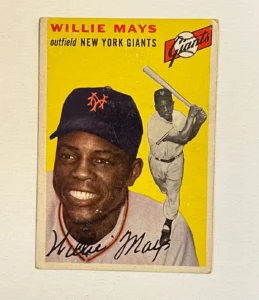
“That ends that argument,” I said.
We had heard about this Mays, and everybody argued about him. To argue sports was to take part in America. At this time, baseball was still the national pastime, and in this first summer of Baltimore Orioles’ rebirth, at this first game of the 1954 World Series, this was our moment to enter the national conversation, to wit:
Who was baseball’s true “Lord of the Flies”: Mickey Mantle of the New York Yankees, Duke Snider of the Brooklyn Dodgers or Mays of the New York Giants?
Baseball fans spent entire summers in this debate. And never mind that with the rising decibels of each debate and the trumpet sound of authority in our voices, we were all faking it, absolutely, because until this moment none of the three boys in Harvey’s basement — Harvey, me, and Joel Kruh — had ever actually seen Willie Mays or any of the others.
This was the summer the Orioles, after half a century’s absence, brought Major League Baseball back to Baltimore. I was nine years old. I was beginning to read the sports pages of the city’s three daily newspapers, which offered game coverage and lines of statistics to give new meaning into arithmetic itself.
Now, tossing a ball around Crawford Avenue, or gathered on someone’s little front porch to swap baseball cards, we could contribute to the great national debate. This made us feel like we belonged to the national game, to the great ballpark crowds, to America talking to itself.
This is what Americans did: we took our playfulness seriously. It bonded us by language, and by passion, and we got lucky when this young Black man, Mays, helped the country momentarily push aside such painful divisiveness as race or religion.
“Mays is the future,” said Harvey’s father, Dave Hyatt. “You watch. The colored, they’re gonna change the game.”
He said this with no value, good or bad, placed upon it. He saw it as a simple fact, and Mays was his argument of the moment. This was a time when entire teams — the Yankees, the Red Sox — were still segregated. Mays was only the sixth African-American admitted to the Major Leagues.
“Please,” said my father, “you’re all wrong.”
He meant about center fielders. He’d grown up in The Bronx, in walking distance from Yankee Stadium, watching Joe DiMaggio.
“I saw DiMaggio make a throw one day,” my father said.
That was all. He saw DiMaggio make a throw, and there was nothing else that needed to be said. I thought, Imagine that. He saw a throw, and he still remembers it. Wars come and go, governments are toppled, and yet a baseball thrown from an outfield lingers in memory through all the years to come.
That’s how I feel about Willie Mays. I saw him make a catch one day. I saw it on TV, with a bunch of other guys, and the memory of that catch stays with me even now, as we watch Willie vanish from sight.

A former Baltimore Sun columnist and WJZ-TV commentator, Michael Olesker is the author of six books, including “Journeys to the Heart of Baltimore” (Johns Hopkins University Press) and “Michael Olesker’s Baltimore: If You Live Here, You’re Home” (Johns Hopkins University).
Michael Olesker pays tribute to WJZ’s retiring Marty Bass, a longtime fixture on local TV screens.
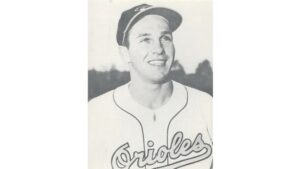
The Orioles' weak defense plays a major role in the nightly carnage, writes Michael Olesker.

Educators, ethicists and Jewish leaders are debating the question as content mills slop on.

Schools in Montgomery County have recently experienced a wave of antisemitic incidents.