

Arthur J. Magida’s latest book is “Two Wheels to Freedom: The Story of a Young Jew, Wartime Resistance, And A Daring Escape” (Pegasus Books/Simon & Schuster). It’s a biography of Samson “Cioma” Schönhaus, a fellow previously overlooked by history.
But it’s more than Cioma’s story. It feels like a slight corrective to previous assumptions about the Holocaust, the Jewish response to it and conditions in Germany as the war turned bad for Hitler.
For Magida — who lives in Mount Washington and has written for local, national and international publications, and taught writing at Georgetown and the University of Baltimore — this book is the end result of stumbling into Cioma a dozen years ago and realizing he had something unique to report.
The Holocaust must never be forgotten. But because it’s been covered so widely and in such detail, it runs the risk of reader indifference, a sense we’ve already been told everything there is to know.
“Read on, if you will,” Magida writes early in “Two Wheels to Freedom,” “for tales of courage and charm and pluck. Read on, even if you think you’ve heard it all before and you don’t want to hear it again.
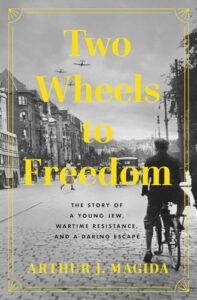
“Read on, for Cioma’s exuberance doesn’t correspond to the usual story of Jews — or of anyone — in Europe during World War II. His joys and pleasures, sorrows and sadnesses, were shaped by knowing what we can do when no one suspects we can do anything.”
Cioma seems cast against type and against the history we’ve gleaned from decades of books and movies depicting the helpless, defenseless Jews marched by the millions to the ovens.
When Cioma’s not openly riding around Berlin on his bicycle (the “Two Wheels” of the title) as other Jews are rounded up, he’s sailing on his new boat or hanging out in swanky restaurants and bars, or courting any of a series of lady friends.
Or most importantly, Cioma, a trained artist, is forging phony identity papers for hundreds of Jews to go on living while struggling to keep himself alive. When learning the Gestapo was closing in, Cioma escaped by spending a month biking to Switzerland, becoming the only individual known to cycle his way out of Nazi Germany.
But Cioma’s exploits aren’t the book’s only corrective to historical stereotyping. We’ve watched war movies for more than three-quarters of a century now. The Nazis are always strutting, bullying the helpless, until the last reel when the Allies triumph and peace prevails.
What’s implicit in such portrayals? Things back in Germany must be fine, until they aren’t. We rarely get a glimpse of day-to-day strife inside Berlin while Allied troops are still clawing their way across Europe.
Magida brings us a Berlin where people’s dinnertime meals come from zoo animals killed during Allied air strikes, including crocodile tails, stored on people’s balconies and later “cooked tender in big containers. … Bear ham and bear sausage were a particular delicacy.”
But it was more than food shortages signaling an awareness that the war was being lost. As a Danish writer put it, Berliners suffered “dullness, anticipation, fear. It was a soulless existence. The war seemed perpetual. The flowers had gone, the books had been burnt, the pictures had been removed, the trees had been broken.”
Writes Magida: “Fun was a crime, and laughing was a sin.”
To tell a joke was to risk imprisonment. But the jokes — and Magida’s got a list of them — reflected a city and nation falling apart.
“A guy tried to commit suicide by hanging himself,” Magida relates one joke. “The rope was so crummy it snapped under his weight. He stuck his head in the oven, but the gas was shut off between two and five in the afternoon. Then he tried living on his rations. He was dead in a week.”
“Two Wheels to Freedom” is full of such unexpected touches. The young Cioma Schönhaus is there at the heart of it, defying all Nazi authority and Holocaust stereotypes. It’s a remarkable story, and in Magida’s hands beautifully told.
Arthur J. Magida will speak about “Two Wheels to Freedom” on Thursday, Sept. 5, from 6 to 7:30 p.m. at The Ivy Bookshop, 5928 Falls Road. For information, visit theivybookshop.com/event/arthur-magida-two-wheels-to-freedom-with-marc-steiner/.
A former Baltimore Sun columnist and WJZ-TV commentator, Michael Olesker is the author of six books, including “Journeys to the Heart of Baltimore” (Johns Hopkins University Press) and “Michael Olesker’s Baltimore: If You Live Here, You’re Home” (Johns Hopkins University).

A lifelong Baltimorean, Hirsh was the owner and CEO of Ottenheimer Publishers, a multi-generational family publishing business that operated for more than a century.

On its "Five Minute Histories" series, the preservation group recently looked at the historic "Shul in the Park," now and then.
In Italy, the Jewish Brigade's flag has unfairly become a flashpoint in today’s battles over Zionism and anti-fascism, writes Dr. Ginaluca Fantoni.

Stewart, a business attorney, believes trust and affordability are the county's biggest obstacles.