
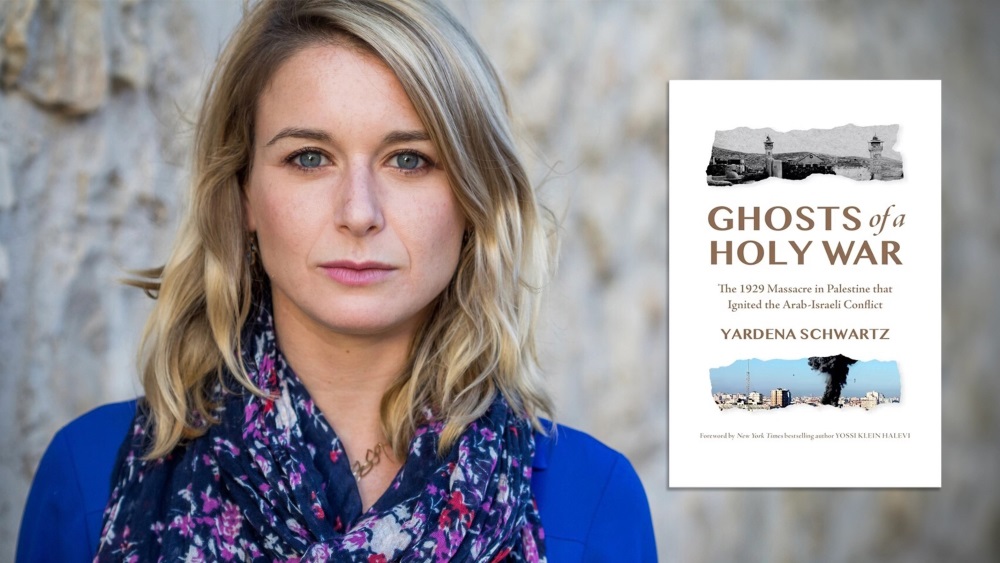
Before Oct. 7, there was Aug. 24.
On that latter date in 1929. “3,000 Muslim men armed with swords, axes, and daggers marched through the Jewish quarter of Hebron,” writes author Yardena Schwartz. Before the day was over, the streets of the ancient city in British Mandate Palestine ran red with blood — 67 Jews murdered, and the rest of the 800-strong Jewish community fled.
In her new book “Ghosts of a Holy War: The 1929 Massacre in Palestine That Ignited the Arab-Israeli Conflict” (Union Square & Co.), Schwartz examines the day’s violence in forensic detail and argues that the pogrom inspired the extremism that continues to make the Israeli-Palestinian conflict so intractable.
Having revised her original manuscript after the Hamas attack on Oct. 7, she argues that there is a direct line between the two attacks in how they shaped a century of bloodshed.
“If we continue to ignore that history and the role religion plays in this conflict, I think we’re just going to be destined to another 100 years of wars and massacres,” she said.
Raised in New Jersey, Schwartz, a TV journalist, moved to Israel in 2013 and reported for NBC News and other outlets. She now lives in Rhinebeck, New York.
Your book was inspired by letters from David Shainberg, who moved to Hebron in 1928 to study at a yeshiva and became one of the massacre’s victims. What did you learn from his letters?
In early 2019, I was introduced to this family in Memphis that a decade earlier had discovered this box of letters sitting in their attic for decades. They were sitting on a treasure trove, because those letters painted a picture of Hebron that few people have ever known.
I didn’t know about a history of Arab and Jewish peaceful coexistence in Hebron that preceded the massacre, and it was astonishing to see how far Hebron has fallen since the time David was living there. Reading them and seeing what Hebron was before the massacre made me want to really dive deep into figuring out how the massacre so fully transformed Hebron and formed so much of the ideology behind the settlement movement, and the settlers in Hebron particularly. And I wanted to know how the Arabs in Hebron view the massacre.
You write that Haj Amin al-Husseini, the grand mufti of Jerusalem, “waged a campaign of fear and propaganda.”
The mufti discovered this wildly successful tool to rally support behind him to distract from his own corruption and failures to improve the lot of his own people. He rallied the anger that was already there and targeted it at the Jewish minority. His star rose as a result of 1929.
If you’ve read Oren Kessler’s book [“Palestine 1936: The Great Revolt and the Roots of the Middle East Conflict,” 2024], you know that he was at the top of the great Arab revolt in 1936 and ultimately fled Palestine and ended up allying himself and his cause with Hitler and serving as a Nazi propagandist and recruiter of thousands of Muslim volunteers for the SS. And yet, after World War II, he lived an open life. He moved to Cairo and then Beirut, and he trained [the late Palestinian leader Yasser] Arafat, and ended up assisting in the jihad against the Jews of Palestine that began in 1947 immediately after the UN Partition Plan [separating the British Mandate territory of Palestine into two states, one Jewish and one Arab].
If a different Palestinian voice emerged during this era, would the region have gone on a different course?
When you look at the Arab leadership at the time, there was a willingness to cooperate. There was cooperation among mayors of cities like Jaffa and Jerusalem and Nablus and Jenin. But the more power the mufti secured, the more he intimidated what are known today as “collaborators” and peace-seeking moderates.
They faced assassination or attacks from pro-mufti activists. It’s really interesting to consider what could have happened if Herbert Samuel [the first high commissioner for British-ruled Palestine] had chosen one of the actual winners of an election for grand mufti in 1921, because al-Husseini came in last. Who knows what could have happened if one of those moderates had been chosen to lead the Palestinian Muslims, who were under British rule at the time?
Att the same time, what was happening in the Jewish community? Today, we talk about hawks and doves, or Labor Zionists and Revisionists. We know at the time of the massacre that there were Zionists who had grander, more nationalist plans for establishing Jewish sovereignty in Palestine.
The Revisionists did want to see all of historic Israel being part of a future Jewish state, but they were the minority at the time, and especially before the 1929 massacre, that mindset was really on the margins. The massacre strengthened those forces within the Zionist movement, strengthened the forces that said there was no coexisting with the Arabs, that said only a Jewish state with a Jewish army could protect the Jews of Palestine. After the massacre of 1929 so much of the opposition melted away. The British just proved completely incapable and almost unwilling to protect the Jews of Palestine in 1929.
What did you discover about the massacre not previously known?
One of the most moving parts for me were the heroic stories of Arab families who risked their lives to protect their Jewish neighbors. I also hadn’t really understood or read the extent to which the Jews and Arabs in Hebron were so intertwined. I didn’t know that there were businesses in Hebron that were co-owned by Jews and Arabs before 1929, and one of those Jewish families actually remained in Hebron after the massacre until 1947.
Also, the stories of the atrocities were just harrowing. Before Oct. 7, we had never seen anything like that in modern times in Israel. Reading about babies being slaughtered in their mother’s arms and teenage girls being raped in front of their families before they were killed: It was just really shocking.
You write that the “parallels between 1929 and 2023 are haunting, and too dangerous to ignore.” What are some of those parallels?
Immediately after the massacre in Hebron, those atrocities were denied by Arab leaders and by Arabs in Palestine who spoke to reporters. And another parallel we see today is the victim-blaming that followed both massacres. Arab leadership also blamed the Jews of Hebron for perpetrating atrocities.
And today, after Oct. 7, that victim blaming didn’t come just from Arab leaders, but it came from academics, from the media, from world leaders. I mean, the U.N. Secretary-General [Antonio Guterres] said the Hamas attack on southern Israel “did not happen in a vacuum,” giving credence to this idea that the victims had it coming.
And when the British sent the Shaw Commission to investigate the causes behind the Hebron massacre, they pardoned the Mufti for his incitement. They attributed the spark of the riots not to the incitement, not to the lies that led to it, but to this peaceful march by Jews to the Western Wall who were protesting against the British for not doing more to protect Jews who wanted to worship freely there.
I also think [about] the fact that in 1929 the victims were overwhelmingly anti-Zionists. Their lives revolved around Torah and the Tomb of the Patriarchs. And then connect that to the victims of Oct. 7, so many of whom were left-wing, peace-seeking Israelis, many trying to help Palestinians in Gaza. And that shows us that this, at its core, is not a conflict about land, but a conflict based in religion, particularly radical Islam. I mean, of course, Jewish extremism plays a role in it too, especially today, but until very recently, the Jewish extremists had very little if any role in the Israeli government. Today they’re holding the reins of the Israeli government, which is horrible and terrifying.
But over the course of the last century, Islamic extremists and corrupt leaders have defined Palestinian government and leadership and held Palestinian society hostage to their insistence on violent armed struggle and a rejection of Jewish existence in the land of Israel and a rejection of Jewish history.
There’s just no hope for a future of coexistence and a two-state solution when Palestinian leaders reject every two-state solution and the right of Jews to live in the land of Israel.
How do Arabs view the massacre?
In Hebron, very few Palestinians even know about the massacre unless they’re over a certain age, and those who do know about it say that it wasn’t the Arabs of Hebron who perpetrated it, it was the British. So there’s this widespread denial of the massacre, and at the same time, there’s a glorification of the perpetrators of it.
Every year, Red Tuesday is honored in Palestinian society as the day when the only three people who received punishment for carrying out the atrocities were executed by the British in 1930. There are Palestinian anthems that are based on poems about those men glorifying what they did, and they’re considered some of the first martyrs of the Palestinian cause.
And on the Jewish side, you write about the late Brooklyn-born rabbi Meir Kahane, whose Kach party called for the expulsion of Arabs from the Land of Israel, and Baruch Goldstein, the Israeli-American who gunned down 29 Muslim men and boys worshiping at the Tomb of the Patriarchs in 1994, and who is now glorified by the settlers in and around Hebron. From the Jewish perspective, what were the wrong lessons learned from the Hebron riots?
One of the most interesting findings I came away with was how prominent the massacre was in shaping the ideology of Meir Kahane. I had no idea, until I met [far-right Israeli activist] Baruch Marzel, just how much the massacre of 1929 formed Kahane’s anti-Arab, anti-coexistence ideology, and it really does just inform so much of the radical settler movement, who cling to this idea that there is no possibility of coexistence.
And I think after Oct. 7, these kinds of arguments are much more prevalent in Israeli society. Oct. 7 radicalized many Israelis, and many left-wing Israelis in the wake of Oct. 7 have shifted rightward.
We’ve seen now, over the course of a century, armed resistance and rejection of a Jewish state, by hardening attitudes, has just pushed a Palestinian state further into the distance. If the Palestinian state was not on the horizon before Oct. 7, it surely is not going to be any closer now.
This article was provided by the JTA global Jewish news source.
Pikesville residents David and Wendy Hefter recently joined Jewish motorcyclists from around the world to raise money for victims of the Oct. 7th terrorist attacks in Israel.
Emma Snyder, owner of The Ivy Bookshop, offers recommendations for must-read titles for adults and children.
A new educational initiative helps Israel’s ethnic and religious minority communities understand their own stories and appreciate what democracy looks like in a diverse society.

Beverly Feig and her daughter, Shana Alter, recently undertook a pilgrimage to the hometown of Feig's late father.