
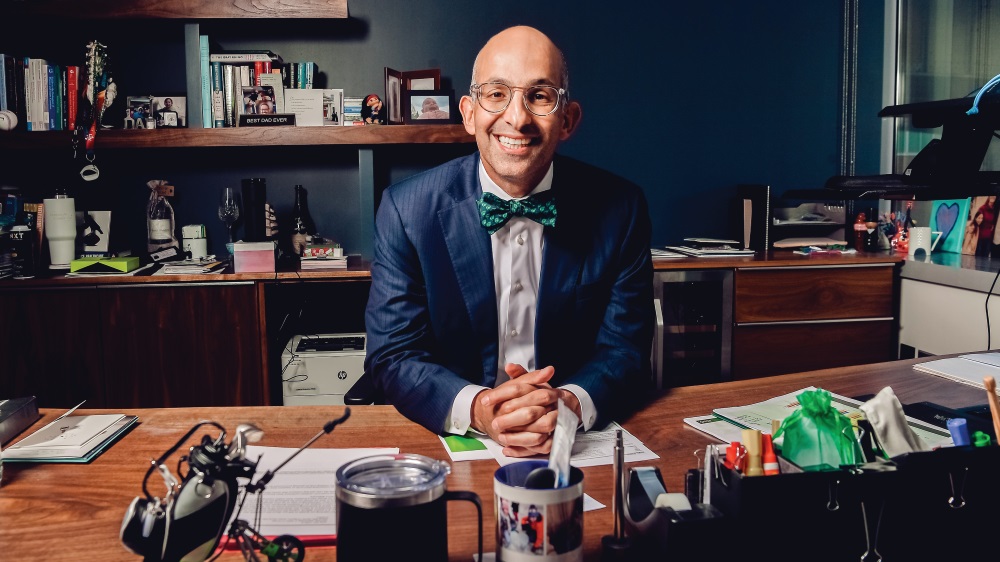
The first thing you notice about Dr. David N. Maine is his all-encompassing, 1,000-watt smile. It radiates warmth and genuineness, and rarely leaves his face.
Walking through downtown Baltimore’s Mercy Medical Center, of which he has served as president and CEO since 2020, Dr. Maine frequently chats with employees, patients and their family members in the hallways. The conversations usually last a while, with Dr. Maine asking a flurry of questions in his laid-back yet schmoozy manner.
“When he asks how you’re doing, he really means it,” confides one Mercy employee. “He doesn’t want to hear you just say, ‘I’m fine.’ He really wants to know how you are.”
The son of Iraqi refugees who came to the United States in 1974, Dr. Maine is the first Jew — as well as first physician — to serve as head of Mercy since the hospital was founded in 1874 by the Sisters of Mercy, a Catholic order of nuns.
Despite the prevalence of Catholic iconography and materials around the hospital, Dr. Maine, who belongs to Ner Tamid Greenspring Valley Synagogue, describes working at Mercy as “very natural. We have a spiritual conviction in how we deliver care that is demonstrated everyday through our values — dignity, hospitality, justice, excellence, stewardship and prayer — and it is through that lens that we make decisions for the good of our patients.”
Dr. Maine has led the Mercy Health System’s growth by introducing clinical programs and expanding its network of primary and specialty care providers and locations throughout the region. In addition, the system has invested in its Centers of Excellence and enhanced its maternal health and preventive care programs.
Under Dr. Maine’s leadership, Mercy has earned a myriad of accolades, including as one of the nation’s “50 Best Hospitals for Surgical Care” by Healthgrades and one of America’s “Most Trustworthy Companies” by Newsweek.
Jmore recently spoke with Dr. Maine — a University of Rochester School of Medicine graduate who completed his residency in anesthesiology and fellowship in interventional pain medicine at the Johns Hopkins Hospital — about his tenure at Mercy and the state of contemporary health care.
In November, he will be honored by Loyola University Maryland’s Sellinger School of Business and Management as the “2024 Business Leader of the Year.” Dr. Maine, who since 2007 has served as director of Mercy’s Center for Interventional Pain Medicine, has been named a “Top Doctor” by Baltimore magazine on multiple occasions.
A native of Rochester, New York, Dr. Maine, 47, lives in Pikesville with his wife, Dr. Rachelle Smith-Maine, and their two children.
Jmore: You became president and CEO of Mercy at the outset of the pandemic. What was it like taking over the leadership of a major medical institution during a worldwide health crisis?
Well, it was a unique experience, helping to lead an organization during a period when there was no real ‘playbook.’ There was a tremendous amount to learn as a leader, but the pandemic and all its facets provided a unique perspective on the human condition.
Having gone through this difficult period along with the labor and financial challenges, I got to experience and learn a great deal. Fortunately, I am surrounded by incredibly talented and brilliant people, and we came out stronger in our sacred commitment to the Baltimore community.
Did it change you as a medical professional?
I think so. I consider it a privilege to care for people. Being a doctor helps me do that and stay focused. For us, it starts and ends with the patient. Health care is hard, challenging work; it’s a 24/7 job, and sometimes you have a bad day. We all try to lift each other up by creating supportive environments. We’re not all the same and have different attributes. But we’re all here to care for patients and provide the highest standard of care.
How has Mercy changed since you took the helm?
We’ve grown considerably in that time period, in the hospital and outside. We’ve grown our ambulatory network. We’ve been able to continue our work with robust primary care and specialists, and that’s critical to health care. A lot of health care today takes place outside these walls.
We provide care in Baltimore City and in our hub sites around the Beltway. We work to ensure patients can be the healthiest version of themselves. We care for around 140,000 primary care adult patients, so we’re talking about primary care, preventive care, access to specialists when needed and working closely with our community partners.
What kind of innovations are taking place at Mercy these days?
It’s constantly happening, and we have great clinicians who push us to be a place of innovation, especially with our anchor specialties such as orthopedics, GI, cancer care and women’s health. Cancer is a classic example. There are new treatments coming out all the time, and we’re also at the forefront of women’s health with exams like the Genius 3D Mammography that increases the detection of breast cancers and decreases the number of women asked to return for additional testing.
In orthopedics, we’re at the forefront of ‘smart implant’ technology during knee replacement surgery. This technology captures patient specific motion data to assist in the best possible functional outcomes for patients. Also, Mercy is now the first medical center in the region to offer shoulder arthroplasty by using a new mixed-reality technology known as Blueprint Mixed Reality Guidance. Dr. Gregory Gasbarro [of Mercy’s Shoulder, Elbow, Wrist and Hand Center] is only the sixth surgeon in the nation to perform shoulder replacement surgery utilizing this new technology.
We’re also at the forefront of robotics and have some of the finest robotic surgeons in the country, and even the world. Mercy is the first hospital in Maryland to offer robotic bronchoscopy, which is used to perform a wide range of interventions including biopsy, dye marking for surgical resection and potential treatment of small peripheral lung nodules.
Is robotic surgery the future of health care?
Robotics surgery is here now. Minimally invasive robotic surgery is being used in many clinical arenas. Some are less mature than others, but the future of robotic surgery is very exciting. And it’s here.
How do you see Artificial Intelligence playing a role in health care?
This is such an exciting and transformative time in health care, and AI will impact business operations considerably. Clinically, there will be a lot of great things happening.
We’re all tied to computers, always looking at computers, so we have to work at keeping the personal touch with patients. AI can potentially help reduce administrative burden and help us provide more direct care for patients. It is also likely to help patients through their health care journey. ‘Doctor Google’ can often misguide or provide information that is impossible to understand for most people without medical training, but AI is very promising in the education of patients. We’re not there yet. It’s going to take some time, but AI is going to have a major impact. Buckle up!
In the next 15 to 20 years, things are going to look a lot different, and a lot will depend on how AI interfaces with health care and how we embrace it.
I believe the care of the patient will always require a human touch. Computers just can’t replace that. But A.I. will have an important role to help us do it better.
Do you ever get tired of people asking you about being the Jewish head of a Catholic medical center?
It’s a gift to be here. I know who I am, and I care deeply about my faith and my parents’ experiences. I share the values of the Sisters of Mercy and their legacy of care. It’s congruent with who I am. I was drawn to Mercy by how we uphold our values.
We have a Judeo-Christian background at Mercy. I love the Mercy cross. I love what it represents. To me, it’s just another symbol of faith.

Is it unique to have a Jewish head of a Catholic institution?
To be completely honest, I’m not really sure. [Laughs] I don’t think it’s common. But I can’t imagine being anywhere else. I sometimes pinch myself and say I’m so happy to be here.
Does being the son of Jewish refugees from Iraq inform who you are as person and professional?
Absolutely. My parents have taught me gratitude in the deepest form. They made a lot of sacrifices to build a house of love for our family. I felt like I had it all growing up, and that’s really a credit to them. They always conveyed a sense of gratitude, particularly because a lot of people helped them along their way.
As I got older, I understood this better. Now, I try to lead with a sense of gratitude. It makes me better at my job, and I hope I show it to my own children on a consistent basis.
What role does faith play in your life?
I lean on my faith all the time. As I’ve gotten older and seen the miracle of my kids and wife and loved ones and colleagues, sometimes it feels like so much. I lean on my faith as a reminder that there’s something bigger. It helps me manage day to day.
I go to my shul every Saturday, and I love my rabbi [Ner Tamid’s Yisrael Motzen]. I feel pain just like everyone else. During the pandemic, I had a tough time seeing what our Mercy family was going through, and patients who weren’t making it out of the hospital and families that couldn’t be with their loved ones at the end of their life. So I leaned on my faith to make me stronger.
What do you consider to be the biggest challenges in health care today?
I would say issues around Medicare and the sustainability of the Medicare trust fund. Affordability of medications and accessibility to care — these are real issues. It’s a challenge. We want people to be the healthiest versions of themselves possible.
We as a state and as a nation can do better. It takes a lot of intention. As a country, we have to deal with this.
Health care is an abyss, it’s very confusing for most people . We have to try to make it easier for everyone.
How would you characterize Baltimore’s health care community?
I think Baltimore has some of the finest health care in the world. Mercy, Hopkins, the University of Maryland and others are all incredible. If you open your eyes, you’ll see how great it is, and we’re very happy to play a role in it.
With other medical systems here being arguably better known, do you ever feel like Mercy doesn’t receive enough attention?
I don’t see it that way. We all just want to help patients. We all play an important role and work together. That was never more apparent to me than in 2020.
But there is fierce competition among health care institutions for funding, patients and delivery of services, right?
Yes, but I think if you take good care of your patients with compassion and empathy, the business side works itself out. The business is tight. Health care is expensive, and it’s a very challenging business. But you always have to remember why you do what you do.
As someone who moved here in 2002, how do you like living in Baltimore?
I love it. I love where I live and the diversity of the community. I love the charm of this place, the grit and the sports culture. We have our challenges, but I really believe Baltimore has a bright future. It’s an amazing community.
As you mentioned, medical professionals have their good and bad days. Where do you draw your inspiration from?
I draw inspiration from my patients, from my colleagues and my family. I try to listen or pay attention and hone lessons from the work that we do.
One thing I always say is that caring for patients is a sacred privilege. If you remember that on the bad days, you’ll be fine.
Do you miss working more on the clinical side of the field?
I don’t hide in the office. I try to be a very present person. I still see patients two days during the week, and I’m better for it. I get out in the hospital and talk to people and hear what’s going on. I don’t take shortcuts. The patient is always number one.
It’s like being a mechanic. If the mechanic tells me I need new brakes, I trust them. So people trust me, and I never take that for granted.
A Norfolk native, Frankle worked at Sinai Hospital, Camp Airy and privately for five decades.
Esther Greenberg, Leora Match, Kathlleen St. Villier Hill and Ben Gershowitz will be recognized for the contributions to the community.

From AI to weight-loss medications, here are the ways that breast cancer diagnoses and treatments are changing.
For more than five decades, Dr. Rosenstein was known by local families as a trusted and caring physician for their children.