

Joshua Leifer’s smart, anguished new book, “Tablets Shattered: The End of an American Jewish Century and the Future of Jewish Life” (Dutton), reads like notes for a eulogy to be delivered at some dreary funeral gathering in the not-so-distant future.
The New York Times calls “Tablets Shattered” a cri de coeur, a cry from the heart. That it is. It’s a heartache based on history, modern cultural trends, raw statistics and an insider’s perspective. It’s steeped in affection for Judaism and frustration over its modern direction.
Judaism’s not alone in facing an anxious future. Leifer, a serious journalist currently pursuing a doctorate at Yale University in the history of modern moral and social thought, writes, “America is less religious than ever before. While as recently as a decade ago, three-quarters of Americans identified as Christians, today the number is less than two-thirds.
“Some scholars estimate that in the United States, somewhere between 6,000 and 10,000 churches close down every year, either to be repurposed as apartments, laundries, laser-tag arenas, or skate parks, or to simply be demolished,” he writes.
Meanwhile, over the past 20 years, more than one-third of Conservative congregations and one-fifth of Reform synagogues have closed.
“The leaders of both denominations have begun to speak in barely veiled terms of managed obsolescence,” writes Leifer.
In Baltimore and cities around the U.S., we’ve seen the merging of once-dynamic synagogues and the closing of once vibrant three-days-a-week religious schools. Families who once sent their children to such schools as years-long preparation for a bar or bat mitzvah have been replaced by a growing generation content to let their kids grab a few months of tutoring for a charade of a religious devotional, followed by a bust-out party.
And many families now slough off the entire rite of passage.
In a 2020 Pew Research Center survey, Leifer writes that 27% of American Jews wrote “none” next to religion, as did 40% between the ages of 18 and 29. To be precise, they said they had “no religion,” although they were “raised Jewish, have a Jewish parent, or consider themselves to be ethnically Jewish.”
Secular Jews, in other words.
So what are we left with? “Mainly,” Leifer writes, “vestiges — of Yiddishkeit … ghostly reminders of once robust traditions.”
When Pew asked American Jews what was essential to being Jewish, most respondents said, “Remembering the Holocaust,” “leading an ethical life,” working for justice/equality” and “being intellectually curious.”
Few, Leifer writes, cited “being part of a Jewish community,” “eating traditional Jewish foods” or “observing Jewish law.”
Polling numbers also reflect growing Jewish-American ambivalence toward Israel. Leifer finished his book before the barbarism of Oct. 7. But he makes it clear that decades of ongoing Middle East violence have taken their toll on the historic allegiance.
In 2016, the Jewish lobbying group J Street reported just 9% of Jewish voters chose Israel as one of their top two voting priorities. Two years later, that figure was 4%.
But Leifer also looks closer to home.
The late Supreme Court Justice Ruth Bader Ginsburg liked to tell listeners, “What is the difference between a bookkeeper in the Garment District and a Supreme Court justice?”
The answer: “One generation.”
Secular Jews have placed so much emphasis on becoming fully American that they lost focus on the religion they were slowly putting behind them. Success in one area has meant great loss in another.
Here’s another problem: synagogue services that are, in Leifer’s words, “terribly, stultifyingly boring … inaccessible and unintelligible … alienating and literally incomprehensible.
“Most American Jews could neither read nor understand the original Biblical Hebrew. Their attendance in synagogue was more reflex and habit than the product of any connection to the texts. As a result, sermons were almost listless, rote gestures, the full meanings of which had become obscure.”
Is there any hope of turning around this religious morass? Yes, Leifer offers some suggestions. None are likely to knock you over — not after 300 pages of tsuris, all of it heartfelt, etched into history, visible as the empty seats at any Shabbat service.
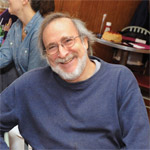
A former Baltimore Sun columnist and WJZ-TV commentator, Michael Olesker is the author of six books, including “Journeys to the Heart of Baltimore” (Johns Hopkins University Press) and “Michael Olesker’s Baltimore: If You Live Here, You’re Home” (Johns Hopkins University).
Michael Olesker pays tribute to WJZ’s retiring Marty Bass, a longtime fixture on local TV screens.

The Orioles' weak defense plays a major role in the nightly carnage, writes Michael Olesker.

Jmore Publisher Scott Rifkin, M.D., reacts to President Donald Trump's latest poll numbers and the real force behind the growing decline of the Trump movement.

Last weekend's Flower Mart once again demonstrated that there's nothing to fear about downtown Baltimore, writes Michael Olesker.