

This paid post is sponsored by MSI Reproductive Choices, a world leader in reproductive health care and champion of the right to choose.
By Inonge Wina-Chinyama
My beautiful home country of Zambia is a vast landscape with rugged rural regions, a place where many people live without the ordinary things you and I take for granted.
One of those things is contraception. For many women in Zambia, contraception is hard to come by. Sometimes, this is because the women live in remote areas very far from a clinic, where there aren’t any pharmacies. Sometimes, it is because the cost is too much and sometimes because social customs make the use of contraception taboo.
With funding from donors, our outreach teams travel into Zambia’s most rural and remote communities where the unmet need for contraception is highest. We refer to this as our “last miles service” because we are often the only organization that goes to these areas.
We use different sources of data and information to map out areas of poverty to help us know where to go to reach those who need us most. And when our teams arrive, we offer people a range of contraceptive methods and a different future path — one that they choose.
When I travel with our outreach teams, it’s not uncommon to find 100 women from a community lining up for contraception in the morning. Women have told me they walked tens of miles to get there; some have even told me they had to pass through game parks, risking their lives against lions and elephants!
These women can sometimes be desperate to use contraception, saying they can’t afford to get pregnant. Many have children already and are struggling to provide them with the life they hoped to be able to offer them. Like mothers everywhere, they want to be able to provide their children with proper nourishment, give them an education and a safe place to live.
Talking with these women, I realize that this is no longer ”a job.” We are here to save their lives in every sense.
Last year, 23.3 million people were able to access reproductive health care through MSI Reproductive Choices. We are 9,000 people working in 36 countries to deliver care to women wherever they are. Our services prevented 16.5 million unintended pregnancies and saved the lives of 37,500 women and girls.
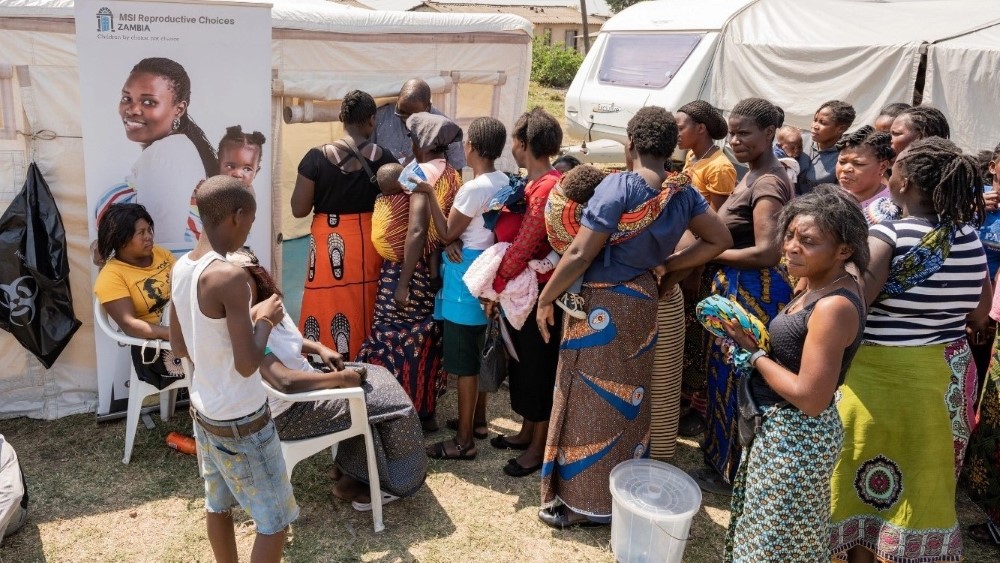
(Courtesy of MSI via JTA)
When your work is this important, you constantly want to do more. It used to be that each outreach team could only reach 20 community sites every month. We kept asking ourselves: how can we reach more people in the most efficient way possible?
And then we had the idea of partnering with health care providers from the Zambian Ministry of Health so we could double the ground we’re able to cover. Now, we send out teams that include our experienced reproductive health care providers working in tandem with four health care providers from the Ministry of Health. This means we can be in two places at once.
While one team serves the furthest communities more than 100 kilometers from “base camp,” the other is delivering services in more urban places. Working with the public health care providers in this way is innovation and partnership at its finest. Public health care providers are integrated into our teams and mentored by MSI to build their skills in delivering quality reproductive choices — short-term, long-term and permanent methods of contraception.
But this is only the beginning. When the public health providers return to their facilities, they take the skills they learned working with MSI back to teach others. And MSI gets something back, too. We get insights from the public health system enabling us to tap into their community networks, so we can mutually grow and reach more people. The impact we can have on women’s lives is exponentially greater.
The number of people our split-teams can serve every month is now 4,700 (a 420% growth from the old model). I know that other MSI country programs are using this split-teams model now, too.
At MSI, we make our approaches and insights known, we share learnings between MSI country programs and with the entire community of reproductive health care providers. We’re proud to shout about the impact of choice.
In 2023, I was glad to speak on different platforms about our innovative split-teams outreach model, and was humbled for our approach to be featured on the global health news site Devex.
One in three of the people MSI supports with reproductive health care through our last-mile services is living in poverty. Giving them the choice to space pregnancies or avoid getting pregnant can be truly transformative. One by one, we’re breaking cycles of poverty and opening opportunities for women’s and girls’ futures, giving them a chance to change the course and quality of their lives. I’m so glad to be part of it.
MSI Reproductive Choices is an international non-governmental organization operating on six continents providing safe abortion, modern contraception and post-abortion care. Driven by its mission to end unsafe abortion and make contraception available to every woman who wants it, MSI serves more than 93,000 people every working day.
To support this work with tax-free giving, visit MSIunitedstates.org.
Inonge Wina-Chinyama is the operations director for MSI Zambia.
This paid post is sponsored by MSI Reproductive Choices, a world leader in reproductive health care and champion of the right to choose. JTA’s editorial team had no role in its production.

A former college campus activist, Veksler will speak at Chizuk Amuno on June 8 at the Ruth and Jay Lenrow Visiting Scholar-in-Residence for Combating Antisemitism.

Why not honor your mom by making a donation to a nonprofit that supports women and children?

CCBC Honors scholars are discovering a level of academic rigor and opportunity typically associated with elite four-year institutions.

Spending on "hasbara" should be “like investing in jets, bombs and missile interceptors,” argues Israel’s foreign minister.