
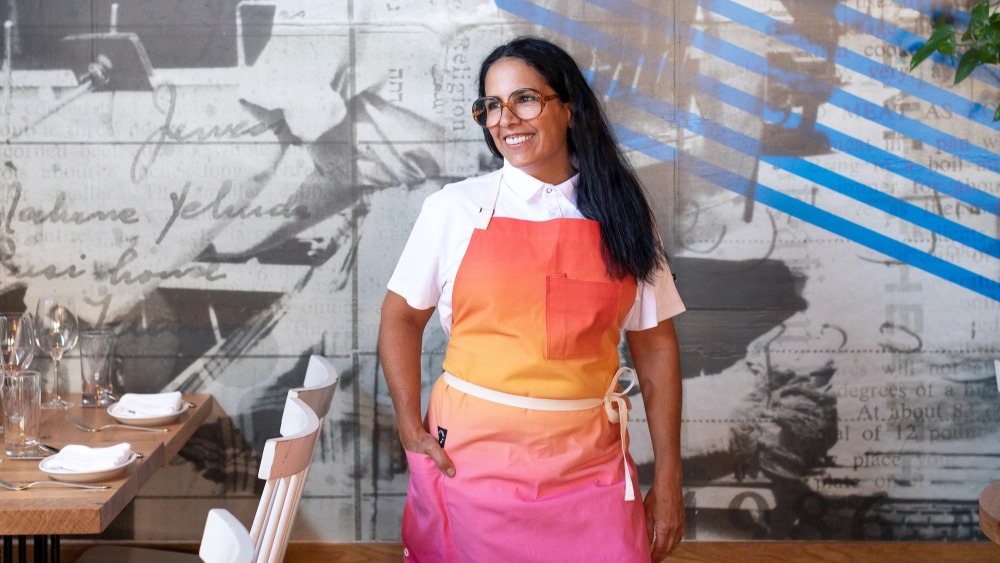
It’s hard to argue with someone who unabashedly calls herself “the ultimate balaboosta.”
A three-time James Beard Award nominee and trailblazer in New York’s Israeli food scene, Chef Einat Admony headlined this year’s “LeadHERship” event presented by The Associated’s Jewish Professional Women.
The gathering was held Wednesday night. May 14, at Chizuk Amuno Congregation in Pikesville.
Born in Tel Aviv-Yafo to Yemenite and Persian parents, Admony is a restaurateur, cookbook author and television personality. She is the owner and operator of New York’s Balaboosta and Moondog restaurants.
Jmore recently caught up with Admony, 53, a mother of two who lives in Brooklyn, New York, shortly before her local appearance to talk about her culinary journey, career and passion for Israeli cuisine.
What should audience members expect from your upcoming talk in Baltimore?
They should expect honesty and a lot of heart. I’m not one to sugarcoat anything. I’m going to talk about food, identity, being an immigrant, a mom, a business owner and all parts of that journey.
And the best part? They’re serving my food! So come hungry, come curious and don’t be afraid to laugh or cry.
What exactly makes you “The Ultimate Balaboosta”? Should other self-proclaimed balaboostas take offense?
If they do, they’re not true balaboostas!
Balaboosta is a Yiddish word for the perfect homemaker, but I’ve redefined it. To me, a balaboosta is strong, messy, fierce, nurturing and ambitious, and doesn’t apologize for any of it.
I’m the ultimate balaboosta because I live that duality. And if you think you are one, too, then welcome to the club.
Who was your personal culinary guru or mentor growing up? An aunt, friend or a savta?
Definitely my mom. She was the ultimate multi-tasker, raising kids while working and still managing to get a full meal on the table every single night. From her, I learned how to cook with instinct and love, not just recipes.
But I also learned a lot from our Moroccan neighbor. She taught me how to roll couscous by hand, slowly and patiently. I’d sit in her kitchen, mesmerized by her rhythm and her stories. Between my mom and neighbor, I got a masterclass.
What is the biggest misnomer in the U.S. about Israeli cuisine?
That it’s one thing or that we just took food from everyone else. People say “Israeli food” and think of falafel and hummus, but Israel is made up of over 70 immigrant cultures. It’s this amazing mix of cultures: North African, Persian, Yemenite, Russian, Iraqi, Ethiopian and anywhere else Jews come from, which is basically everywhere.
What makes Israeli cuisine different from other culinary traditions in the Middle East and elsewhere?
Israeli cuisine is unique because it’s shaped not only by geography but by Jewish culture, especially the influence of kosher laws and Shabbat traditions. Beyond that, Israeli food is a fusion of many cultures all coming together in a celebration of fresh ingredients, bold flavors, and simple, homey cooking. It’s a cuisine that reflects both the diversity of Israel and the deep-rooted traditions that guide how we eat and live.
Why is food such a powerful manifestation of ethnic identification and cultural memory?
Because food lives in the body. You eat something your grandmother made and suddenly you’re six years old again.
Recipes are passed down like stories, like love letters. When people immigrate, they often lose language or land, but they don’t lose taste. That’s why food is so personal, so political, and so healing.
What kind of reaction are you seeing to your Balaboosta, Taim and Moondog restaurants in New York?
It’s been incredible. Balaboosta is intimate. It’s for people looking for a soulful, homey, elegant experience. And Moondog? That one’s fun. It’s a Mediterranean-Mexican listening bar with a serious underground vibe.
While I’m no longer involved with Taïm, I still love seeing that it is still a go-to for people who want something healthy, flavorful and not boring, and I think it still has some of the best falafel in town.
Has your business changed in any way since Oct. 7th? How do you avoid politics in your field?
Honestly, it hasn’t impacted the business the way I feared it might. Balaboosta is still super-busy, and we’re incredibly grateful for the continued support from our community. I think people come because they feel the love and soul in the food, and they know it’s a space where everyone’s welcome.
I don’t avoid politics. I just lead with humanity. I focus on creating connection through food, not division. Food is a bridge, and I try to build those bridges every day, one plate at a time.
Could you see Israeli cuisine becoming a nationwide phenomenon, like Mexican or Thai?
Absolutely. It already is in a way, but it’s just getting started.
People want bold flavors, fresh ingredients, color, spice, diversity. Israeli cuisine delivers all of that.
Do you personally prefer Sephardic or Ashkenazi cooking styles?
I definitely lean toward Mizrahi cooking because that’s what I grew up with. Yemenite and Persian flavors were the backbone of our home kitchen. That’s my comfort food, the food of my childhood. But growing up in Israel, you’re surrounded by so many different cultures and cuisines, so of course I also have some Sephardic and Ashkenazi favorites.
What is your all-time favorite recipe or dish?
Falafel will always be close to my heart. It’s what put me on the map when I opened Taïm. But if I’m honest, sabich is probably my all-time favorite. It’s super nostalgic for me. That mix of fried eggplant, hard-boiled eggs, amba, tahini and Israeli salad stuffed into a warm pita.
I grew up right by the original sabich place, and my dad and I used to go all the time. Eating it still brings me back to those moments with my dad. It’s the ultimate Israeli street food, and it tells such a rich story of tradition and identity.
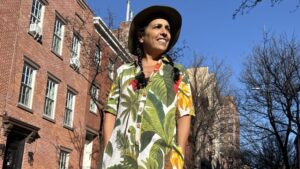
How do you feel about mashing up different cuisines, like Mediterranean and Mexican?
Israeli food is such a mashup of different cuisines by nature, but I love doing it at Moondog! If it’s done with respect and curiosity, fusion is just evolution. I’ve always loved blending cuisines. At the original Balaboosta, I did tons of mashups from cuisines all over the Mediterranean, and I still bring those influences into the food today. The menu has so much influence from all over Asia, too. One of the most popular dishes at Balaboosta is my Yemenite soup dumplings.
How did serving in the IDF launch you into a career in the food service industry?
I was a driver in the air force and one of the only women on base who wasn’t a secretary. I wanted to be independent. The base had these two elderly Yemenite women cooking for the pilots, and their food reminded me of home. I started helping them in the kitchen, and they taught me to cook with instinct, not recipes.
Then, my commander asked me to cook a feast for all the generals. I had three hours and whatever ingredients I could find. That dinner got a standing ovation, and something clicked.
That moment gave me the confidence to turn cooking into my career.
What makes the ultimate falafel? The ultimate hummus? The ultimate couscous?
The ultimate falafel is all about freshness and flavor. It’s packed with herbs like parsley and cilantro, made with high-quality ingredients, and fried right when you order it. That’s what gives it that perfect crispy outside and soft, fragrant inside.
For hummus, it’s all about the tahini. You need the best tahini, with that rich, smooth texture that elevates the whole dish.
And couscous — if it’s not hand-rolled, it’s not really couscous. Instant couscous is just not the same; hand-rolling it gives it that perfect, light, fluffy texture and a depth of flavor you can’t get from the quick version.
Should French fries be inserted in a falafel, like many eateries do in Israel?
Personally, I don’t think French fries belong in falafel. It’s a newer trend that I don’t really feel is necessary. Falafel is already perfect on its own. When made right it’s crispy, fresh and full of flavor. The fries just get soggy and lose that crispy texture, which takes away from the whole experience. I like my falafel simple and true to its roots.
You’ve lived in the U.S. for over a quarter-century. Do you now feel more Israeli or more American?
I’m definitely more Israeli. The connection I have to Israel is even deeper now, especially after Oct. 7th. It’s a time when we all need to stand together, and that sense of unity is stronger than ever.
My kids, though, they’re definitely more American. Still, I make sure they know where they come from, and Israel is always part of their identity. For me, Israel will always be home, and no matter how long I’ve been here, that will never change. After my most recent trip back in March, I feel that connection even more deeply.
In addition to being a chef and a culinary trailblazer, you’re a standup comedian. Nu, how did that come about?
People always told me I should do standup because I tell stories like a madwoman. I tried it once and fell in love. It’s like therapy, but with a mic and a crowd. And honestly, the restaurant industry is so intense, you have to laugh or you’ll lose it.
I also needed a non-food or restaurant challenge in my life and standup really is unlike anything else I’ve ever done.
Your husband, Stefan Nafziger, is your business partner. How do the two of you handle spending so much time together?
We divide and conquer. He runs front-of-house, I run the kitchen. We’ve had every fight under the sun, but we trust each other.
I’m loud, he’s calm. We balance each other. And at the end of the day, we still love working together.
In your home life, what do you usually cook for dinner? Does your husband cook as well? Your kids?
I cook whatever’s in the fridge — usually eggs from our chickens, rice, lentils and some kind of stew. I still make a big Shabbat dinner every Friday, too, with all the traditional dishes. It’s one of my favorite rituals.
I love hosting friends and cooking big dinners, where everyone can gather and share a meal. My husband bakes sometimes, and my kids can cook when they want to.
My daughter’s obsessed with Korean food right now, so sometimes we’ll make budae jjigae together. It’s always a team effort — or takeout when we just need a break!

The Jerusalem Orchestra East & West, which arranged the program for young musicians, blends Western orchestral music with Middle Eastern traditions.
A Norfolk native, Frankle worked at Sinai Hospital, Camp Airy and privately for five decades.
Esther Greenberg, Leora Match, Kathlleen St. Villier Hill and Ben Gershowitz will be recognized for the contributions to the community.

Dara Bunjon talks with award-winning author Monica Saigal (Bhide) about her "Modern Spice" cookbook, "Papa's Butter Chicken" children's book, and more.