
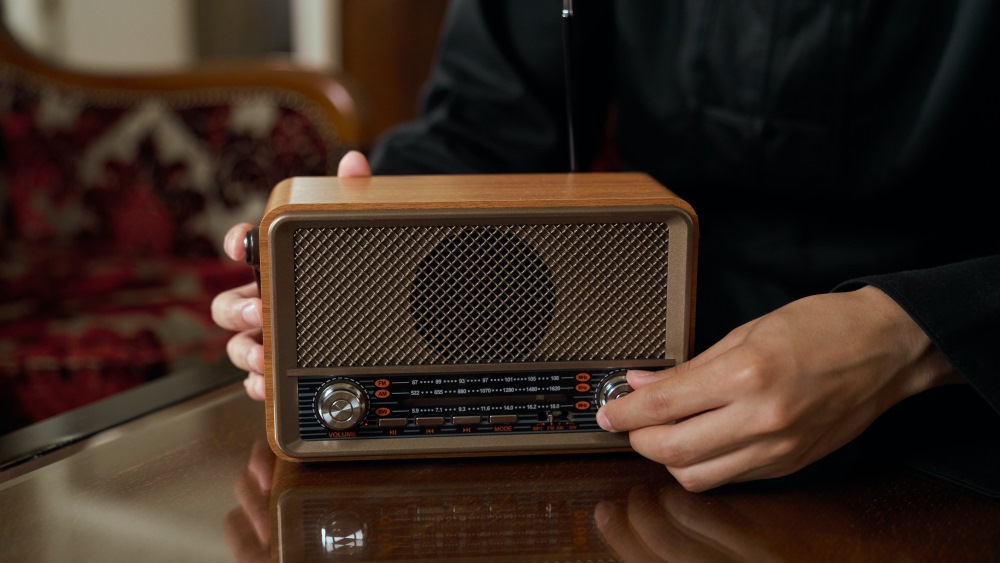
When the news of Alan Berrier’s death arrived a few weeks ago, nobody who knew him could believe it. “The Bear,” one of Baltimore radio’s great names when WCAO ruled the rock ‘n’ roll AM airwaves, faced every challenge of his life and acted as if he never noticed any of them.
He was 79 when heart failure stopped him. How ironic. This is a guy who had more heart than any 10 of us. And almost none of his thousands of listeners ever knew about any of it.
“He was an inspirational figure,” said Ron Matz, who spent a decade at WCAO before going to WJZ-TV’s “Eyewitness News.” “What he dealt with on a daily basis, you marveled at it.”
“He was news director at WCAO when I interned there in 1975,” said John Patti, who spent half a century in local radio before retiring from WBAL in 2023. “I’m still thankful of my time with one of my childhood heroes.”
Berrier got me started in broadcasting, too. I was writing a newspaper column at The News American when he called in 1977 and offered me a job.
“I don’t know anything about radio,” I said. “I’d make a fool of myself.”
“No, you wouldn’t,” he said. “Just do commentaries like your column.”
“In my column,” I said, “I sometimes criticize radio.”
“Fine,” he said. “Come on the radio and criticize radio. We believe in freedom of speech. Freedom of speech is very important.”
“Nah,” I said, “I don’t think so.”
Then, he mentioned money.
“You’re right,” I said. “Freedom of speech is terribly important.”
When meeting him the first time, I was startled the same way everyone was who saw him in person. He had no fingers. He had small stumps where his hands should have been, and two tiny hooks poking out. Later, I learned he also had stumps where his feet should have been.
“He was born that way,” said Virginia Berrier, his wife of 55 years. They had two sons and six grandchildren. “Nothing stood in his way, and I never heard him complain. Not once. Never, never. He was raised that way. His mother told me when he was still in his highchair, if he spilled something, she made him clean it up. She was teaching him to take care of himself.”
They met at a Baltimore County teen recreation center when they were 13. Virginia went to Overlea High School and Alan (whose first name was Terry) went to Kenwood High. Virginia became a physical education teacher. Alan went to broadcasting school and then hooked into radio.
He did a few other things over the years. He got a pilot’s license. He played softball. He played and coached football. He golfed and played racquetball. He “stuffed his shoes,” Virginia said, to make up for abbreviated feet.
When he joined WCAO, the station was riding high. Today, a hit radio station might grab 10 percent of the whole market. In mid-20th century Baltimore, WCAO was commandeering big multiples of that percentage, especially among young listeners.
A generation of baby boomers still recall such names as Johnny Dark, Gene Creasy, Les Alexander, Robert C. Allen III, Kerby Scott, Jack Edwards, Bob Bartel, Alan Field and Frank Luber.
For about 20 years, the station was an absolute powerhouse. But as FM radio began flexing its muscles, AM stations struggled to stay afloat.
Berrier hooked up with jock Lou Roberts for a morning show billed as “Louie and The Bear.” They were funny, smart and enjoyed a pretty good following.
“They were a couple of guys having a great time together who just happened to be on the radio,” Ron Matz said.
As FM radio took over the market, WCAO tried changing formats from rock ‘n’ roll to country, and then to gospel. “The Bear” was gone by then.
He started Nottingham’s Restaurant in Columbia. Then, he and a partner launched Bluestone in Timonium.
Nothing stood in this guy’s way.
Nothing.
A former Baltimore Sun columnist and WJZ-TV commentator, Michael Olesker is the author of six books, including “Journeys to the Heart of Baltimore” (Johns Hopkins University Press) and “Michael Olesker’s Baltimore: If You Live Here, You’re Home” (Johns Hopkins University).
Commemorations of the Holocaust must transcend the past to include concerns about the present and future, writes Menachem Z. Rosensaft.

Someone needed to tell Donald Trump that his appearance at a UFC fight over the weekend was not a good look, writes Michael Olesker.

Journalists bear a responsibility to go beyond the headlines and social media posts to understand the past and present, writes New York University student Lucia Alonso.
The Trump administration's invoking of religion is reminiscent of the words and actions of one of history's most brutal Crusaders, writes Michael Olesker.