

By Vered Guttman
This story originally appeared on The Nosher.
Apples dipped in honey and honey cakes are popular across the Jewish world around the Rosh Hashanah season. But if you grew up in Israel, you most likely came across a unique variation of honey treats: duvshaniyot.
These dense, dark, round honey cookies are a must in many families’ High Holiday season nosh rotation.
The modest duvshaniyot (their name derives from the Hebrew word dvash, meaning honey) seem to have been part of the Israeli repertoire forever, and you can find them on the cookie shelves in every supermarket in the country. They are cheap, pareve and last forever, so no wonder they have become a regular for Rosh Hashanah afternoon tea, for breaking the fast on Yom Kippur, and for dipping in a cold glass of milk in the sukkah.
But these unassuming cookies hold a long history, as most Jewish and Israeli dishes do.
Duvshaniyot are the Israeli adaptation of a popular Russian cookie called pryaniki. Dating back to medieval Russia, pryaniki were made with honey, rye flour and berry juice, and were known simply as “honey bread.”
Starting around the 12th or 13th centuries, when Russia started opening up to imports from the Middle East and India, spices and dried fruit were added to the cookie. In different regions throughout Russia, people experimented with new additions to this cookie, from jam filling to a later invention of sweetened condensed milk.
Some versions were imprinted using delicate wooden forms, and some were simply rolled by hand and dipped in sugar glaze — the same version that’s still popular in Israel today.
People sometimes confuse pryaniki with German lebkuchen (aka gingerbread cookies), but it is rare to see ginger added to these classic Russian cookies, and even lebkuchen don’t always have ginger in them.
Traditionally, pryaniki were spiced with cinnamon, nutmeg, cardamom, coriander, and even black pepper and cumin. In fact, their name, pryaniki, comes from the Russian word for spiced, pryanik.
Different versions of pryaniki can be found around Eastern Europe, like piernik in Poland and lect cookies in Slovenia, which are heart-shaped, painted red and artfully decorated with colorful icing. These Eastern European versions were traditionally served around Christmas, but were adapted by Jews for their own holidays, mainly Rosh Hashanah, for the use of the symbolic honey.
From Eastern Europe, the little honey cookie made its way to Israel and the United States. “The Settlement Cook Book,” a classic 1901 American Jewish cookbook by progressive reformer, philanthropist and author Lizzie Black Kander, includes two versions of lebkuchen, both with citrus and almonds but no ginger. Even more interesting is that neither include honey, but instead call for brown sugar or molasses.
An early Israeli cookbook, “Folklore Cookbook” by Molly Bar-David, has recipes for honey cookies that are similar to pryaniki and for lebkuchen. Bar-David suggests adding ginger to the honey cookies and calls for margarine instead of butter, maybe to keep the cookies pareve.
Today, Israeli manufacturers of duvshaniyot must be doing a good job, as I notice the same Israeli brand cookies at many Russian stores in the United States. But maybe because duvshaniyot are readily available in every supermarket, most Israelis do not prepare them at home.
That’s a shame, because as is the case with most baked goods, homemade is better. And when the recipe is as easy as the one below, there’s no reason not to.
You can add any of the classic gingerbread cookie spices (cinnamon, nutmeg, cardamom, coriander, clove, and even black pepper and cumin) as well as cocoa powder, strong coffee or chopped chocolate. Candied citrus peel or any tart candied fruit, as well as citrus zest.
You can try to replace some of the flour with rye flour to be closer to the original Russian version, or replace some of the flour with almond meal and make it closer to the German lebkuchen. It’s up to you.
Some recipes, including centuries-old recipes, suggest letting the dough rest for a few hours and up to a week before baking the cookies. This will deepen its flavors and will make rolling the dough easier.
But even if you bake it right away, the cookies will improve with time, so I suggest baking them at least two days before serving. You can easily prepare them the week before Rosh Hashanah and then serve them for break the fast on Yom Kippur.
Notes:
- The cookie dough needs to chill in the refrigerator, or up to overnight.
- The cookies will improve with time, so I suggest baking them at least two days before serving, though you can keep them in a sealed container at room temperature up to a month.
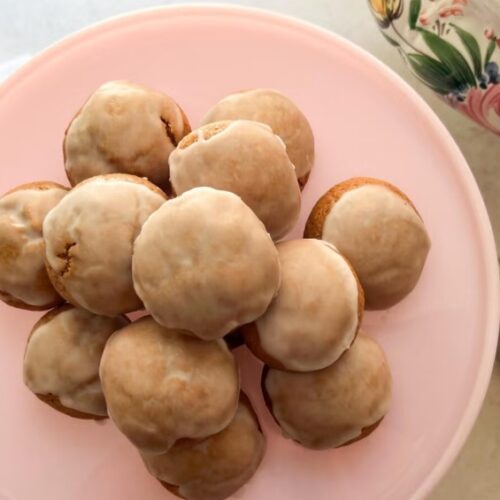
Israeli Honey Cookies
Ingredients
For the cookies:
- 3/4 cup honey
- 1/4 cup light or dark brown sugar
- 1/2 cup butter
- 1 teaspoon cinnamon
- 1/2 teaspoon each cardamom, ginger, nutmeg, allspice
- 1/8 teaspoon black pepper
- 2 large eggs, at room temperature
- 1 teaspoon lemon or orange zest
- 1 teaspoon baking powder
- 1/4 teaspoon baking soda
- 2 1/2 cups all-purpose flour (you can substitute half with rye flour)
For the sugar glaze:
- 2 cups powdered sugar
- 1 teaspoon lemon juice
- 2–3 Tablespoons water
Instructions
- Place a saucepan with 1/2 inch water on a burner and turn to medium heat. Put a large metal or glass bowl over the saucepan and bring water to simmer. Once the water boils. Add honey, sugar, butter and spices to the bowl and mix until butter melts and all the ingredients incorporate. Remove bowl from the heat and let cool for about 30 minutes.
- Add eggs and lemon zest to the bowl and mix.
- Add baking powder, baking soda and flour to the mixture and mix with a wooden spoon or a spatula until smooth. Cover bowl and place in the fridge for 4 hours and up to overnight.
- When you‘re ready to bake, turn the oven to 350°F. Line two baking sheets with parchment paper.
- Use your hands to roll 1-inch-round cookies and place them 2 inches apart on the baking sheet.
- Bake for 13-15 minutes, switching between baking sheets after 7 minutes, until cookies are just golden at the bottom. Do not over-bake, as the cookies will become too hard. Transfer to a cooling rack until completely cold.
- To make the sugar glaze: mix powdered sugar, lemon juice and 2 Tablespoon water with a spoon in a medium bowl. If the mixture seems too dry, add up to 1 Tablespoon more water and keep on mixing until a smooth glaze is formed.
- Dip the cookie tops in the glaze and put back on the cooling rack to set.
Notes
- The cookie dough needs to chill in the refrigerator, or up to overnight.
- The cookies will improve with time, so I suggest baking them at least two days before serving, though you can keep them in a sealed container at room temperature up to a month.

Vered Guttman is an Israeli chef and food writer living in Washington, D.C.

Dara Bunjon talks with award-winning author Monica Saigal (Bhide) about her "Modern Spice" cookbook, "Papa's Butter Chicken" children's book, and more.
It doesn't get much easier than this cucumber and purple cabbage salad from Elite Jakob, perfect for a warm spring day.

Dara Bunjon talks sustainable farming, chocolate, and more with farmer, chef, educator and chocolatier Mark Mills of Chocolates and Tomatoes Farm in Middletown.

Dara Bunjon talks with cook, writer and television host Monti Carlo about her new cookbook, "Spanglish: Recipes & Stories," and more.