

By Dan Fellner
If ever there was a synagogue that’s earned the right to throw itself a birthday shindig, it’s the elegant and intriguing Trondheim Synagogue located in central Norway only 220 miles south of the Arctic Circle.
Over the past century, the Trondheim Synagogue has weathered isolation from the rest of the Jewish world; the Holocaust, which wiped out half its community; challenges related to Shabbat observance because of its far northern latitude, and persistent antisemitism that has grown worse since the war in Gaza began in 2023.
This fall, the synagogue will be observing its 100-year anniversary with a three-day celebration, culminating with an Oct. 26 event which members of Norway’s royal family, the country’s prime minister, the mayor of Trondheim and other dignitaries are scheduled to attend.
“There will be speeches, songs and, of course, we will tell the history of the community,” says John Arne Moen, president of the Trondheim Jewish community. “We are on the outskirts of the Jewish world, living close to the polar circle. You will probably not find a community like ours any other place in the world.”
With a population of about 200,000, Trondheim is Norway’s third-largest city, behind Oslo and Bergen. Located on the shores of a fjord that’s an inlet in the Norwegian Sea, the city was founded in the year 997 and was Norway’s capital during the Viking Age.
The unlikely story of Jewish life in Trondheim began in the late 19th century, when Jewish immigrants began arriving from Poland and Lithuania, usually because they couldn’t afford to go to America. By 1900, more than 100 Jews lived in Trondheim and the city’s first synagogue was established. During the next 20 years, the community grew to more than 300 members, prompting the need for a larger shul.
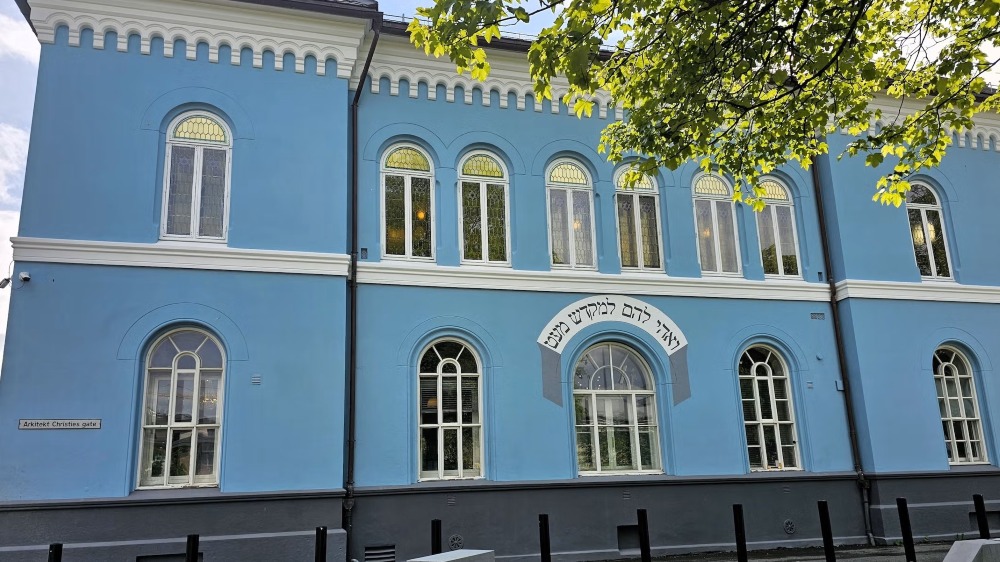
In 1923, an old railway station at Arkitekt Christies Gate 1 was purchased with the financial support of approximately 200 Jews from Oslo and converted into a synagogue. It was inaugurated in 1925 and remains — along with the synagogue in Oslo — one of only two synagogues in the country.
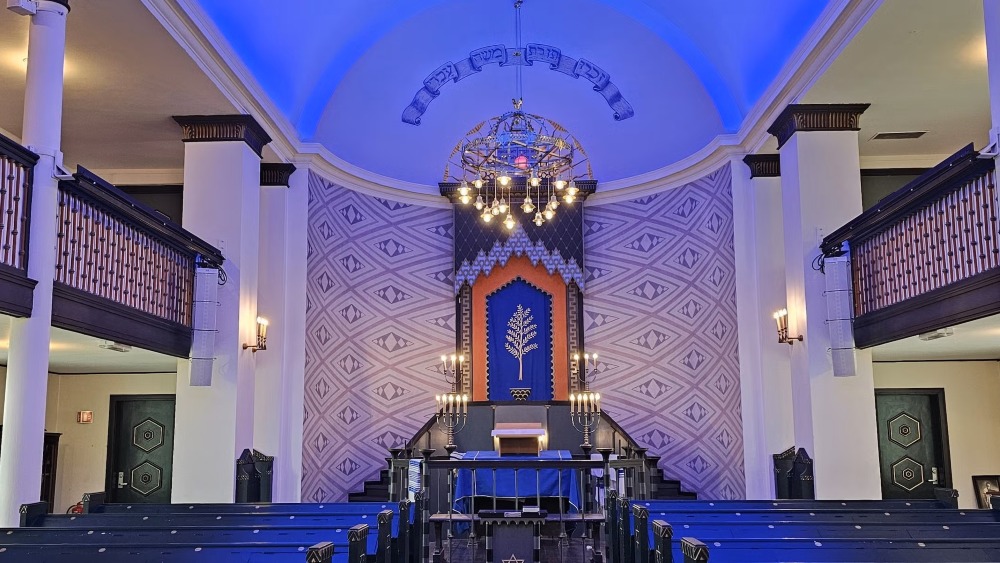
Designed in the Neoclassical style, the building is fronted by a light-blue façade with arched windows and white molding. Inside, the two-story sanctuary also features a blue motif. Originally, women were seated in the balcony during services. Now, the balcony is no longer used; men and women sit together on the main floor.
Germany occupied Norway from 1940 to 1945. The Nazis confiscated the synagogue and used it as a barracks, replacing the Stars of David in the windows with swastikas.
It’s believed that 165 local Jews — about half of Trondheim’s Jewish population at the time — died in the Holocaust, fueled by collaboration by local authorities. Most of the victims were deported by train to the Auschwitz concentration camp in Poland, where only a few survived.
Early efforts to memorialize the murdered Jews of Trondheim were undertaken by the remnants of the community that survived. But in the mid-1990s, the city embarked on its own memorial enterprise, choosing Cissi Klein — who was 13 when she was seized from her school, deported to Auschwitz and killed upon arrival — to become a symbol of Trondheim’s Nazi victims.
A statue of Cissi stands in a park a short walk from the Trondheim Synagogue. Built in 1997 as part of the city’s millennium commemorations, the memorial is located outside the apartment building where Cissi lived with her parents and brother. A street alongside the park has been named in her honor.
Today, Moen estimates there are 200 Jews living in Trondheim; about three-quarters are members of the synagogue. Shabbat services are typically held every other Friday.
The chief rabbi of Norway, Michael Melchior, lives in Israel but periodically travels to Oslo and Trondheim to conduct services. When Rabbi Melchior isn’t in town, services are usually led by Israeli-born Asher Serussi, who has lived in Trondheim for 30 years. Serussi describes the Trondheim Synagogue as “Orthodox but very flexible and modern.”
For the more religious who follow traditional Jewish law, the question about how to handle the starting and ending times of Shabbat has been a topic of debate ever since the congregation was founded in 1905. According to Jewish law, Shabbat begins a few minutes before sunset and lasts for 25 hours.
But Trondheim is located so far north that the amount of daylight can vary between 20 hours in the summer and just four hours in the winter. So what’s an Orthodox congregation to do in a country known as “the land of the midnight sun”?
Other communities in far northern latitudes handle the issue in a variety of ways. Some set the Shabbat clock based on Jerusalem time, while others divide the day equally into two 12-hour segments. Some start Shabbat at the traditional moment, even if that means lighting candles around midnight.
For the Trondheim Synagogue, Shabbat begins at 5:30 p.m. on Fridays and ends at 6:30 p.m. on Saturdays, regardless of the time of year and whether there’s sunlight or polar darkness.
“It’s been our rule for 120 years,” says Moen. “We have grown up with it. We are the only Orthodox synagogue in the world doing it this way.”
According to a recent report from Israel’s Diaspora Affairs Ministry, there has been a sharp rise in antisemitic incidents in Norway since Oct. 2023, with 69% of the Jewish community personally experiencing hostility related to their Jewish identity.
In 2024 ,the Trondheim Jewish cemetery was vandalized and someone threw a Molotov cocktail at the synagogue. The attack caused no damage, and the perpetrator was never found.
“We are telling our congregation not to show any Jewish symbols when they are walking the streets,” said Serussi. “We feel like it’s not like normal days.”
The Jewish Museum Trondheim opened in 1997 and annually attracts 7,000 visitors, many of them local schoolchildren. They come on field trips to learn about the Holocaust and the history of Jewish life in Trondheim.
A particularly moving exhibit devoted to the Holocaust tells the stories of several of the city’s victims and includes a rack with 165 empty coat hangers, each representing one of the Jews who perished during the war.
Trondheim isn’t the easiest place for travelers to reach. Most flights into the city’s small airport come from Oslo and other domestic cities. But Trondheim does attract a fair number of visitors on cruise ships. Holland America and Norwegian-based Hurtigruten are two of the larger cruise lines that offer itineraries that include port stops in Trondheim.
Moen says that despite its many challenges, the Trondheim Jewish community is now on solid footing and looking forward to continuing to meet the spiritual and cultural needs of residents and tourists.
“We have a lot of young people and we haven’t seen this much activity in our community since before the war,” he says. “We have a beautiful shul. If you want a place to pray, the synagogue is open to any Jew that wants to come.”
Freelance travel journalist Dan Fellner wrote this article for the JTA global Jewish news source.

An ambitious new educational initiative seeks to emphasize personalized learning and strengthen Israeli society.
The Tower of David Jerusalem Museum is collecting photographs of the Western Wall ahead of an exhibition next year marking the 60th anniversary of the Six Day War.

Opposition leader Yair Lapid spoke at Thursday's Jerusalem rally, which drew 10,000 participants and 2,000 police officers.

The Jerusalem Orchestra East & West, which arranged the program for young musicians, blends Western orchestral music with Middle Eastern traditions.