
By Andrew Silow-Carroll
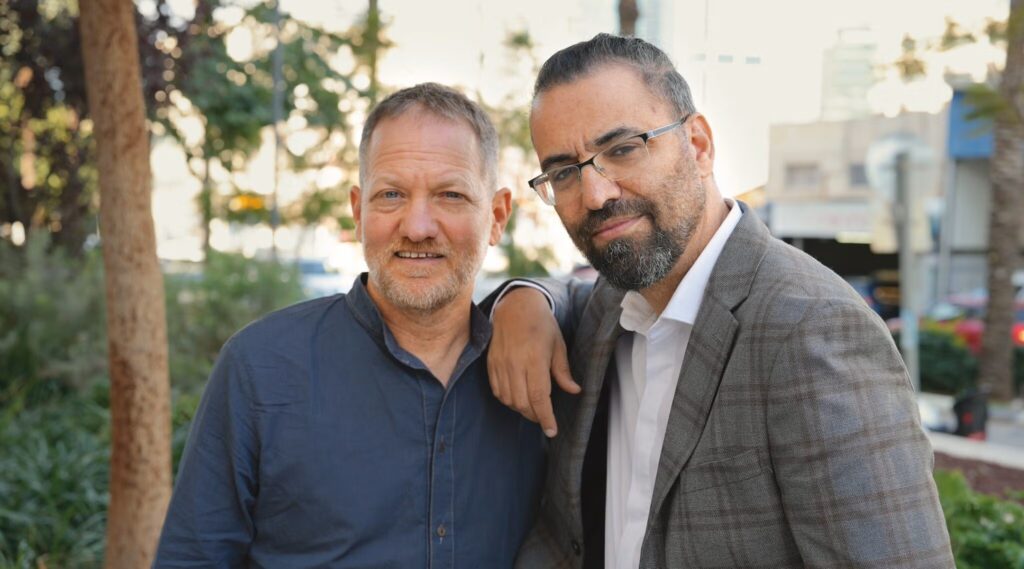
At a time when a resolution to the Israeli-Palestinian conflict arguably feels more remote than ever, Aziz Abu Sarah and Maoz Inon offer a story of hope.
Inon, a Jewish Israeli, and Abu Sarah, a Palestinian Muslim, are on a media blitz for their new book, “The Future is Peace: A Shared Journey Across the Holy Land” (Crown).
Inon’s kibbutznik parents were killed on Oct. 7, 2023; Abu Sarah’s brother died in 1990 after being tortured in an Israeli prison.
The two – who spoke at Baltimore Hebrew Congregation in July of 2024 — have become partners in an effort to “step down from the battlefield,” Inon said.
Last Monday, Apr. 13, the authors took their message to “The Daily Show,” sitting across the desk from Jon Stewart. The mood was light, even buoyant. Abu Sarah joked that he and Inon found each other on JDate, and that after the two had an audience with Pope Francis, he had to stop Inon from converting to Catholicism.
“All I want to do is hug you and talk about this beautiful book and how wonderful it is,” Stewart gushed.
By last Thursday, Apr. 16, the YouTube video of Inon and Abu Sarah’s interview had been viewed more than 300,000 times, and the comments were overwhelmingly positive.
“I usually don’t read the comments because they are terrible, but what I read mostly [under the ‘Daily Show’ video] were things like, ‘We are desperate for these voices,’” said Inon.
Still, commentators on the pro-Palestinian left have accused the pair of ”false equivalence” and “normalization” by suggesting that both sides share equal blame and responsibility, and say that their “kumbaya” act obscures the Palestinians’ powerlessness under occupation.
Notably, the authors’ tour schedule is taking them to several synagogues and Jewish institutions, but no appearances have been publicly advertised to take place in mosques or hosted by Arab groups.
Meanwhile, staunch supporters of Israel will bristle when the authors refer to the Gaza war as a genocide, or when Abu Sarah keeps open the possibility for “a single state with equal rights, where any qualified Palestinian or Israeli could serve as president of prime minister.”
Inon and Abu Sarah have heard critiques of their views and remain unfazed.
“For disagreements not to lead to violence, we need to agree on values,” said Abu Sarah. “We both agreed on universal values: equality, justice, dignity, recognition of each other. When we ask how we deal with disagreement based on those values, it is much easier than you can imagine.”
There was little disagreement on display at a Manhattan book event held last Monday night by New Jewish Narrative, a liberal Zionist organization. The authors shared their painful personal family histories at the gathering.
The last time Inon spoke to his parents, Yakovi and Bilha, was that Saturday morning when they messaged him that Hamas had invaded Netiv Ha’asara, their kibbutz by the Gaza border. Hamas gunmen shot and killed the couple, and reduced their home, and bodies, to ashes.
Abu Sarah grew up in East Jerusalem during the first intifada and would throw stones at passing Israeli cars. After his older brother Tayseer was released from an Israeli prison, where he had been taken on accusations of throwing rocks at soldiers, he died from what Abu Sarah said were untreated injuries inflicted by his interrogators.
Inon and Abu Sarah met as adults working in the tourism industry and reconnected when Abu Sarah reached out after the Oct. 7 attacks. Despite backgrounds that have led others to seek revenge, the two felt compelled to learn the other side’s narrative.
“We can be on the same side, fighting for justice and for equality and for peace,” said Abu Sarah. “The way we should divide ourselves is into those who believe in equality and justice and peace, and those who don’t.”

The authors’ rapport was brotherly, and their back and forth seemed both natural and practiced.
“Do we need more policy papers?” said Abu Sarah. “What we need is for people to believe those solutions are possible. I think it was Kafka who said that ‘impossible is what you haven’t desired enough.’ It sounds like a cliche, but if you are filled with despair, it is impossible to act.”
What Inon and Abu Sarah offer is less about policy than process. Eliding the discussion of one state or two, they agree that Israelis and Palestinians need to get to a place offering both sides justice, forgiveness and reconciliation. It starts, they insist, by modeling a new reality through joint initiatives.
“Hope,” said Abu Sarah, is an act of resistance.”
Said Inon: “In the face of despair, you have to believe there is a way of getting out of this, and that is us working together. That is not a false hope.”
Andrew Silow-Carroll wrote this article for the JTA global Jewish media source. Jmore staff contributed to this report.
Emma Snyder, owner of The Ivy Bookshop, offers recommendations for must-read titles for adults and children.

An ambitious new educational initiative seeks to emphasize personalized learning and strengthen Israeli society.

The Tower of David Jerusalem Museum is collecting photographs of the Western Wall ahead of an exhibition next year marking the 60th anniversary of the Six Day War.

Opposition leader Yair Lapid spoke at Thursday's Jerusalem rally, which drew 10,000 participants and 2,000 police officers.