
By Dr. Sarah Bunin Benor
On the holiday of Sukkot, which begins at sundown tonight, Oct. 6, we strengthen our local communities, hosting elaborate meals with relatives and friends and leaving one wall of the sukkah open, symbolizing hospitality.
Sukkot also invokes the Jewish community in time. We build temporary structures to commemorate our biblical ancestors wandering through the desert, and we invite ushpizin — symbolic guests.
Traditionally, ushpizin have been biblical characters, kabbalistically associated with particular divine attributes. In my own community in Los Angeles, I have noticed and participated in a new approach: summoning the presence of more recent ancestors.
This Sukkot, I am promoting this tradition with a focus on our ancestors’ words.
I first experienced a more personalized ushpizin at a friend’s sukkah about a decade ago. Before dessert, the hosts asked each guest to share one person — historical or contemporary — that they would like to symbolically invite to the meal.
The guests offered diverse responses, which led to additional conversations and strengthened ties among guests. My family and others we know have adopted this practice at our own sukkah gatherings, interspersed with kiddush, lulav shaking, singing, schmoozing and, of course, copious food.
In our ushpizin conversations, some guests have “invited” celebrities like Taylor Swift and Post Malone, or Jewish heroes like Ruth Bader Ginsburg and Rachel Goldberg-Polin.
Some have used the opportunity to introduce lesser known historical figures, like scientist Rosalind Franklin and entertainer Gertrude Berg.
But the most common type of ushpizin I’ve noticed over the years has been relatives — an adult child living in another state, an elderly parent who was too frail to travel, a deceased grandparent they sorely missed, or even a great-great grandparent who had been part of their family lore.
When sukkah guests speak of their deceased ancestors, especially parents and grandparents, they often get emotional. Several have told me afterwards that sharing a bit about their relatives made their holiday more special and personal.
And I have observed guests speaking to each other to learn more about their ancestors and share similar stories of love and loss.
This year, I’m planning to introduce a linguistic angle to our round of ushpizin. I will ask each guest to share one “heritage word” — a word they inherited from their ancestors even though they don’t speak that language.
This idea flows from the podcast I host, Heritage Words, a production of the HUC Jewish Language Project and HUC Connect. In each episode, I interview guests about the languages their ancestors spoke and the meaning those languages bring to their lives today.
From the 16 episodes to date, I have learned about the heritage words Jews continue to use generations after their families stopped speaking their immigrant languages. Several are terms of endearment — expressions of love, usually said to children by parents and grandparents.
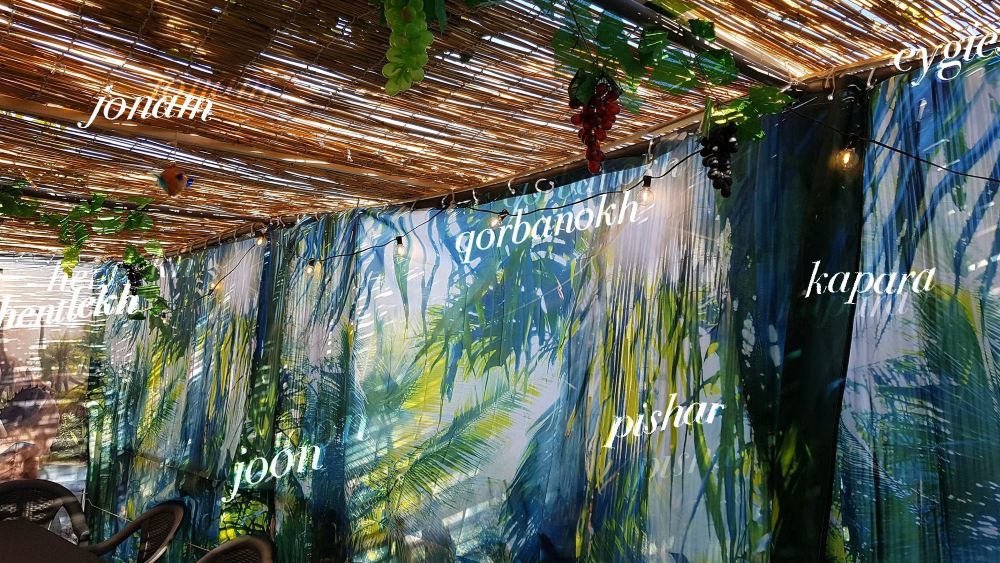
Rozeeta Mavashev reports that her mother uses the Bukharian word “jonam” (darling), similar to the Persian word “joon,” as in “How are you doing, jonam?”
Sam Miller has fond memories of his Jewish Neo-Aramaic-speaking grandmother expressing love with “qorbanokh” (dear one, lit. “your sacrifice”), similar to the Judeo-Arabic and Modern Hebrew word “kapara.”
Other heritage words involve euphemism, avoiding a word seen as crass by substituting a different word, often from a foreign language.
Anthropologist Evelyn Dean-Olmsted, who coined the term “heritage words,” says the word “pishar” (to urinate) is common in the Spanish of Mexican Jews, likely an influence from Ladino or Yiddish but also claimed by Syrian Jews as Judeo-Arabic.
Mayim Bialik uses diminutive forms of Yiddish words for body parts when speaking to her children, like “hentlekh” (hands) and “eygies” (eyes).
Another common domain of heritage words is cuisine. Sarah Aroeste speaks — and sings — about “masadiku,” an empanada-like savory pastry filled with potato and cheese, a recipe passed down by her Ladino-speaking ancestors from Monastir.
Telahun Liad Samuel shares his experiences doing the Hamotzi blessing with “dabo,” traditional Ethiopian Shabbat bread.
Often with strong emotion, the people I interviewed associate these words with particular ancestors: parents, grandparents, even great-grandparents. Those ancestors – or their parents or grandparents – moved to a new country, and they or their children learned a new language.
At some point, the immigrant language was mostly lost, and heritage words (and maybe some songs, recipe cards, or family letters) are all that remain. Similar to our treasured family possessions — jewelry, candlesticks and kiddush cups — heritage words are heirlooms, but more portable and less at risk of being stolen, damaged, or destroyed in a fire.
Like photos on a Mexican ofrenda, Heritage words connect us to our ancestors and keep their memory alive for generations after they have passed away.
Sukkot is a perfect holiday to honor our immigrant ancestors. The exodus commemorated by our temporary structures involved our biblical ancestors migrating to the Promised Land.
Similarly, the traditional biblical ushpizin migrated: Abraham, Joseph, Moses, etc. Most Jews today have ancestors who migrated — from Fes to Paris, Sanaa to Tel Aviv, Baghdad to London, Damascus to Brooklyn, Rhodes to Seattle, Tehran to Los Angeles, or Warsaw to Chicago, to give just a few examples.
When I hear the term of endearment “bunchky,” it brings up fond memories of my grandfather, and it reminds me that my great-grandparents immigrated from Lithuania to the United States speaking Yiddish. By using this word and sharing it in my sukkah, I am helping to preserve my ancestral language and my ancestors’ memories.

I look forward to enriching my Sukkot holiday with my guests’ heritage words — linguistic souvenirs of their ancestors’ sojourns to a new land.
A Rockville native and graduate of the Charles E. Smith Jewish Day School, Dr. Sarah Bunin Benor is vice provost, professor of contemporary Jewish studies and linguistics and director of the Jewish Language Project at Hebrew Union College-Jewish Institute of Religion. This article was provided by the JTA global Jewish media source.
Michael Olesker pays tribute to WJZ’s retiring Marty Bass, a longtime fixture on local TV screens.
The Orioles' weak defense plays a major role in the nightly carnage, writes Michael Olesker.

Jmore Publisher Scott Rifkin, M.D., reacts to President Donald Trump's latest poll numbers and the real force behind the growing decline of the Trump movement.
Last weekend's Flower Mart once again demonstrated that there's nothing to fear about downtown Baltimore, writes Michael Olesker.