
When talking about her family’s recent trip to Poland, Jacqueline Pertman Tuma describes it as “‘A Real Pain’ on steroids.”
Tuma was alluding to the award-winning 2024 film in which a pair of cousins travel to Poland to visit their late grandmother’s homeland.
Why on steroids?
For starters, Tuma, who lives in Columbia, was among 21 extended family members who visited Poland over the summer in two separate multi-generational contingents. Like the film’s protagonists, played by Jesse Eisenberg and Kieran Culkin, the groups visited the birthplaces of their respective parents, grandparents and great-grandparents.
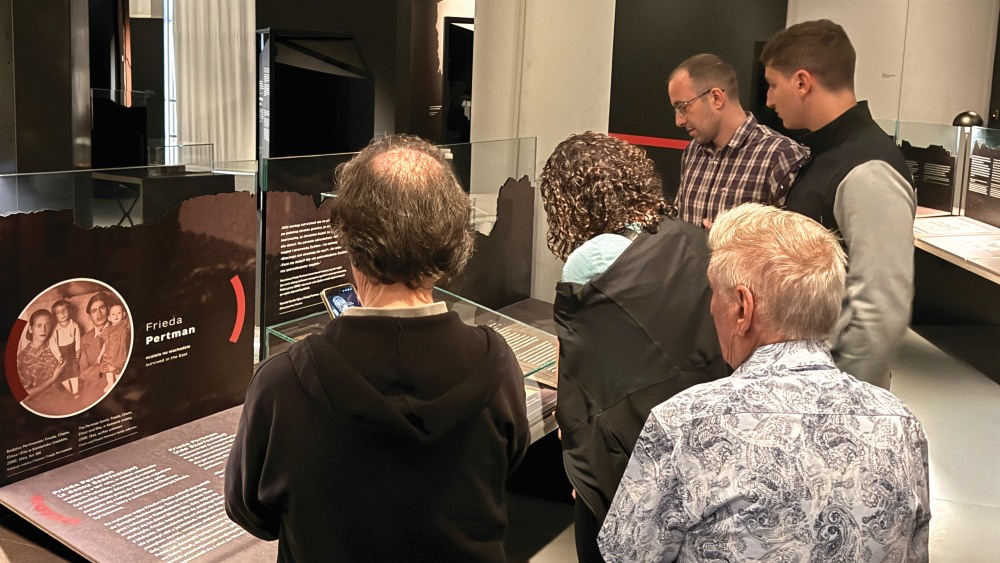
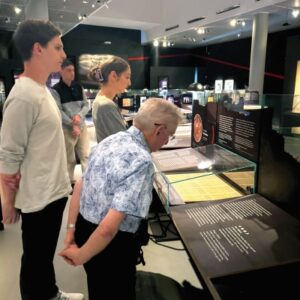
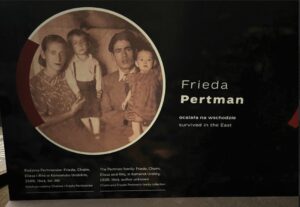
But the Pertman and Abel families also went to Poland to tour a museum exhibition featuring the stories of Tuma’s late grandparents, Chaim and Frieda Pertman.
After years of hardship in Poland, the couple and their children — Allan Pertman, Rita Abel, and twins Henry and Adam Pertman — eventually relocated in Baltimore. (Chaim died in 2004; Frieda in 2017.)
The Pertmans’ inclusion in the exhibition — “1945: Not the End, Not the Beginning” at the Polin Museum of the History of Polish Jews — stemmed from Frieda’s chance meeting with Dr. Kamil Kijek.
An historian, sociologist and professor, Kijek was working with the Polin Museum in Warsaw and got Frieda’s name from a contact at the U.S Holocaust Memorial Museum. He reached out to Frieda, then 92, and asked her to share her wartime and post-war experiences.
Soon after, Kijek flew from Poland to Baltimore. “In the course of a week, Kamil meets with [Frieda] four times for a total of 12 hours of interviews,” said Tuma. “We always knew my grandmother was very intelligent, but Kamil said he never interviewed anybody with that level of intelligence. He fact-checked her and the details were all right.
“Kamil told us, ‘[Frieda] hadn’t spoken Polish in 50 years, and it wasn’t even her first language. Her first language was Yiddish.’ … But she spoke as well as a university professor in Poland!”
After the museum opened in 2013, Kijek approached its leadership about creating an exhibition about Polish Jews who remained in the country after the war. The Pertmans’ story was among 15 featured in the show, which closed Sept. 15.
‘Bits and Pieces’
Frieda and Chaim Pertman grew up in an eastern Polish town called Wohyn. In 1939, Chaim learned the Nazis planned to invade Wohyn and the young couple fled Poland for the relative safety of the Soviet Union. They couldn’t convince their families to accompany them.
After the war, they returned to Wohyn to discover their entire immediate family was murdered.
The Pertmans spent the next couple of years trying to track down distant relatives in other countries, to see if any would sponsor them for relocation. But by 1950, the Polish government would not allow them to leave the country.
The Pertmans made the best of the situation and tried to shield their children from the antisemitism and post-war devastation around them.
“Thanks to my parents, my life was simple and seeded with promise,” recalled Columbia resident Allan Pertman. “They just played along with the regime. The communists looked at the generation of my sister Rita and me as the generation they were going to educate. That generation was going to become the future leaders of communist Poland. My life there was free of worries, free of care, except on the street I knew I was a Jew [due to bullying].”
During her childhood, Rita Abel, who lives in Owings Mills, said she always sensed her parents had suffered during and after the war.
“I knew bits and pieces, and this story and that story, but there was never a train of thought,” she said. “We celebrated no [Jewish] holidays. We did not know a Saturday from a Sunday. I never saw a synagogue in my life. The communists didn’t exterminate the Jewish religion. They took away the ability to practice your religion, because you were punished if they saw visible signs of it. So [her parents’] shielding really had to do with that. Let’s not show any signs that we are Jewish. That way, maybe they will leave us alone more.”
Rita said her visit to the exhibition, and Kijek’s insights and historical expertise, gave her a deeper understanding of what her parents endured.
“The Jewish people who survived had … to be young and strong. They had to be intellectually clever, and they had to be lucky,” she said. “And the reason they survived is because they had that survival instinct, a will to live when everything around you is dying. They parented us to make sure we can survive. We weren’t coddled. I don’t think I heard from my parents ‘I love you’ until I was 15.”
Said Allan: “No effort was wasted on things that wouldn’t help us to survive. My job was to bring home good grades. … [After seeing the exhibition] my emotional, mental, psychological bond with my parents took on another dimension and I had more respect in that regard.”
Opening Eyes
For Rita and Allan, one of the main purposes of traveling to Poland was to expose their children and grandchildren to their roots.
“We wanted them to see a snapshot of where we came from,” said Allan, “that it didn’t all begin in the state of Maryland.”
That message was received loud and clear by Rita Abel’s grandson, Jake.
“It was so eye-opening to see how our unique family story was a very good example of the general trends happening to Polish Jews before, during and after the war for those who survived,” said Jake, 26. “I felt really proud to be part of our family, of our history and appreciative of everything that everyone went through for us to be here now.”
Younger family members said they were also moved by the experience of walking the streets where their parents and grandparents grew up. “It was so powerful,” said Eric Abel, who lives in Owings Mills.
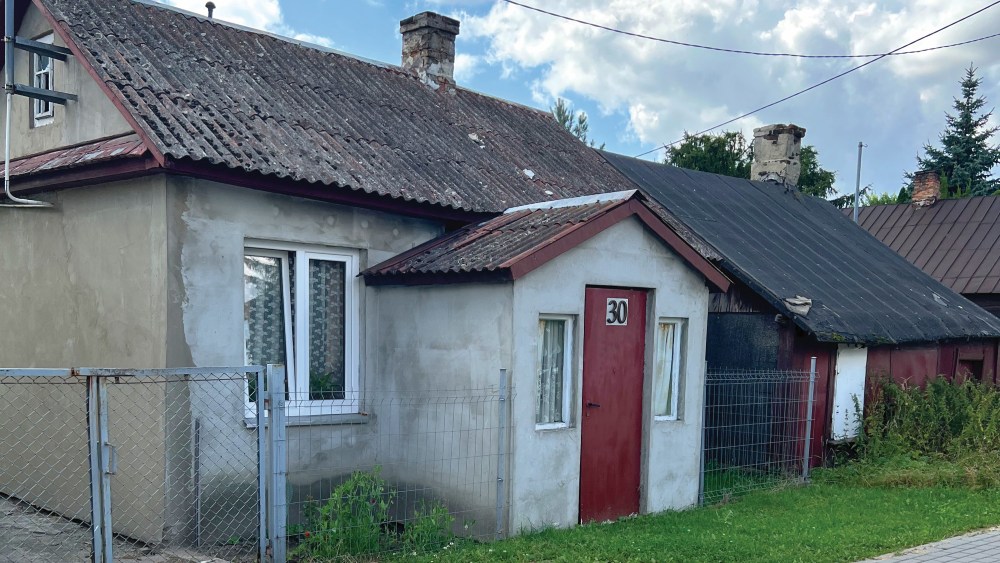
He said he was surprised by what he discovered about modern-day Poland.
“We came back a little bit Polish proud. Everyone was so nice,” Abel said. “We didn’t encounter any type of negativity. It wasn’t what I had expected in terms of really loving Poland.”
Jake said he was also struck by the country’s natural beauty. “Given how dark the family history is around Poland, I never really thought of it in a very bright light,” he said. “But the countryside was beautiful.”
Jake said his biggest takeaway from the journey was about “the collective and generational trauma that all European Jews went through together during the Holocaust. It gave me a better perspective on how that trauma has been transmitted to the next generations and affected people today.”
Duke Zimmerman and Lori Gale will talk at Towson University about their new book "People Get Ready" and the role played by Globe Posters in the civil rights movement.
The new exhibition revisits and updates a previous show about ritual hair covering in the observant community.

One of the most competitive local races for public office this political season is for Baltimore County Executive. Jmore recently spoke with four of the candidates about their views on how they hope to enhance life in the county.
The Pikesville resident's latest offering "There's a Dragon in the Tree House and He Won't Come out!" was co-written with her grandsons.