

By Susan Barocas
This story originally appeared on The Nosher.
In the United States, pumpkin pie is almost mandatory at Thanksgiving, while pumpkin makes occasional appearances in sweet breads and sometimes a creamy soup during the fall and winter — all the way through .
Pumpkin also holds a special place in the stomachs — and history — of Sephardic Jews.
This versatile fruit is used in cakes, soups, stews, puddings, jams, pastries and pancakes — including latkes. It can be savory or sweet and baked, boiled, roasted, steamed or stuffed.
And, yes, it’s a fruit much like avocados, tomatoes and squash.
Pumpkins have been around as a cultivated food for a surprisingly long time. Native Americans grew them for nearly 6,000 years before pumpkins became one of the first New World foods introduced to Europeans by Spanish explorers in the early 1500s. During the 16th century, the Jews remaining in Iberia were nearly all conversos, converts to Christianity, with many secretly hanging onto their Judaism, often through food.
During the 16th and 17th centuries, these secret Jews continued to flee Spain’s inquisition across Europe to the Ottoman Empire and throughout the Mediterranean and Middle East, bringing with them their love of this new ingredient, pumpkin. As Gil Marks notes in “The Encyclopedia of Jewish Food: ”The presence of pumpkin in early Mediterranean dishes is usually a sign of Sephardi influence.” (You can read more about the history of Sephardim and pumpkin here.)
From this Sephardic influence, Italian Jews were among the first to robustly incorporate pumpkin into their cuisine, becoming known for their pumpkin-stuffed ravioli and tortellini, puddings and sweet pumpkin fritters (fritelle di zucca). Sephardim who found new homes in what is now Turkey and Greece made many pumpkin dishes, including filling flakey Ottoman pastries to make borekas de kalavasa (pumpkin in Ladino, the language of Sephardim) and deep-fried pumpkin fritters or sweet pancakes, both called bimuelos de kalavasa.
There are, by the way, different versions of the name, which include bumuelos, birmuelos and, in Central America, buñuelos. We can’t talk about pumpkins without bringing up its 21st-century status as a “super food” acclaimed for its nutrient-dense benefits. Pumpkin flesh is fat-free, and high in fiber, potassium and vitamin C.
It provides antioxidants and is one of the best sources of beta carotene. All this adds up to being good for hearts, eyesight, weight control and cancer-fighting. Canned pumpkin still has these healthy benefits including 7 grams of fiber per cup, more than two slices of whole wheat bread. In fact, unlike most fruits and vegetables, nutritionally, canned pumpkin is usually as good, or even better, than the homemade puree… and a whole lot less work.
Sephardim recognize pumpkin’s importance during the fall holidays. At the traditional Sephardi Rosh Hashanah seder, one of the special seven blessings is symbolized by pumpkin (or its close relative, squash). At Sukkot, not only is pumpkin a fall crop, but the many seeds symbolize fertility and abundance.
These pumpkin patties, bimuelos de kalavasa, are perfect for Hanukkah along with the deep-fried version. So this year, for your potato latke-laden Chanukah, let these pumpkins patties bring an easy and tasty bite of Sephardic history to the table.
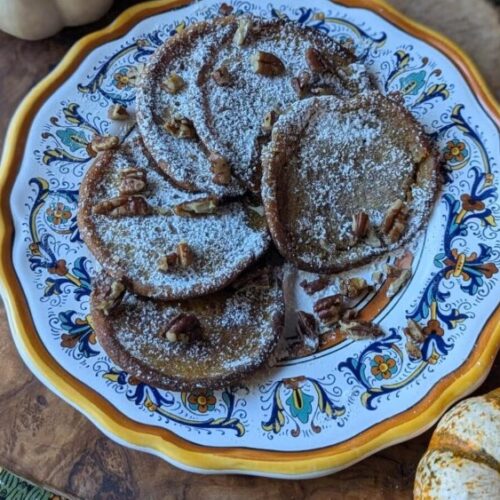
Quick and Easy Sephardic Pumpkin Patties

Ingredients
- 1 1/2 cup all-purpose or 1:1 gluten-free flour
- 2 teaspoons cinnamon
- 1/2 teaspoon coriander
- 1/4 teaspoon allspice
- 1/8 teaspoon salt
- 3 eggs, beaten
- 1/4 cup maple syrup
- 1 (15-oz) can pumpkin (about 1 3/4 cup)
- Neutral vegetable oil, for frying (sunflower or avocado are good choices)
To serve:
- Honey, date syrup (silan), maple syrup and/or powdered sugar
- Chopped walnuts or pecans
Instructions
- In a bowl, whisk together the flour, spices and salt. In a separate mixing bowl, whisk the eggs, maple syrup and pumpkin until well blended and smooth. Add the dry ingredients to the wet and whisk or mix well until smooth.
- Heat about 1/4 inch of oil in a large skillet over medium heat. The oil is ready when a drop of water spatters in it.
- Add a very full Tablespoon (about 1/8 cup), or less to make mini appetizer-sized patties, of the batter to the hot oil. With the back of the spoon, slightly flatten and spread each patty into a circle as you add it. Cook about 3 minutes per side, flipping only once, until each patty is a deep golden brown. The patties will be crispy on the outside and soft on the inside. Drain well on doubled paper towels or on top of a wire cooling rack placed on a paper-towel-lined baking sheet (cut open brown paper bags work, too).
- To serve, drizzle with warm honey, maple or date syrup, or sprinkle with powdered sugar, then add chopped nuts, if desired. These are best when served immediately, but the cooked patties can be kept warm in a 200°F oven on top of wire cooling racks placed on a baking sheet for up to 40 minutes.
Notes
- To refrigerate or freeze, put cooked patties in an airtight container with layers separated by parchment paper. Can be refrigerated for four days or frozen for up to a month.
- To reheat, defrost slightly, just enough to separate patties. Place directly on a parchment-lined baking sheet or on top of wire cooling racks placed on a baking sheet. Heat in 350°F oven for 8-10 minutes.
- 1/4 cup granulated sugar can be used instead of maple syrup.
- Date syrup (aka silan) is available at Middle Eastern and some kosher markets.
- These are best when served immediately, but the cooked patties can be kept warm in a 200°F oven on top of wire cooling racks placed on a baking sheet for up to 40 minutes.
This story originally appeared on The Nosher. Susan Barocas is a writer, cook, teacher and speaker who lives in Washington, D.C.

Dara Bunjon talks sustainable farming, chocolate, and more with farmer, chef, educator and chocolatier Mark Mills of Chocolates and Tomatoes Farm in Middletown.

Dara Bunjon talks with cook, writer and television host Monti Carlo about her new cookbook, "Spanglish: Recipes & Stories," and more.

At a time of economic uncertainty, Yossef's Laffa-Milia, a new kosher restaurant in Owings Mills is thriving.
This lemon and dill salmon recipe from Elite Jakob celebrates the delicious colors, aromas and tastes of spring.