
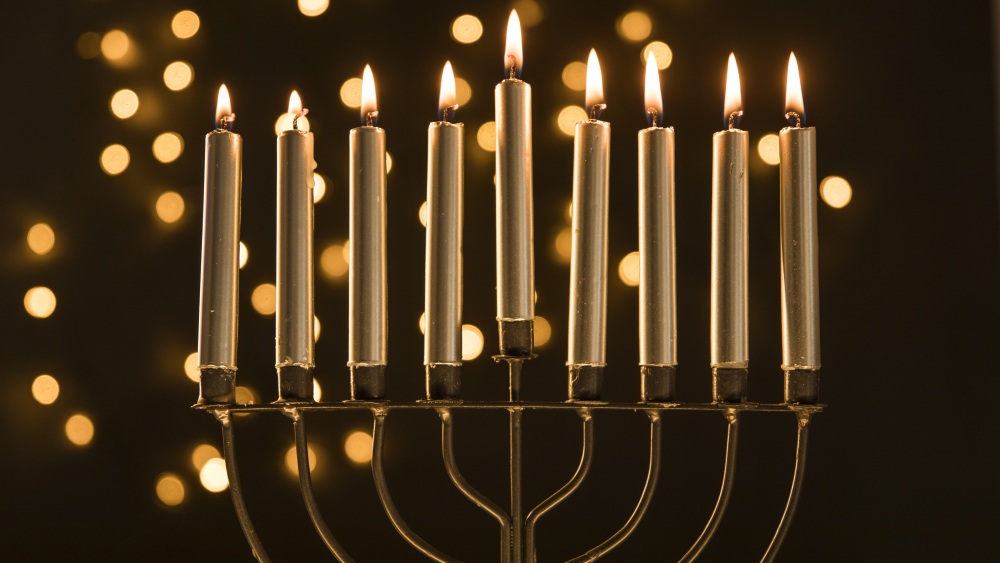
This year, our 1895 Baltimore rowhome turned 130 years old. We live on Eutaw Place near Beth Am and, beginning in the early 20th century, a series of Jewish families purchased and lived in the home.
Sometimes I consider our deep, wooden windowsills and wonder how many previous menorahs shone there in the decades when Reservoir Hill was at the heart of the Jewish community. For many years when the kids were younger, we placed our family hanukiyot in those windows so passersby could see them from the street. These days, they live on our dining room radiator, still by a window but where we can admire their glow while eating latkes.
Jews have a longstanding tradition of placing the menorah in a publicly visible place: “It is a mitzvah to place the Hanukkah lamp at the outside of one’s house within the handbreadth closest to [the edge of] the entrance, so that the mezuzah will be to the right and the Hanukkah lamp to the left. And if he was living in an attic [or second story apartment], he should place it in the window that is closest to the public domain. One who has placed the Hanukkah lamp above twenty cubits has not done anything, because it is not recognizable.” (Mishneh Torah, Hilchot Megillah v’Hanukkah 4:7)
Maimonides’ rationale, based on the Babylonian Talmud (Shabbat 23b), is pirsumei nisa, publicizing the miracle of Hanukkah. This may not be a given. Hanukkah memorializes an era, not entirely unlike our own, in which Jews endured great pressure to assimilate. Some were Hellenizers. Others were proud, observant Jews insistent on maintaining their traditions despite societal pressure (and imperial decree) to do otherwise.
This value of pirsumei nisa was so important that if an impoverished family had funds sufficient for either kiddush wine or a Hanukkah lamp — but not both — the priority is the Hanukkah lamp to enable the family to proclaim their Jewishness publicly and proudly.
What exactly is the miracle we are meant to publicize? One possibility is it is the unlikely victory of the Maccabees over the Seleucid Greeks. The more common story justifies Hanukkah’s timeframe, suggesting one small cruse of oil was sufficient to keep the menorah burning for eight days.
Modern thinker Rabbi Irving “Yitz” Greenberg writes about the Jewish spirit implicated in such a legend: “Pessimists and assimilationists have more than once informed Jews that there is no more oil left to burn. As long as Hanukkah is studied and remembered, Jews will not surrender to the night. The proper response, as Hanukkah teaches, is not to curse the darkness but to light a candle” (“The Jewish Way”)
A Talmudic tale (Avodah Zarah 8a) imagines an unlikely origin story for the festival of Hanukkah. Adam, the first human, was created on day six, but crucially not long after Rosh Hashanah, in a season when the days get shorter, darker earlier. When noticing this, he said, “’Woe is me; perhaps because I sinned the world is becoming dark around me and will return to chaos and disorder.’ … He arose and spent eight days in fasting and in prayer.”
In the rabbinic imagination, those eight days are the days of Sukkot, the holiday following Rosh Hashanah and Yom Kippur.
We know from the Book of the Maccabees there is a connection between Sukkot and Hanukkah, each one an eight-day holiday. The connection is downplayed by the tale of the oil, but the legend from the Talmud offers some reprieve for Adam. The world wasn’t growing darker because he sinned, it grew darker because winter was coming. Once Adam crossed the threshold of the Winter Solstice, however, things change and the days begin to get longer. Adam observes another eight days, this time feasting and expressing gratitude simply for the “order of the world” (Avodah Zarah 8a). In this fantastic tale, Adam invents both Sukkot and Hanukkah, seasonal festivals that would be appropriated by pagans before, one day, becoming Jewish expressions of joy and light.
This month brings us Hanukkah, our Jewish festival of illumination, a celebration filled with candles in the darkness. In a darkening world where a litany of evils swell and rise, where antisemitism threatens to force our people into hiding once more, our tradition insists we increase our light. Isaiah proclaims we are to be an “or lagoyim,” a light unto the nations (42:6).
The miracle of Hanukkah is that 130 years after my house was built, I can still place my hanukiyah in the window, that we survive to tell these tales thousands of years after the Greeks became the latest empire to try (and fail) to stamp us out.
In Adam’s time, the miracle of Hanukkah was that the world began getting a little brighter. In our time, it’s the miracle of Jewish chutzpah, our insistence on lighting candles rather than cursing the darkness.
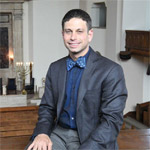
Rabbi Daniel Cotzin Burg is spiritual leader of Beth Am Synagogue in Reservoir Hill. This column and others also can be found on his blog, The Urban Rabbi.
Jmore Editor-in-Chief Alan Feiler remembers Temple Emanuel's longtime spiritual leader, who passed away earlier this week at age 91.

Camp and youth group experiences have the ingredients for true, deep, lifelong transformation, writes Rabbi Jessy Dressin.
Proposed legislation in Israel would transfer authority of the entire Kotel to the Chief Rabbinate, writes Rabbi Robyn Fryer Bodzin.
In Italy, the Jewish Brigade's flag has unfairly become a flashpoint in today’s battles over Zionism and anti-fascism, writes Dr. Ginaluca Fantoni.