
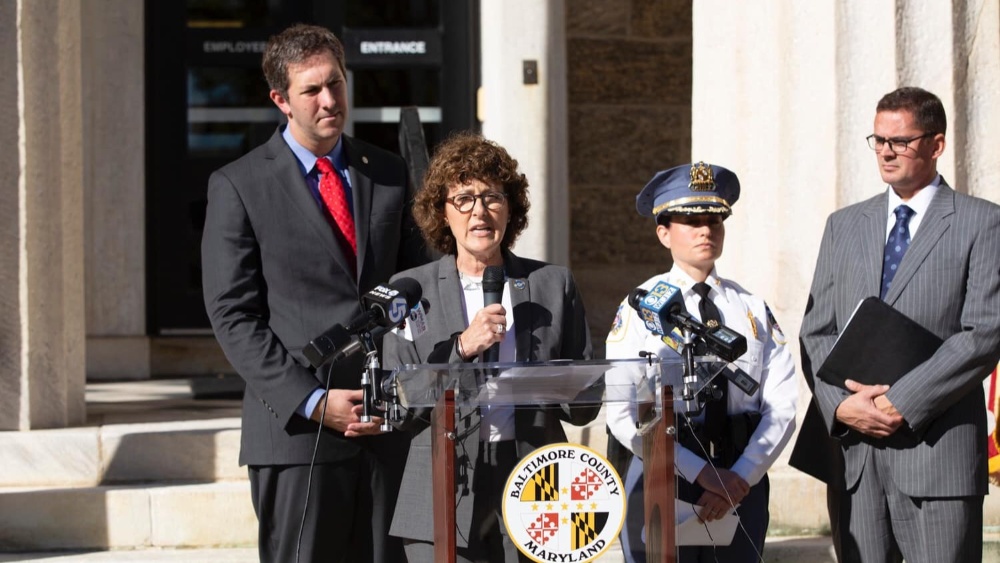
Not long after she was elected to the Maryland House of Delegates in 2015, Sen. Shelly L. Hettleman (D–11th) read a newspaper article that deeply disturbed her.
It was about a young woman in Baltimore County who was raped. The woman opted not to involve the police, a decision commonly made by survivors reeling from the trauma.
Approximately a year later, she felt ready to come forward to hold her rapist accountable. But when contacting law enforcement authorities, she learned her rape kit no longer existed; she was told it was thrown away.
Hettleman discovered Maryland did not have a consistent policy for preserving rape kits. Some counties kept them for a year, others for longer, a few indefinitely.
“That meant whether a survivor had access to justice depended not on the facts of the crime but on where the crime occurred,” Hettleman said. “That struck me as fundamentally unjust.”
In 2017, Hettleman introduced House Bill 1076 to standardize rape kit retention throughout the state.
“It shouldn’t matter where you were raped when it comes to how you’re treated by the criminal justice system or how long the state preserves your DNA,” she said.
The bill, which passed, required rape kits to be preserved for at least two decades. (That period has since been extended to 75 years.)
But that was only the beginning.
Over the next eight years — first as a delegate, then as a state senator — Hettleman sponsored legislation addressing systemic problems in how sexual assault cases are handled, from health care access to evidence tracking and accountability.
Survivors, she contended, should be able to ask such questions as “Is my kit at the hospital?” “Is it with law enforcement?” “Is it at the lab?” and receive answers.
As Hettleman continued reviewing law enforcement practices, she became aware of a procedure she found especially alarming. Some law enforcement agencies asked survivors to sign waivers releasing police from liability if a case was not pursued.
“These waivers were sometimes presented at one of the most traumatic moments of someone’s life,” said Hettleman. “I said, ‘No. That is definitely not OK.’”
While the practice has largely been outlawed, Hettleman noted that vigilance remains necessary.
Hettleman stressed her work does not take place in a vacuum. She is a member of the Attorney General’s Sexual Assault Evidence Kit Funding and Policy Committee, which brings together legislators, law enforcement, hospitals, forensic nurse examiners, prosecutors, advocates and the Maryland Coalition Against Sexual Assault.
The committee has tackled such issues as ensuring that insurance companies cover the full course of HIV prevention medication after sexual assault and securing federal funding to test backlogged rape kits.
“There were states with warehouses full of untested kits,” Hettleman said. “Each one represented an unresolved case.”
Another challenge is access to specialized care. Forensic nurse examiners who conduct sexual assault exams are in short supply throughout the nation. Maryland designates specific hospitals, typically one per county, for this type of care. But in the aftermath of an assault, most survivors go to the nearest emergency room.
“Without the right systems in place, survivors can be bounced from hospital to hospital like a ping-pong ball, reliving trauma at every stop,” said Hettleman.
In Baltimore County, GBMC is the designated site. Decades before DNA testing existed, the late GBMC pathologist and emergency room physician Dr. Rudiger L. Breitenecker had the foresight to preserve thousands of microscope slides from sexual assault exams. His work was the foundation for GBMC’s Sexual Assault Forensic Examination program, which now provides 24/7 specialized care.
In 2019, then-Baltimore County Executive Johnny Olszewski formed the Sexual Assault Investigations Task Force to review how sex crimes were investigated and prosecuted. As a result, older GBMC evidence slides were transferred to the Baltimore County Police Department, logged and sent for DNA testing. If usable DNA was found, it was entered into the national DNA database to identify potential suspects in cold cases.
In 2023, Hettleman sponsored Senate Bill 615, which established a statewide online rape kit tracking system so survivors can check the status of their evidence. That same year, she introduced a bill extending rape kit retention to 75 years. She also helped secure funding to ensure all remaining slides were tested by the end of 2024, including a $1.5 million state grant and up to $500,000 from the Towson-based Hackerman Foundation.
On Dec. 4, 2025, Hettleman received a GBMC Circle of Advocates award for individuals whose advocacy has transformed care for survivors of sexual assault and abuse. The award reflected Hettleman’s decades of work predating her political career. In the 1990s, she was founding executive director of CHANA, the Jewish community’s response to domestic violence.
“I find it infuriating how often women experiencing trauma aren’t taken seriously,” Hettleman said. “Our systems are not good at responding to trauma. Government shouldn’t be part of the problem. It should be part of the solution.”
A former resident of Baltimore and central Florida, Ritt was active in the Soviet Jewry movement of the 1970s and 1980s.
For more than four decades, Goldman played a vital role in the supervision of elections in the city.

The 16-year-old sophomore succumbed to injuries sustained in a car crash last week in Cockeysville.

Schools in Montgomery County have recently experienced a wave of antisemitic incidents.