
By Peter Arnold
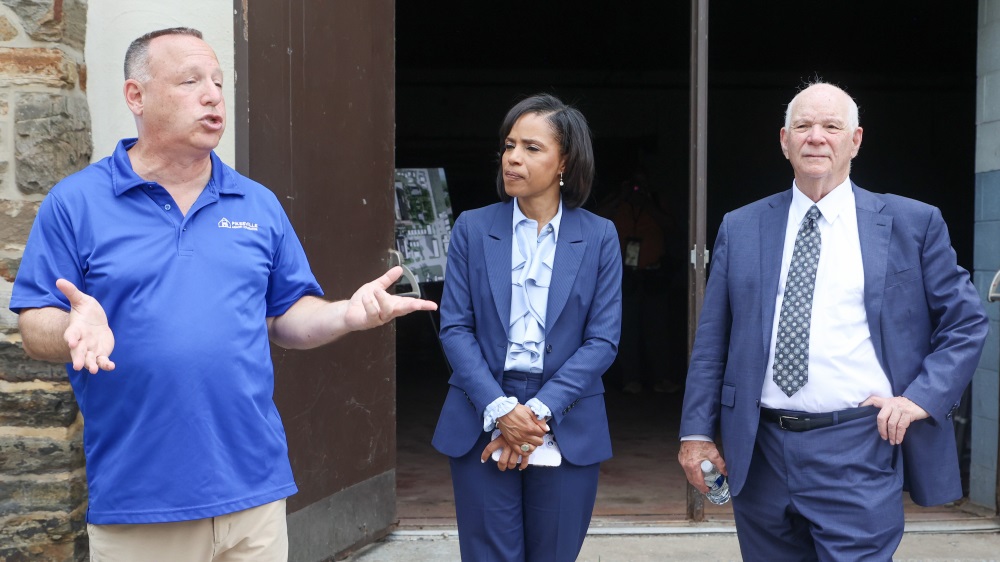
Last year, Sen. Angela Alsobrooks made history when she became the first Black person to become a U.S. senator representing Maryland. She was also the third Black woman ever elected to the U.S. Senate.
A lifelong Marylander and a Democrat, Alsobrooks, 54, graduated from Duke University and earned her law degree from the University of Maryland School of Law.
She succeeded retired Sen. Ben Cardin (D-Maryland) after defeating former Gov. Larry Hogan in the general election.
Jmore recently spoke with Alsobrooks about her tenure so far in the Senate.
What has surprised you most since becoming a senator?
My 20-year-old daughter, Alexandra, called me on my way to Washington for my orientation. She said I’ve been accustomed to being in places where generally people see the world in the same way that I do. [She said,] ‘Now you’re going to a place where they don’t see it quite the same. You’re really lucky because you get to hear why. You go there, build relationships and do good things.’
I’ve been really surprised by the opportunity, the atmosphere, to find genuine friendships with people I disagree with. Yet we’ve found common ground to work together, so that has been really a pleasant surprise. I’ve been able to work with [Sen.] Katie Britt (R-Alabama) and introduce the Homeless Children and Youth Act. I worked with [Sen.] Cynthia Lummis (R-Wyoming) to co-sponsor my bipartisan Uterine Fibroid Intervention and Gynecological Health Treatment Act. I have bills that I’m working on with many Republicans.
By finding common ground, I get things done for my constituents.
Does anything in particular distinguish Democrats from Republicans?
I’m struck by one difference between our parties. We Democrats are much more representative of America. We have a diversity of backgrounds and experiences. I think that’s really important.
I think people who are closest to the problems are often closest to the solutions, and we have Democrats who are leaders closest to the actual problems we’re trying to solve. Democrats do a much better job than Republicans of electing people who live like the people they represent. We’re fighting for hard-working, middle-class Americans so we need hard-working middle-class Americans in the Senate.
My life experience certainly impacts the way I legislate. I’m currently caring for two aging parents who have Alzheimer’s and one with cancer. I personally know how important Medicare is for families.
How can working families and the middle class be better protected?
By creating economic opportunity. That’s the north star for me. Creating wealth is the goal, to create generational wealth and opportunities for families. But to make sure that working families in the middle class are not left behind, which is what this administration has done. They’ve fired federal workers, and their families have been targeted by the president. Cuts to Medicaid and Medicare will lead to millions of Americans without health care. We’ve seen spikes in health insurance due to the Republicans’ unwillingness to extend the ACA tax credit.
I think we should be trying to make sure that Maryland families are living beyond their wildest dreams and thriving. So I’ve worked with [Sen.] Tim Scott (R-South Carolina) to introduce the Small Business Tax Fairness and Compliance Simplification Act to allow small businesses to qualify for federal tax relief. I’ve joined Sen. Dave McCormick (R-Pennsylvania) to introduce the bipartisan Access to Small Business Investor Act to make it easier for small and middle market businesses to attract capital.
And I’m working with Sen. Bill Haggerty (R-Tennessee) to introduce the Main Street Depositor Protection Act to make sure we are creating opportunities, to really reduce the barriers for people who are seeking to feed their families.
How can voting rights be strengthened?
It’s not lost on me how important this right is to all of us, so I’m making sure my voice is heard. I’ve introduced the Deceptive Practices and Voter Intimidation Prevention Act. I’m also a sponsor of the John R. Lewis Voting Rights Advancement Act of 2025 to update and restore critical safeguards to the original Voting Rights Act.
In Texas and other states across the country, we watch rules being changed in ways that will disenfranchise voters. There’s nothing ordinary about the times we’re living in, so I think we must take extraordinary measures to adjust to the environment we’re in. We must make sure we’re protecting the voting rights of Americans.
What can be done about the rise of White Christian nationalism?
All of us who claim to be Christians have to speak out against the hatred and division, the violence, the antisemitism, the racism, the sexism. They all go against the teachings of Christ.
I’m here in the Senate doing what I can to make sure that faith is not used to harm people. It should be used to empower them, so I’m on a bipartisan task force combatting antisemitism, and I’m also a co-sponsor of Sen. Chuck Schumer’s (D-New York) resolution condemning Nick Fuentes and the creed of hateful White nationalism.
What should be U.S. policy regarding Israel?
I visited Israel in 2019 and came to really understand the close relationship between Israel and the United States. I believe this is an important relationship and will continue to be important for us to continue together.
To focus on the shared values of democracy and freedom, to really emphasize human rights, these are American values and I think we should continue to work with Israel to support them.
It is also important to make sure that Israel has safety and security. Israel deserves to be able to defend herself.
And I think we should also be working to have safety, security and self-determination for the Palestinians. I think we should continue to work toward the two-state solution, and the ultimate goal should be peace and prosperity for both Israel and the Palestinians.
It is important for the ceasefire to continue to hold and for more aid to be distributed so that Gazans can begin to rebuild their lives. We need to sustain diplomacy to turn the ceasefire into a durable peace that provides security, stability and dignity for all Israelis and Palestinians.
Peter Arnold is a freelance writer.

Schwab currently serves as president of Cumberland's historic B'er Chayim Congregation.
A former U. S. Marine, Pat Young has served as a Baltimore County Council member representing District 1 since 2022.
Mansoor Shams is known for carrying around a sign proclaiming, “I’m a Muslim and a U.S. Marine. Ask anything.” Now the Baltimore County Department of Recreation and Parks community engagement and outreach officer is running for Baltimore County Executive.
Baltimore native Susan Landsman recently celebrated her rite of passage surrounded by family, friends, fellow residents and staff.