
By Grace Gilson
On Sunday morning, Mar. 1, excited chatter echoed throughout the hallways of Congregation Shearith Israel in Dallas as about 900 people streamed in for the shul’s Purim spiel.
But as similar festivities commenced at synagogues around the world, members of this historic Conservative congregation knew they were in for something far more ambitious than the average Purim festivities.
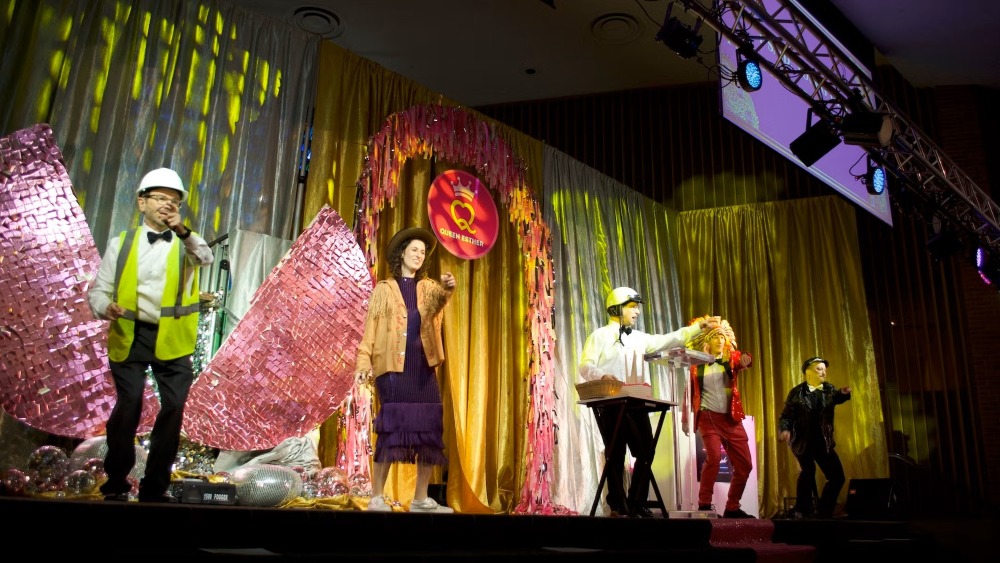
For the past eight years, the Purim spiel at Shearith Israel has taken the form of a high-octane theatrical performance featuring intricate set designs, original music, and a yearly stunt that has included its rabbi riding into the sanctuary on horseback and ziplining onto the stage.
This year, the performance featured confetti canons and a mechanical rig that lowered a child onto the stage behind a giant disco ball.
The congregation’s annual performance did not always resemble the elaborate, effects-laden production it is today. The spectacular is the brainchild of Baltimore native Rabbi Adam Roffman, one of the synagogue’s senior rabbis, whose second act in the clergy followed an earlier stint in a musical theater in New York City.
“The Purim spiel is a love letter to the community,” said Rabbi Roffman.
Melissa Goldberg, a congregant whose husband’s family has belonged to Shearith Israel for five generations, said the spiel is her family’s “favorite time of year.”
“I love it because it gives Rabbi Roffman a chance to create, to flex his creative muscles, so we don’t lose him to Broadway, because he can have his moment every year,” said Goldberg.
A graduate of Pikesville’s Krieger Schechter Days School, Rabbi Roffman he said he “idolized and worshiped” his rabbis before being “bit by the bug” of musical theater in high school.
After graduating from Amherst College in 2002, Rabbi Roffman studied musical theater at Circle in the Square Theater School in New York City and began his stint as an actor and director.
But a few years into the scene, he said he began to question whether the profession suited him.
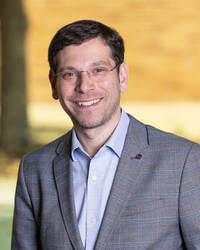
“In my mid-20s, I found myself kind of realizing, it didn’t matter how much talent I had as an actor, the industry was not for me,” said Rabbi Roffman. “When you’re an actor, you’re the president of ‘Adam Roffman Inc.,’ you have to fight for yourself all the time, and that just isn’t my personality, and what I was missing was sort of connection and community.”
So he reengaged in the Jewish community, saying he became “addicted in the same way that I was when I started acting in high school.”
His rediscovered passion soon inspired him to seek rabbinic ordination from the Jewish Theological Seminary in New York City.
After coming to Dallas in 2013 to join Shearith Israel’s clergy with his wife, Rabbi Shira Wallach, he said the pair soon discovered that the local Jewish community had “tremendous institutional loyalty” and a unique commitment to Jewish life.
“They’re very cognizant of the fact that they are the minority here in the Bible Belt,” he said. “This is a Christian place, and that gives them even more incentive to commit to their Judaism and to commit to being here, being present here.”
Rabbi Roffman said he spent his first few years adjusting to the role before beginning to think about how to get back on the stage.
“I think a lot about the overlap between Jewish practice and theater,” he said. “I think of the prayer book as a script. It’s one of the oldest scripts written in human history, because it is a book of words written by somebody else that you have to open up and personalize and process.”
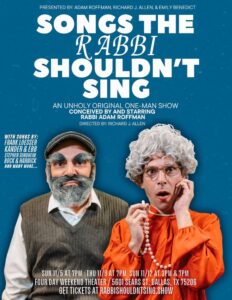
During his time at Shearith Israel, Rabbi Roffman has performed two self-written autobiographical one-man-shows at local theaters, including “On Sunday the Rabbi Sang Sondheim” in 2017 and “Songs the Rabbi Shouldn’t Sing,” which he took a sabbatical to write in 2023.
In 2019, Rabbi Roffman told his colleagues at Shearith Israel that he would be taking over preparations for the Purim spiel.
It began fairly simple, with Rabbi Roffman pulling off a Broadway-themed performance featuring him and his wife singing songs from “Phantom of the Opera” as they rolled into the sanctuary in a canoe surrounded by fog.
Things escalated from there, with Rabbi Roffman incorporating a “stunt” every year to outdo the last, including standing atop a cherry picker for a “Lion King”-inspired spiel, riding into the sanctuary on a horse and ziplining above congregants’ heads for last year’s “Wicked” theme.
“We try and do something that nobody’s really ever seen before in a synagogue,” said Rabbi Roffman. “But there’s a primary goal, which is that the people see their rabbis, all four of us on stage, really putting it out there and doing crazy stuff to show that we’re people, too, and also to really build a connection between us and the people who are here.”
The buildup to the Purim spiel is a monthslong affair, with Rabbi Roffman beginning to work on his concept in December. In the weeks leading up to the extravaganza, he said his colleagues rotate him out of leading Shabbat services so he can focus his efforts on crafting the performance.
“Starting in January, I start to work on lyrics, and then four weeks out, basically what I do is I do lifecycle events, I teach on Shabbat, and that’s it,” said Rabbi Roffman. “I’m spending another 40 or 50 hours a week just on Purim.”
Rabbi Roffman said the performance was largely unconstrained by a budget, noting that “it could cost $20,000, and then it could be a lot more than that, and people would be OK with that.” He and others declined to say what was being spent on this year’s production.
“The people here are just extremely committed to Judaism and Jewish life and Jewish continuity, so the fact that this Purim show costs what it does, and people don’t blink an eye,” said Rabbi Roffman.
During this year’s spiel, the congregation screamed and applauded as Queen Esther descended onto the stage in a giant disco ball suspended on a mechanical lift, a fog cannon blasting as she made her entrance.
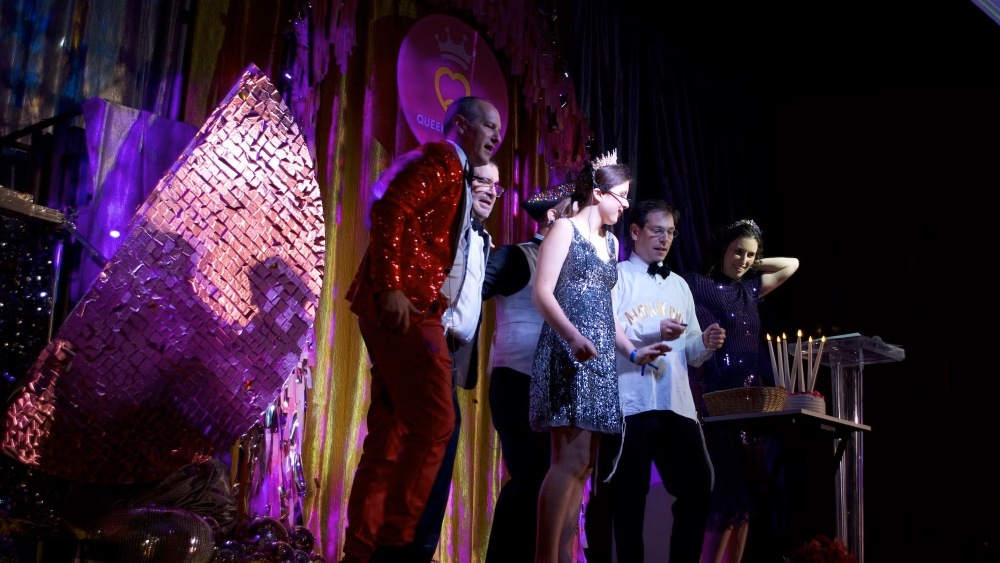
Later in the performance, the clergy danced to Rabbi Roffman’s parody of the Village People’s “Y.M.C.A.,” complete with the lyric “It’s fun to pray to the yud hey vav hey,” a reference to the Hebrew name for God. Audience members lifted coordinated signs to spell out the letters in unison.
Shearith Israel’s Rabbi Ari Sunshine said the attendance to the spiel had more than doubled since the first year Rabbi Roffman took over.
“We like to joke, ‘We take our Purim fun seriously,’ because we think that this is a great opportunity,” said Rabbi Sunshine, a Potomac native. “We know it’s one that people look forward to, we know it’s a great community-building experience.”
The spiel is not the only place where the synagogue has seen a surge in participation. Over the past five years, Shearith Israel’s religious school has gone from 60 students to 250.
“When we first came, the shul was kind of in a little bit of a downturn in terms of energy and membership,” said Rabbi Wallach. “One of the things that was really important to Adam and me when we came is that we changed the culture so that it was really warm and embracing.”
Debbie Mack, who has belonged to Shearith Israel for 48 years, said the synagogue “wasn’t always as lively and as fun and youthful” as it feels today.
“Our children don’t live here, our grandchildren are not here, but we love coming to see all that the synagogue is now, and remember the difference between how it was and the way it is,” said Mack.
But even amid the spectacle, the story’s darker themes were not lost on congregants this year.
For Shiva Delrahim Beck, a Persian congregant who has attended the Shearith Israel Purim spiel for 12 years, this year had a special significance in the wake of joint U.S.-Israeli attacks on Iran.
“For us, the story of Purim and the way that they did it at the spiel really brought to life the significance of Purim and modern-day Purim, as it happened yesterday,” said Delrahim Beck. “So this was great for my family, and I could not be happier to be here.”
During the opening prayers for this year’s spiel, Rabbi Wallach drew parallels between the story of Purim and the burgeoning conflict in Iran.
“In that same way, our heroes of today are risking their lives so that we can continue to do what we are doing here, showing our love for and pride in Judaism and the Jewish people in Israel and all over the world,” she said.
This year was not the first time that the spiel intersected with heavier themes. Last year, when the spiel’s theme was “Wicked,” Rabbi Roffman played a montage of images of the Israeli hostages coming out of Gaza as the congregation’s cantor, Hazzan Itzhak Zhrebker, sang “Somewhere Over the Rainbow.”
“I think it really moved people,” he said. “They weren’t expecting it, because they were there to laugh, but, you know, that’s the thing about theater. It sort of hits you in places that you don’t expect.”
Grace Gilson wrote this article for the JTA global Jewish news source.
Pikesville residents David and Wendy Hefter recently joined Jewish motorcyclists from around the world to raise money for victims of the Oct. 7th terrorist attacks in Israel.
The Baltimore resident taught at Johns Hopkins for five decades.

Beverly Feig and her daughter, Shana Alter, recently undertook a pilgrimage to the hometown of Feig's late father.
Marc Terrill talks with Jewish Federations of North America President and CEO Eric Fingerhut about the opportunities and challenges he sees from his vantage point as a former congressman, leader of the Ohio State University system, Hillel International and now JFNA.