

This article is sponsored by and produced in collaboration with Yad Vashem, the World Holocaust Remembrance Center. This story was produced by JTA’s native content team.
By Larry Luxner
A guitar strummed by Jewish teenager Nina Simon of Skopje, Yugoslavia. A shortwave radio once belonging to Raphael Ahav of Lyon, France. An embroidered tallit used by 7-year-old Yosef Valdman of Borsczców, Poland.
These are among 33 everyday artifacts displayed in glass cubicles at the entrance to “Living Memory,” a new exhibit at Yad Vashem, the World Holocaust Remembrance Center in Jerusalem.
What these items all have in common is none of their owners lived to see the end of World War II — all were victims of the Shoah.
The exhibit explores how memory is formed and passed on through personal objects that tell extraordinary — and at times, unbelievable — stories, along with rare Holocaust-era documentation and compelling artwork.
“These personal items serve as bridges between past and present, as evidence of what happened,” said Eliad Moreh-Rosenberg, chief art curator at Yad Vashem. “Some of them deal with religion, others with daily life. We ask ourselves the question, what is memory? And how will we transmit this memory when the direct witnesses to the Holocaust will no longer be among us?”
The exhibit is designed to offer museum-goers a firsthand encounter with a Jewish world that no longer exists. The objects on display range from a tiny pocket watch used by Yaakov Ostfeld of the Romanian town of Vatra Dornei to the full-sized wardrobe, salvaged from a house in Poland, in which Jewish teenager Genia Sznajder hid in 1941, the wooden door punctured by a German soldier’s bayonet.
In total, more than 400 rarely seen artifacts and artworks form the exhibit.
Partially funded by the Austrian government, “Living Memory” opened last October in a ceremony featuring a performance by 104-year-old Auschwitz survivor and conductor László Roth.
“The idea for this exhibit came after we opened a new repository for all our collections in July 2024,” said Moreh-Rosenberg. “It occurred to me that we should make these collections accessible to the public.”
The exhibit — which includes items connected with survivors as well as victims — consists of three sections comprising three layers of memory.
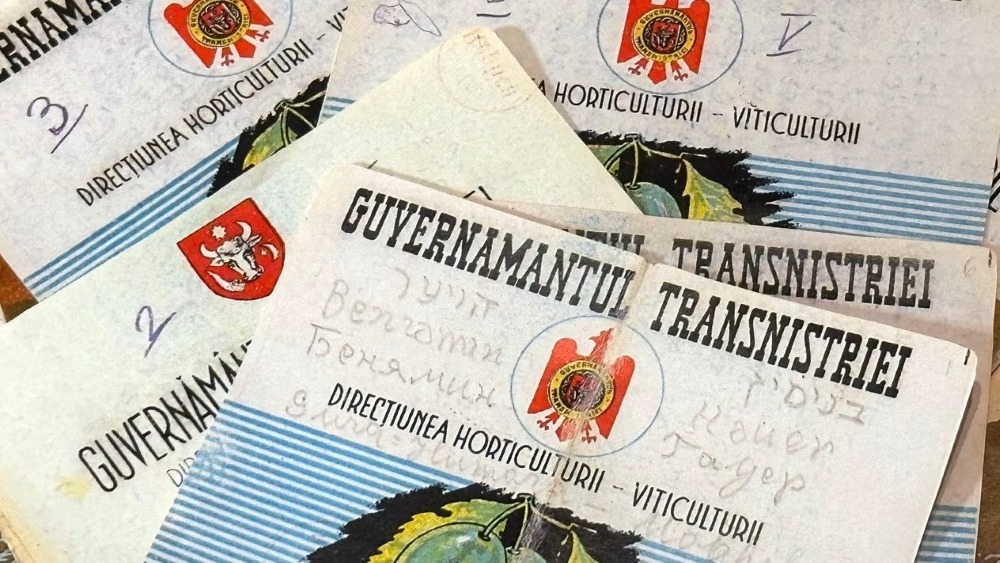
“The first stage is during the Holocaust itself, when Jews made every attempt possible to preserve memory so something would be left,” said Moreh-Rosenberg. “The second stage is after the Holocaust, when survivors went back to their homes and communities, trying to find traces of life and collect documents, names and information. The third stage is memory speaking through symbols. This is collective memory. … We’ve made a point of showing original, authentic pieces.”
One of the most unusual objects is the trunk of a hollowed-out tree that saved the life of Jakob Silberstein, a Polish Jew who escaped from a Nazi death march in Czechoslovakia’s Sudetenland. He eventually found refuge at the home of a Czech woman.
“One day, he saw a rabbit running and entering the tree, so he understood the tree was hollow,” Moreh-Rosenberg said. “He dug into the tree, and you can see here the hole he made. He knew he had a hiding place in case the Germans would come looking for Jews.”
That’s where he fled when the Gestapo made a final sweep of the area toward the end of the war. Silberstein hid in the tree for nine hours. He survived the war and eventually settled in Israel. Sixty years later, he returned to the Czech Republic, found tree and donated it to Yad Vashem.
Other remarkable artifacts include a package of yellow stars intended for distribution to French Jews, and a Chanukah menorah that was concealed under the floor of a synagogue-turned-church in the Dutch town of Alphen aan den Rijn. The menorah was discovered in 1980, wrapped in newspapers from 1941.
Also on display is a silver-threaded waistcoat made by Sol Levi, who lived in the Greek port of Thessaloniki. Levi spent four years knitting the coat but never wore it. In 1943, the entire family was deported to Auschwitz; only Levi’s son Marcel survived.
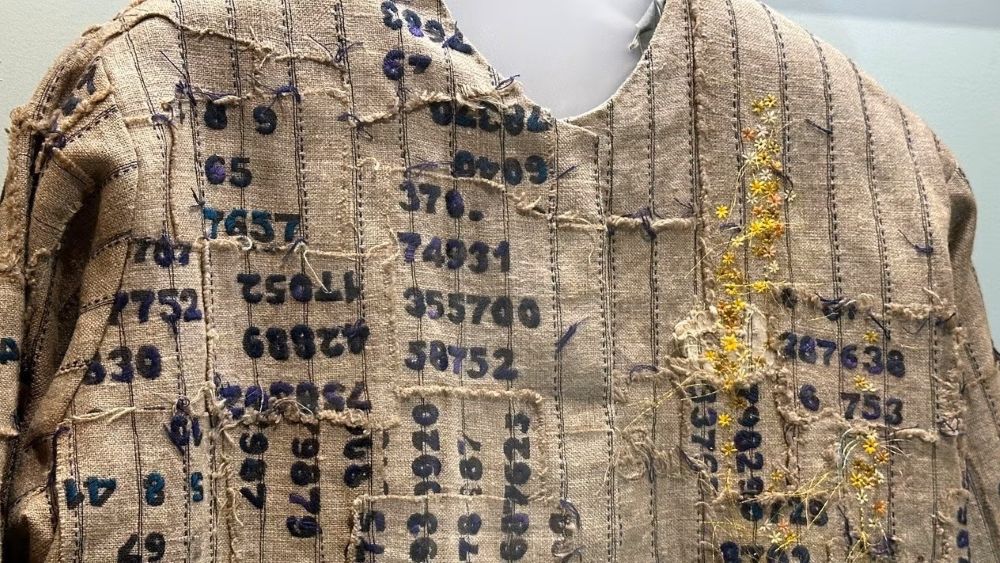
“There is one artifact that especially moved me — a notebook that belonged to Josima Feldschuh, a child prodigy pianist and composer who gave concerts in the Warsaw Ghetto,” Moreh-Rosenberg said. “We have her notebook in which she composed music. She and her parents found a hiding place, but at the age of 13 she died of disease, and so did her mother. Only her father survived.”
The last section of the exhibition showcases the work being done at Yad Vashem’s new Shapell Family Collections Center. In this space, visitors get a behind-the-scenes glimpse of the cataloging and research that takes place daily there for future generations.
At the conclusion of “Living Memory,” a prominent quote from the late Holocaust survivor and Nobel Prize-winning writer Elie Wiesel sums up the exhibit’s mission: “We have to be the messengers’ messengers.”
This article is sponsored by and produced in collaboration with Yad Vashem, the World Holocaust Remembrance Center. This story was produced by JTA’s native content team.

The Jerusalem Orchestra East & West, which arranged the program for young musicians, blends Western orchestral music with Middle Eastern traditions.

From AI to weight-loss medications, here are the ways that breast cancer diagnoses and treatments are changing.

A former college campus activist, Veksler will speak at Chizuk Amuno on June 8 at the Ruth and Jay Lenrow Visiting Scholar-in-Residence for Combating Antisemitism.

Why not honor your mom by making a donation to a nonprofit that supports women and children?