
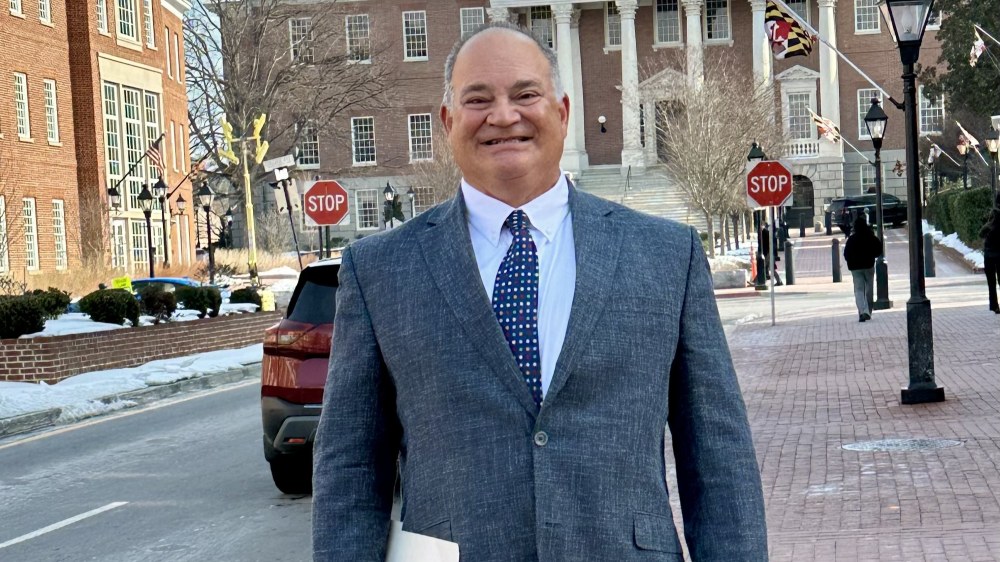
John Singer was understandably relieved when informed by his neurologist that a comprehensive workup showed no signs of a neuromuscular disease, such as multiple sclerosis or ALS.
But Singer — an avid swimmer and biker who underwent two spine surgeries in his 50s and was no longer able to walk without “wobbling” — wasn’t exactly jumping for joy.
His diagnosis? Idiopathic bilateral denervation.
“That’s a very fancy way of saying my nerves have very little conduction,” says Singer, now 68. “They don’t do a whole lot. My muscles have atrophied in both in both legs — worse on the right. I have drop foot, too [causing him to occasionally stumble and fall].”
The Pittsburgh-born Singer – who splits his time between Baltimore and Charleston, South Carolina – assumed he would simply have to settle for living that way.
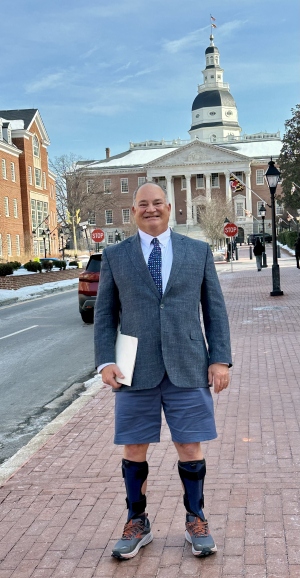
But a few years ago, he met his son’s future mother-in-law, a physical therapist. She encouraged him to see an orthotist, a health care provider who designs braces and splints.
After examining Singer, the orthotist prescribed ankle foot orthoses. AFOs are supportive braces that help people with mobility challenges to walk with greater stability. “They were life-changing,” says Singer.
After one AFO broke, he purchased a replacement. Eventually, Singer, a former Washington, D.C.-based prosecutor, acquired a backup pair.
“I’m not going to be running marathons or anything, but I can walk,” he says. “We’ve gone on vacations to places like Machu Pichu [in Peru]. I will use a trekking pole or two if we’re walking long distances, but with some modifications and some adaptations, I can lead a normal life and certainly a much better one than I had before.”
AFOs are only designed to last about three years and can cost as much as $2,200 per pair. Making matters worse, many insurance companies will only cover the cost of new AFOs every five years.
Singer was fortunate in that his medical insurance covered 80% of the cost. Even when his insurance wouldn’t pay for a replacement, he was able to afford to pay out of pocket.
Last May, one of Singer’s AFOs broke again while he was vacationing in Paris. He realized he was blessed to have the financial resources to afford a new AFO waiting for him when returning home.
“That’s when it hit me that most of the world is not in the fortunate financial position that I’m in,” he says. “Many people can’t afford the co-pay for new AFOs if they have insurance, and even more people can’t pay the full cost of an AFO if they need a replacement or do not have any insurance. … I said, ‘I’d really like to do something to help people who are in my situation and can benefit from AFOs but can’t pay for them.’”
After researching the matter, Singer decided to create an endowment and chose to partner with Johns Hopkins Medicine’s Department of Physical Medicine and Rehabilitation.
Singer selected Hopkins because of his own experience as a patient there and the department’s stellar reputation.
“I’m told they have never had [an endowment structure] like this [because] they are essentially a conduit for an endowment and then distribute the money to patients, either directly or to an orthotics company to pay for something they make for a patient,” he says. “Hopkins’ physical medicine people told me they hope to be able to use this format as a model for other medical institutions.”
The Singer AFOs for All Fund endowment “went live” last March. Singer says his goal is to raise at least $250,000 for the endowment.
As an incentive for donors, he and his wife, Karen Singer, have committed to matching the first $125,000 in donations.
In addition, Singer says his family is making an additional $35,000 donation to Hopkins “to create an onsite AFO Assessment Kit and Library so that patients can try out AFOs before they buy them. This library will help patients avoid the extended trial-and-error process I experienced before finding the best AFOs for me.”
Since getting involved in the effort, Singer was invited to offer live testimony in separate hearings before the Maryland General Assembly in support of bills that will significantly expand insurance coverage for AFOs and other orthotics in the state.
In addition to his live testimony, he and his family submitted written testimony about how much Singer’s AFOs have improved his quality of life.
If the bills pass, Maryland will be the sixth state in the nation to expand such coverage, says Singer. But he notes that even if legislative efforts at the state level are successful, there will still be a great need for the Singer AFOs for All Fund since patients will still require financial assistance to offset co-pays.
In addition, the bills do not help uninsured Marylanders or those insured by federally administered insurance companies like Medicare and federal employee health insurance.
“If someday my endowment became totally unnecessary and they just use it to buy AFO libraries, that would be wonderful,” says Singer. “I don’t think that day will be coming in my lifetime.”
For information about the Singer AFOs for All Fund, visit secure.jhu.edu/form/singerfundor contact Laura Malloy at lmalloy@jhmi.edu.

At Krieger Schechter Day School, joining in the later elementary or middle school isn’t a setback -- it’s a launch pad.
Steve Hofstetter, who will perform at Soundstage next week, recently made headlines for his social media post ridiculing some fans' warnings about Charm City's safety.
Marc Terrill talks with Maryland State Delegate Samuel "Sandy" Rosenberg (D-41st), one of the longest serving lawmakers in state history, about the recently completed Maryland legislative session.
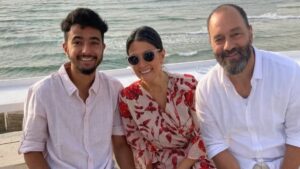
Israeli-Americans Rachel Goldberg-Polin and Jon Polin talked about the pain of losing their 23-year-old son, who was kidnapped and later murdered in the Oct. 7th tragedy.