
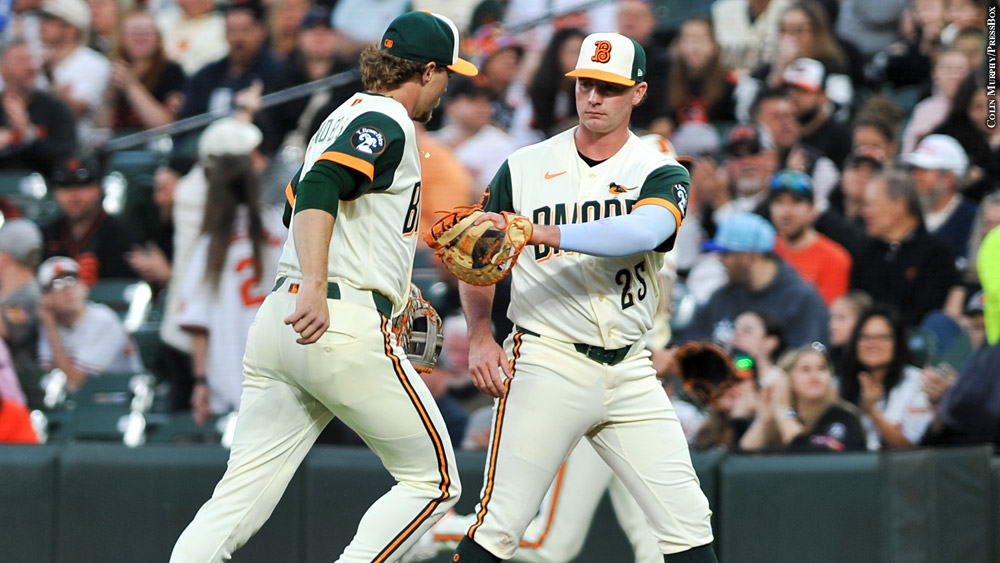
In a smarter-than-thou piece of analytical reporting in The Sun newspaper not long ago, the following phrases were employed regarding the Baltimore Orioles and a sport they play, called baseball:
Data management.
Motion capture technology.
Wearable health tracking.
Analytics infrastructure.
To which I can only inquire: Whatever happened to “Way you chuck ‘em in, babe?”
For baseball dinosaurs like me, such language seems closer in spirit to computer video games than it does to the physical act of hitting a ball with a stick of wood.
As this is written 26 years into the new century, sports reporting has had the color drained out of it by technology. We’re informed of launch angles and spin rates and such, and miss the drama of human beings displaying their remarkable skills.
The broadcasters are even more relentless than the writers. Every pitch is analyzed like the seventh game of the World Series. Two-seamer or four-seamer? Who cares? The score’s 12 to 2 and we’re only in the third inning!
In the countless dull, interminable moments that come with any baseball game, can you tell me a story or two to remind me of the game’s charms? Can you give me some insight into the personalities of these guys wearing the hometown uniforms?
I’m listening to Kevin Brown and Ben McDonald broadcast a dramatic late-inning moment the other day, and they’re telling me the spin rate of the last pitch, and the number of seams gripped by the pitcher.
And these two, Brown and McDonald, are smart, sometimes funny, solid pros. So, why can’t they get through a single English sentence without attaching a number to it?
I grew up reading Bob Maisel’s sports columns in The Sun. He had you sitting in the dugout, before the game, chatting with manager Paul Richards. I read John Steadman in The News American, informing me how John Wesley Powell got the nickname “Boog” and Jim Palmer got the nickname “Cakes.”
They gave us human beings.
And those little touches of personality became part of community folklore for generations.
Maisel and Steadman could analyze the hell out of any sport. But they also understood, this is a game they’re describing for an audience hoping to be entertained as well as informed.
Chuck Thompson lasted for decades behind Baltimore microphones because he could tell you a story about the players and not just inform you that the last pitch was a four-seamer. And he knew years of history to weave into the evening’s narrative, and some funny stories, all of which were not only entertaining but made us feel part of a community.
He didn’t sound as if he were delivering a lecture to an audience comprised entirely of pitching coaches.
Those who cover sports are immediately up against a wall. If the team’s not doing well, those who cover it will catch some of the flak from fans. And these Orioles have not been doing well.
But the emphasis on all the new data has been going on for several years now, through winning and losing. There was a time when we thought we knew our hometown jocks as people and not just a collection of statistics.
Maybe here’s part of the problem: the other day, in a “Mailbag” column in The Sun, the baseball write Jacob Calvin Meyer was asked, “How’s team morale among the players?”
“This is a tough one to answer,” Meyer replied. “We’re only in the clubhouse pre-game for 50 minutes a day (and the players know that and largely avoid us) and then we’re in there post-game.”
These ballplayers don’t know it, but they ought to be embracing those who cover them, not hiding from them. The writers and the broadcasters can bring them to life, can endear them to fans hungry to love them.
What Meyer was telling his reader about these Orioles’ personalities was: I wish I could tell you more.

A former Baltimore Sun columnist and WJZ-TV commentator, Michael Olesker is the author of six books, including “Journeys to the Heart of Baltimore” (Johns Hopkins University Press) and “Michael Olesker’s Baltimore: If You Live Here, You’re Home” (Johns Hopkins University)

Michael Olesker pays tribute to WJZ’s retiring Marty Bass, a longtime fixture on local TV screens.

The Orioles' weak defense plays a major role in the nightly carnage, writes Michael Olesker.

Jmore Publisher Scott Rifkin, M.D., reacts to President Donald Trump's latest poll numbers and the real force behind the growing decline of the Trump movement.

Last weekend's Flower Mart once again demonstrated that there's nothing to fear about downtown Baltimore, writes Michael Olesker.