

By Gefen Miller
When performing throughout the world, Israeli-American cellist Amit Peled is often asked by audience members why he wears a bright-red rubber bracelet.
It’s a question he loves.
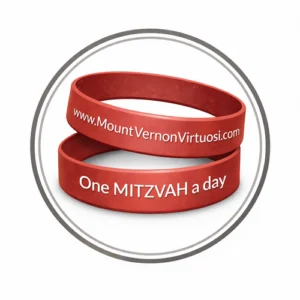
Peled, a professor at the Peabody Institute and founder and director of the youth chamber orchestra Mount Vernon Virtuosi, informs audiences the bracelet bears the message “One Mitzvah A Day.”
It is part of a community initiative to expand the mission of Mount Vernon Virtuosi beyond making music accessible to the masses by actively fostering kindness and community engagement in everyday life.
Jmore recently spoke with Peled, 52, a Pikesville resident, about “One Mitzvah a Day.”
What inspired you to start this initiative?
It all began with the Mount Vernon Virtuosi, an orchestra organization I started in 2018 to do good in the community through music, including free-of-charge performances, education and lessons.
I thought to myself, ‘What if we find a way not just to play or teach music, but also to listen to the community and its needs with simple, simple things — from helping a person crossing the street, taking trash from the ground, and so on.’
What is the purpose of the bracelet?
It is a reminder for you. When you put the bracelet on, you encourage yourself not to change the world but your little surroundings — your neighborhood, your school, your community, your kids’ environment — to make them better, little by little.
Living in a world where there’s big wars and politicians fighting each other, [one should] start change small, just in our own little bubble.
Of course, Jewish people know the meaning of a mitzvah. But for people who are not Jewish, I explain to them that mitzvah means good deeds, something we can all do.
How have you personally been impacted by small acts of kindness?
My wife comes from [a Christian background in] Germany, but I like to say she’s more Jewish than I am. The rabbi that converted my wife here in Baltimore, [the late] Rabbi [Mark G.] Loeb of Beth El, loved operas. He found a way to connect to my wife through both of their love of operas and music. I thought that was really meaningful.
My doctor always asks me, ‘Ma Nishma? How are you? How is Israel? How is your family?’ His concern always stands out to me.
Do you try to influence your audiences about this philosophy?
Since I’m always very open about my Judaism on stage, I’ve been in many unpleasant situations [since the terrorist attacks of Oct. 7, 2023, and the subsequent war in Gaza]. I’ve been attacked, there have been demonstrations outside the hall when I played, and I’ve been asked by conductors not to speak and only to play — which I never do, of course.
I’ve become more of an advocate for Israel, and in turn, I can raise the issue of goodness and use my power of music to bring it out.
How did growing up on a kibbutz influence your vision for “One Mitzvah A Day”?
In the kibbutz, from age 10 or so, you start working in the fields. So basically, one day a week you don’t go to school, you just work in the community. Everybody is equal in what work they have to do on the kibbutz, but also equal in opportunity. That’s the essence of my organization — to give music free of charge to the community.
My musicians get paid for what they do, but they also have to work twice a month in the food pantry in East Baltimore. They do it and they enjoy it. It’s just to give back to be aware of those around us.
Does “One Mitzvah A Day” appeal to non-Jews?
To do good is something that is universal. It’s like music. You don’t have to be a great musician to appreciate the art. You don’t have to be a saint to do one good deed per day.
I have students that are from Asia. I have African-American students. When they wear [the bracelet] and play a concert – or even if I just watch them in the cafeteria — I feel, like, wow. That reminder makes me feel good.
Would you encourage the average person to practice the philosophy of ‘One Mitzvah a Day’?
I tell people to just think about what good you can do in your life. What can you do and see that can make you as a person feel better? And when you feel better as a person — especially after watching the news and seeing everything around you — it doesn’t affect you as much. It actually makes you a better person.
I feel that by making that change in awareness, in our society, in our community, we just create a better society, better citizens.
For information, visit mountvernonvirtuosi.com/one-mitzvah-a-day.
Gefen Miller is a local writer and a student at Beth Tfiloh Dahan Community School.

A former college campus activist, Veksler will speak at Chizuk Amuno on June 8 at the Ruth and Jay Lenrow Visiting Scholar-in-Residence for Combating Antisemitism.
A lifelong Baltimorean, Judge Rosenberg served as a U.S. magistrate judge from 1973 to 1998.

Container vegetable gardening is a terrific option for people with limited space and/or time. Rebecca Brown and Norman Cohen share some tips.
A former resident of Baltimore and central Florida, Ritt was active in the Soviet Jewry movement of the 1970s and 1980s.