
By Alanna E. Cooper
Every time I drive down Fairmount Boulevard near my home in the Cleveland suburb of Beachwood, I scan the horizon for the distinct lines of the “Fairmount Temple” building.
For now, it’s still standing.
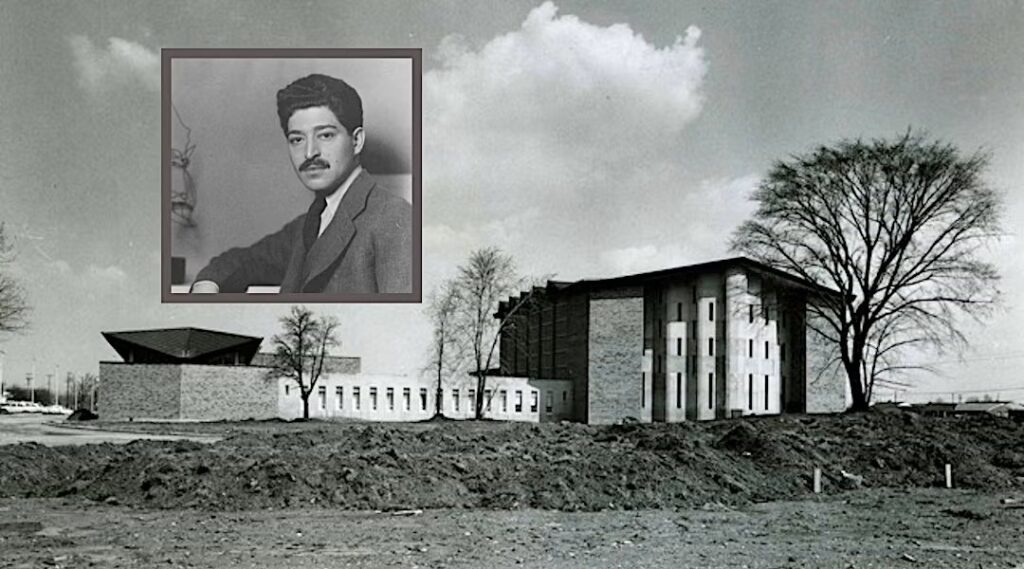
The large sanctuary comes into view first with its angular tent-like facade. Then, the structure stretches out along a low connecting corridor, followed by a smaller chapel at the other end, its roof lifted above a band of windows, as though an eagle about to soar.
Heavy at one end and diminutive at the other, the building’s elegant asymmetry must have been astounding when it first rose up over the undeveloped field that surrounded it.
That was nearly 75 years ago. Now the building’s age shows.
And I’m bracing myself because the wrecking crew is coming. The congregation has found a new home a mile away, and the City of Beachwood purchased their property in June of 2024. While a formal development agreement has not yet been signed, Communications Manager Ben Lombardi has confirmed the city’s intention to demolish the edifice and use the site for senior housing.
The plan is pragmatic, sensible and perhaps even in everyone’s best interest. Nevertheless, I feel the impending loss.
Not just of this structure, but of the vision of Percival Goodman, the architect who designed the synagogue building to bring people into unmediated connection with each other and with God.
A Spiritual Refuge
Between 1948 and 1983, Goodman designed more than 50 synagogues across the country — a soaring concrete triangle in the suburbs of Detroit, a white igloo-shaped structure in Miami, Florida, a jeweled crown of curved concrete in Highland Park, Illinois.
Goodman also designed Baltimore Hebrew Congregation’s iconic home of the past 75 years, at 7401 Park Heights Avenue on the Baltimore City/County border.
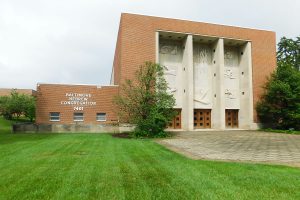
No two Percival Goodman designs looked alike, yet all grappled with the same concern: suburban migration was dissolving social networks once sustained by the rhythms of shared daily life.
He developed this thinking most fully in “Communitas,” his popular 1947 book on cities and society, which he co-wrote with his brother, social theorist Paul Goodman.
The central crisis of modern life, they argued, was due in part to the technologies of their day which were replacing direct human contact with secondhand encounters: television screens substituting for being among the crowds of a sports stadium; automobiles and highways fragmenting neighborhoods.
As an architect, Goodman envisioned the synagogue as a refuge from this mediated world. Here, face-to-face encounters between people, and between the individual and their Creator, remained possible.
“The house of prayer,” he wrote, “is designed for this moment.”
The Buberian Connection
Goodman, who died in 1989 at age 85, grew up in New York with no religious education and only a weak sense of Jewish belonging. Following an early career designing stores and apartment buildings, his path toward Jewish architecture began in 1944 when he was commissioned to renovate a Fifth Avenue mansion donated to the Jewish Theological Seminary.
That project brought him into the orbit of leading Jewish thinkers of his day. Self-described as an “agnostic converted by Hitler,” Goodman was ready to be transformed by those interactions.
He met philosopher Martin Buber, whose work “I and Thou” elevated direct, face-to-face encounter as the highest form of human connection. For an architect, that idea opened the question of what a building might do to foster such a connection.
Goodman had long believed that good design could influence the contours of social relations. Now he turned that conviction toward shaping Jewish communal life in postwar America.
Goodman made a strong case for his theological architecture, which posited that the social, the sacred, and the built environment were inseparable. He popularized his ideas by publishing in Commentary Magazine and Architectural Record.
He lectured at national conferences, spoke to congregations during Friday night services, and dazzled building committees with his bold modernist vision and elegant drawings.
Among them was Anshe Chesed, Cleveland’s oldest synagogue. Founded in 1841, the congregation occupied several successive synagogue buildings over the course of its history.
When the synagogue migrated to suburbia in the years following World War II, it became known as “Fairmount Temple,” named for the road on which it is located.
For this new building, the congregation turned to Goodman — the most sought-after synagogue architect of his day — whose clean, innovative lines were a departure from everything that had come before.
Goodman built his vision of spiritual presence into Fairmount Temple’s sanctuary. The space was vast, with seating for over 1,000 worshippers.
And yet it held you.
A vaulted white ceiling soared overhead, supported by buttresses leaning in from the sides. Behind the ark, scattered windows of pink, blue, orange and green wrapped the congregation in light. And on the side walls, Ibram Lassaw’s “Ten Sephirot” — abstract bronze renderings of the mystical attributes of God — encircled the room, providing a sense of enclosure.
But that enclosure was not fixed. Goodman is widely credited with popularizing the folding wall used to expand the sanctuary, allowing the prayer space to flow into the social hall.
Most accounts treat this as a pragmatic solution, designed to accommodate large High Holiday crowds. Indeed, the movable partition at the back of Fairmount Temple’s grand sanctuary opened up to double the capacity of available seating.
For Goodman, however, the wall was not just a convenience. It was a statement about what counts as sacred.
“The bold architect,” he wrote, “will discard the divisions of profane and sacred and establish as the basis of his design the simple faith that all that happens in the precincts of his plan will be holy.”
Encounters Sacred and Social
The same design principle of spaces flowing into each other shaped the large area where I attended services with an independent minyan that rented a room in the building.
An expansive set of rooms overlooked an outdoor courtyard. For my daughter’s bat mitzvah, we prayed together there and looked out into the gardens. When services were over the room partitions were folded back, tables were set and food was served. Sacred and social flowed into each other, all of it holy.
Even then, however, I couldn’t help but wonder about the structure’s future. Although I was not a member of Fairmount Temple, I visited frequently, as did many in the broader Jewish community.
I attended holiday celebrations there, theater productions my children performed in, and services with the independent minyan.
While I felt the grandeur of the space, I also noticed the worn carpets and fixtures that needed attention.
The confirmation photographs lining the religious school hallways told the same story in a different register. Up to 70 smiling students crowded the frames of graduating classes in the postwar years.
Decade by decade, however, the pictures grew sparser until recent years when little more than 10 children appeared. By 2024, congregational membership had fallen to roughly 1,000 households, half its former size.
Also in Beachwood, Temple Tifereth Israel was facing the same reckoning. The two Reform congregations had been one before they split in 1850 over a dispute about religious ritual. Nearly 175 years later — in early 2023 — the Cleveland Jewish News reported that the two were exploring “collaboration opportunities.”
Weeks later, an electric fire broke out in Goodman’s Fairmount Temple building. Everyone was safely evacuated, but the helicopters circling over Beachwood for much of the day proved to be an omen.
By March of 2024, the two congregations voted to reunite. They formed Congregation Mishkan Or and agreed to make their home in the much newer Tifereth Israel building on Shaker Boulevard.
Meanwhile, the City of Beachwood purchased the 17-acre Fairmount Temple property for $8 million. Following community input, the city is pursuing plans to replace the building with at least 80 homes designed for aging in place, addressing what officials have described as a pressing shortage of senior-targeted housing in this Cleveland suburb.
In June of 2024, Anshe Chesed marked the final weekend in their building on Fairmount Boulevard with a series of gatherings as the community thoughtfully said goodbye. Some in attendance had been there when the temple first opened, nearly 67 years earlier. They processed out knowing the building would not survive them.
Of the more than 50 synagogues Goodman designed, Fairmount Temple will be the third demolished. The first was Long Beach, Long Island’s Beth Sholom in 2010, and the second was Tulsa, Oklahoma’s Temple Israel, razed just this past February.
As congregations across the country continue to downsize and consolidate, more losses will likely follow.
I will miss the Fairmount Temple building after it’s gone, those graceful proportions, colors and lines. But I’ll also miss the way it embodied Goodman’s insights about the need for sacred space.
If television and the automobile alarmed him, what would he make of smart phones, AI and social media? Surely, his architectural vision for bringing together our social lives and our spiritual lives is more urgent now than ever.
Sooner or later the wrecking crew will arrive. Still, Goodman’s questions will persist, for builders and congregants alike.
What does it mean to be fully present with each other and the sacred? And what does it take to build — and care for — spaces that can engender such encounters?
A Potomac native, Alanna E. Cooper serves as the Abba Hillel Silver Chair in Jewish Studies and Associate Professor in Religious Studies at Case Western Reserve University in Cleveland.
As millions mourn the passing of Stephen Colbert from the airwaves, Michael Olesker looks back on the "institution" of late-night TV.

As he gets ready to leave for California, Rabbi Daniel Cotzin Burg looks back on his time in Baltimore and his 10 years writing for Jmore.

Michael Olesker pays tribute to WJZ’s retiring Marty Bass, a longtime fixture on local TV screens.