
Riding on the Paris Métro on my way to Charles de Gaulle Airport — and eventually back to the “land of Coca-Cola,” in the words of a Bob Dylan song — I turned casually to look at the name of the next subway stop.
I saw a sign on the wall and immediately got chills: Drancy.
I was on a train last month in the northeastern Parisian suburb that once served as home to an internment camp for Jews bound for Nazi extermination camps. Between 1942 and 1944, more than 67,000 Jews were deported from Drancy to Auschwitz.
Among them was my friend, the late Leo Bretholz, who fled his native Vienna after the Nazi annexation of Austria and later miraculously escaped a cattle car deporting him to Auschwitz from Drancy.
In his memoir “Leap into Darkness” (Anchor) co-authored by Michael Olesker, Leo — who possessed an incredible memory — told his harrowing tale of survival, including his time spent in the overcrowded, “dehumanizing” environment of Drancy.
In an oral testimony, Leo recalled how Drancy’s authorities would take the belongings of new arrivals and hand them a faux receipt “with the admonition, ‘Don’t lose that because you will never get them back. That is your receipt that has your number on it.’ … It had a number on it. Just imagine that.”
For an intelligent, cultured man like Leo, it was unfathomable how the country that gave the world Voltaire, Montesquieu and Zola — as well as the French Revolution and Enlightenment — could participate in such cruel collaboration and ruthless deception.
Leo loved French history and culture but was never able to get past the legacy of Drancy. Later in life, he was part of a lawsuit against SNCF, the French national railway that transported Jews and others to concentration and death camps. (In 2014, only a few months after Leo’s death, SNCF agreed to pay up to $60 million worth of compensation to survivors.)
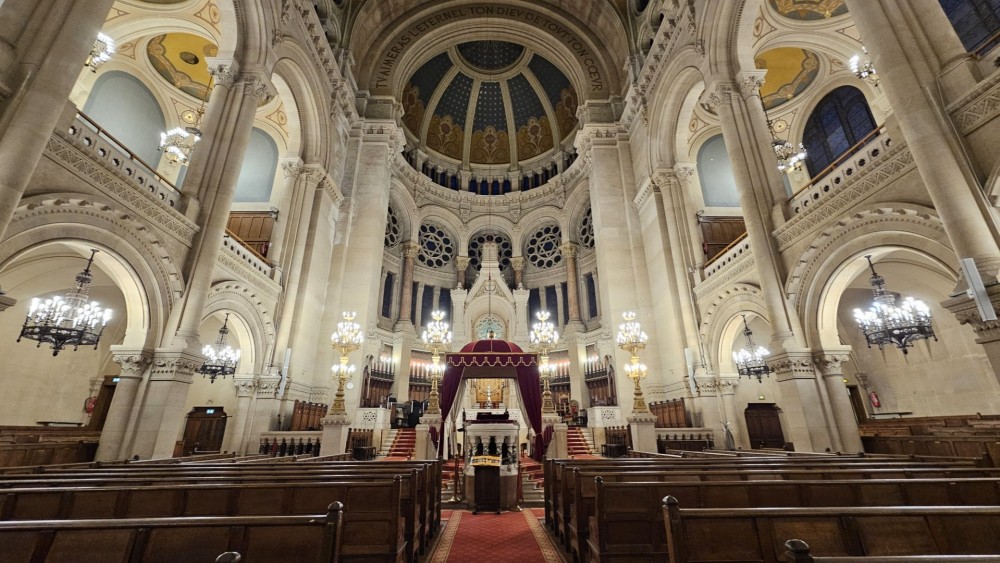
A day before my brief stop in Drancy, I davened in the Grand Synagogue of Paris, located in the Marais district that is home to the Pletzel, the city’s Jewish Quarter. A magnificent Romanesque Revival structure, the synagogue was built in 1875 and financed by Baron Gustave de Rothschild on a tract of land donated by the French government.
After the maariv service, a synagogue leader offered a tour of the shul. Proudly, he showed us an interior metal framework design donated by Gustave Eiffel, the French civil engineer for whom the iconic tower is named after. He also showed us a conference room where Rothschild, Theodor Herzl and Capt. Alfred Dreyfus reportedly met to discuss the viability of a future Jewish state.
Because of potential terrorism, armed gendarmes stand guard in front of the Grand Synagogue while its small and aging congregation gather for services and events. Over the decades, the synagogue has survived the national trauma of the Dreyfus Affair, two world wars and the Holocaust, and the Arab-Israeli conflict. It stands as a symbol of the endurance and resilience of the Jewish people.
But last year with the rise of the far-right National Rally party, the synagogue’s Rabbi Moshe Sebbag made international headlines by saying there is no Jewish future in France.
It’d be tragic if a community — the world’s third largest Jewish community — that has thrived in France for centuries would no longer exist. But I never forget the George Santayana quote that Leo was fond of citing: “Those who cannot remember the past are condemned to repeat it.”
That’s wisdom we should also keep in mind when looking at our own backyard.
Sincerely,
Alan Feiler, Editor-in-Chief
A lifelong Orioles fan, Jmore Publisher Scott Rifkin, M.D., shares a message to Orioles owner David Rubenstein.
Attorney and Barry Levinson confidante Donald Saiontz left his mark on the world, writes Michael Olesker.

When we create a world with a warm and loving connection, even when someone beloved is gone, that relationship is carried on, writes Pamela R. Weissman.

The Orioles this season have proven that money can't buy happiness, writes Michael Olesker.