
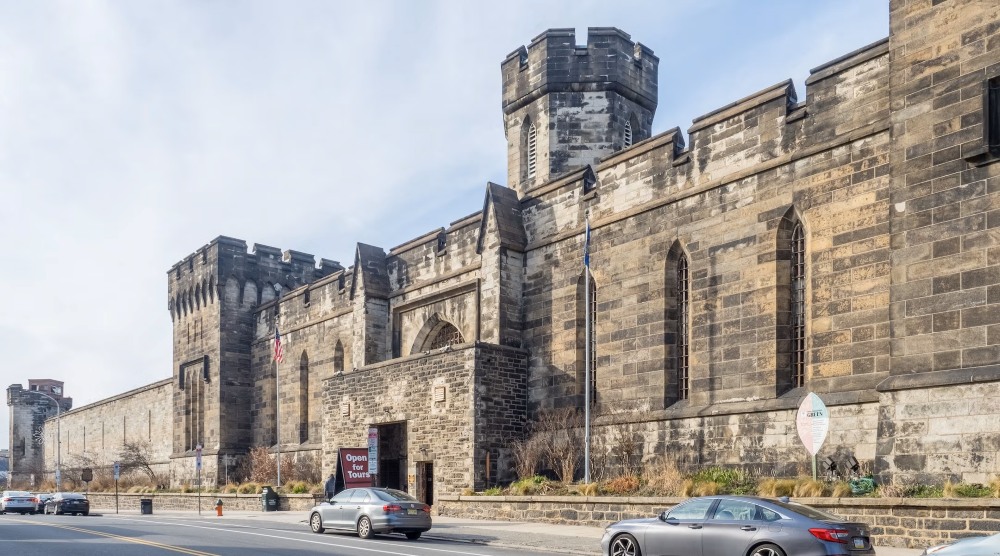
Behind the imposing, foreboding stone walls of Eastern State Penitentiary — the Philadelphia prison that once held the likes of mob boss Al Capone and bank robber “Slick Willie” Sutton, and was toured (and condemned as “this melancholy house”) by Charles Dickens — sits a small, unlikely sanctuary: a synagogue built by inmates, for inmates, nearly a century ago.
Now, a new exhibition is telling its story.
Located in in Philly’s Fairmount neighborhood, Eastern State was an active prison from its founding in 1829 until closing in 1971. After that, it was essentially in ruins before being revived in the late 1990s as a museum and attraction.
While founded by Quakers and long Christian-oriented, Eastern State hosted Jewish prisoners as early as the 19th century.
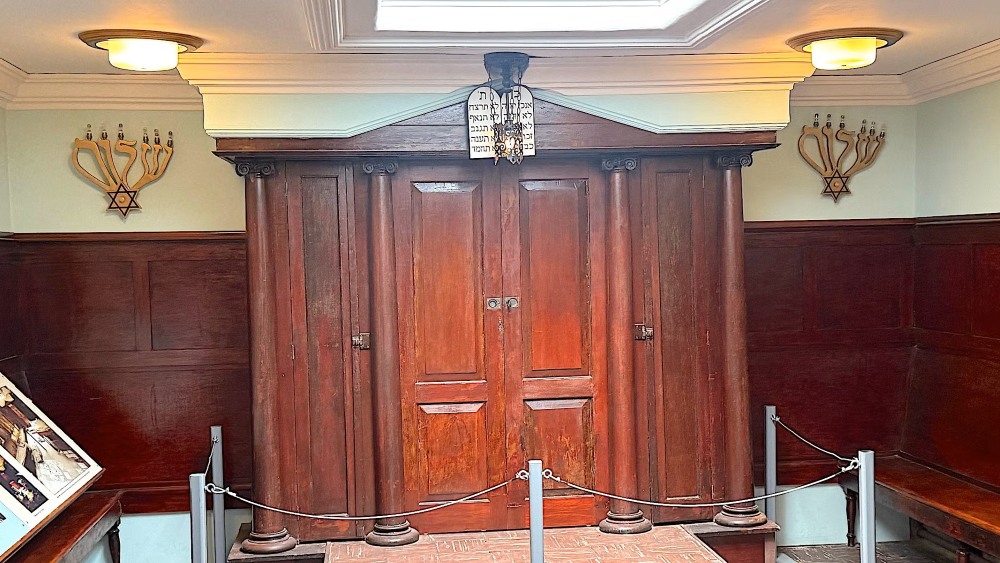
Dedicated in 1929, the Alfred W. Fleischer Memorial Synagogue was the first known Jewish worship space established in an American prison. It was named after a Philadelphia-born real estate tycoon and supporter of the institution who died the year before.
In part, Philly’s Jewish community supported the creation of a shul because of fears that Jewish inmates, who previously prayed in the prison’s hospital, would be converted while inside. Jewish prisoners helped build the synagogue, with some support from Fleischer and others in the outside community. The inmates themselves led a renovation of the synagogue in the 1960s.
The synagogue was unearthed during excavations in 2004 and, following a philanthropic campaign, restored five years later.
Earlier this month, Eastern State debuted a new permanent exhibition called “Freedom through Faith: Judaism at Eastern State and Beyond,” which examines the Jewish history of the institution and the synagogue, as well as the broader history of religious freedom for incarcerated Americans.
The exhibition, the product of more than a year of research, was developed by the independent Philadelphia-based museum consultant Beth Tinker. It’s part of a series of programs for the nation’s 250th anniversary, called “A Time For Liberty.”
The exhibition has an online component as well.
“[Fleischer] pooled his sort of power to really help the Jewish congregation here, and help get architects in. But the congregants themselves also helped to get this built,” Tinker said during a recent visit to the exhibition.
Eastern State was founded on “the idea of rehabilitation through faith and solitary confinement,” she said, although the solitary component was dropped in 1913.
The synagogue, Tinker added, provided a respite from that difficult existence for Jewish prisoners, many of whom landed there not long after immigrating to the United States.
“We really wanted to focus on the congregants and their humanity as people rather than their mug shots and what crimes they had committed,” she said.
The research, Tinker said, unearthed some fascinating stories. One was that of Joseph Paull, a Jewish circus strongman who visited the synagogue as an entertainer in the 1920s and then, like a proto-Johnny Cash, became a supporter and advocate for the prisoners he had met.
“We found all his letters, and that gave us information from prisoners and family members who are writing to him, saying, ‘Hey, can you help me find a job when I come out? Can you help with parole, or do you just need some more kosher meat?’” Tinker said of Paull, who later worked as a butcher.
The exhibit tells stories of Jewish life at the 11-acre prison before the synagogue was built. The Italian-born Rabbi Sabato Morais was the first Jewish chaplain at the prison, starting in 1893. Researching his story, the museum discovered that Rabbi Morais has a descendant who currently works as a prison chaplain in Pennsylvania.
Also, the first bris at the prison took place in the 1850s, after a baby was born to a Jewish woman prisoner.
In addition, the exhibition includes information on case law related to freedom of religion, including for incarcerated people.
“That’s part of what makes it really amazing that there’s a synagogue here in 1922, having High Holidays in 1913, when legally there was no obligation,” Tinker said.
A hulking structure located in what is now a mostly upscale urban neighborhood, Eastern State stood in ruins for many years until restoration efforts began in the 1990s. The museum hosts a haunted house attraction at Halloween time, which serves as a fundraiser.
Its exhibits, especially since 2020, have put greater emphasis on mass incarceration and the inequities of the prison system.
Also playing a part in the exhibition was Josh Perelman, senior advisor for content and strategic projects at Philadelphia’s Weitzman National Museum of American Jewish History.

“‘Freedom Through Faith’ reveals the leading role Eastern State Penitentiary played in establishing religious rights in American prisons,” Perelman said. “Moreover, it demonstrates what becomes possible when the communities inside and outside the prison’s walls — in this case Philadelphia’s Jews — collaborate both during imprisonment and afterward.”
Advising the project, Perelman said, entailed “bringing my expertise in American and American Jewish history to the project and advising how the Eastern State’s story intersects with the broader history of Jewish Americans in Philadelphia and beyond.”
Tinker said the reception has been positive so far, and that despite the rising climate of antisemitism, she’s seen no negative reaction to the exhibition.
“This should not be contentious,” said Tinker, who is not Jewish. “This is a place where we’re finding humanity in a place where it was very hard to find it.”
For information, visit easternstate.org/historic-site/included-with-admission/exhibits/freedom-through-faith-judaism-at-eastern-state-and-beyond.
Stephen Silver wrote this article for the JTA global Jewish media source.
The story is now coming out about three Jewish refugees from Nazi Germany who built Iceland’s classical music scene from scratch.

The history of Jewish Barcelona is fascinating and complex, and a tour of the Jewish Quarter offers a glimpse into the city’s tragic past.

Marc Terrill talks with Jewish Federations of North America President and CEO Eric Fingerhut about the opportunities and challenges he sees from his vantage point as a former congressman, leader of the Ohio State University system, Hillel International and now JFNA.

Part musical festival, part celebration and part networking event, the first Big Tent gathering since 2023 brought together high schoolers from across North America and Israel.