
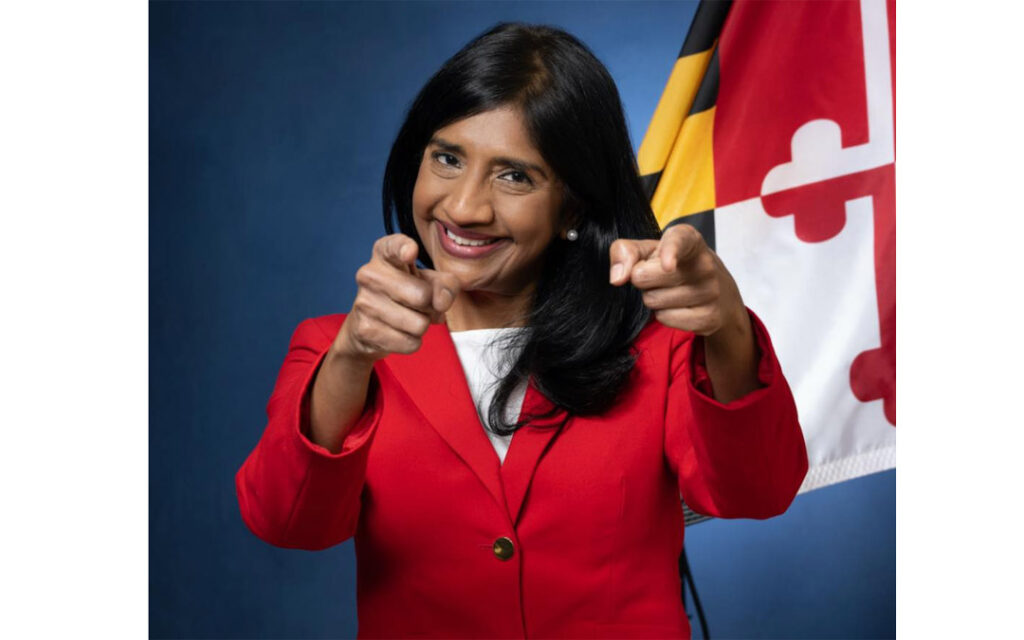
That was a lovely inaugural speech the other day from Gov. Wes Moore. It had passion, it had promise, it had the feel of history in its bones. But the speech that’s staying with me is the one delivered by Aruna Miller, Maryland’s new lieutenant governor.
She made it personal, and she attached it to her American journey. And she introduced a word that’s probably never been used previously in any formal inaugural speech.
The word is “vomit.”
Don’t hold your nose and say it was inappropriate, because it wasn’t. Miller attached it to her earliest moments in America. She’d arrived in Poughkeepsie, N.Y., from her native India. She was 7 years old, and this was her first day of school.
Of her classmates, she told the big inaugural gathering in Annapolis, “None of them looked like me, and I couldn’t speak a word of English. But I wanted to fit in.”
In the school cafeteria, “I was gonna do what everybody else was doing. I ate American food for the first time. I drank cold milk for the first time in my life. I was feeling pretty good.”
Then she walked back to class, where she proceeded to lose everything she’d just ingested – and lost it all over her desk.
“I was mortified,” she told the inaugural crowd. “My teacher called my mom, my mom came and picked me up, and on my way home I told her, ‘I want to go back to Grandma,’ who raised me in India. ‘I hate cold milk, too, Mom.’”
When she got home, though, there was a knock on the door. Standing in the snow, said Miller, was one of her classmates, “with a stack full of paintings in her hand – paintings that had hearts and smiling faces, little faces with tears coming down. And in that moment, I knew I belonged in this great country.
“It took an educator to teach what I believe is one of the most important qualities in a human being – and that is to have empathy and compassion for others.”
What a sweet and unanticipated inaugural message. It’s not only a departure from traditional political speeches, full of empty air and empty promises. It’s a reminder of how America likes to think of itself, full of compassion for the underdog, full of acceptance for the one who doesn’t exactly look like us, or speak like us, or pray like us.
We’ve lost some of that self-identity over recent, mean-spirited years. It took an American lady from India, recalling a frightened little girl, to remind us of the very heart of the American spirit: smiling faces, offered to a stranger.
Michael Olesker’s latest book, “Boogie: Life on A Merry-Go-Round,” was recently published by Apprentice House. It’s the life story of Baltimore legend Leonard “Boogie” Weinglass, an original “Diner” guy who grew up to create the Merry-Go-Round clothing chain and contribute millions to charity.
Commemorations of the Holocaust must transcend the past to include concerns about the present and future, writes Menachem Z. Rosensaft.

Someone needed to tell Donald Trump that his appearance at a UFC fight over the weekend was not a good look, writes Michael Olesker.

Journalists bear a responsibility to go beyond the headlines and social media posts to understand the past and present, writes New York University student Lucia Alonso.
The Trump administration's invoking of religion is reminiscent of the words and actions of one of history's most brutal Crusaders, writes Michael Olesker.