
By Lisa Keys
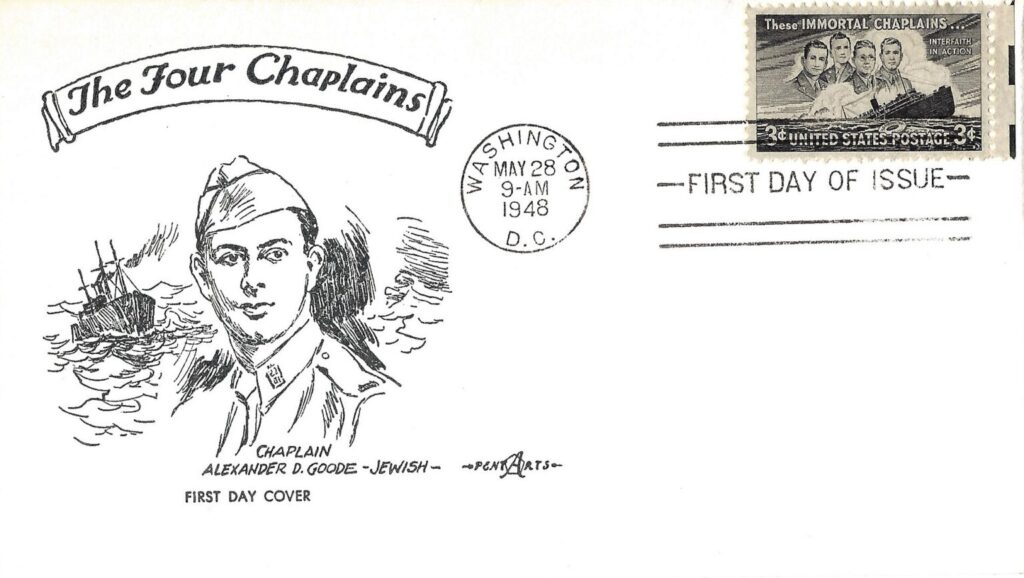
Growing up in Brooklyn, New York, Mark Auerbach was not yet 5 when he noticed an unusual stamp in his father’s dresser. The well-worn three-cent stamp featured a rendering of a group of men and a sinking ship with the words, “The Immortal Chaplains … Interfaith in action.”
“’Our cousin is on that,’” Auerbach recalls his father saying. “’He said he was a rabbi who died during World War II when his boat was torpedoed by the Germans.’ He made me promise to make sure that the story is never forgotten.”
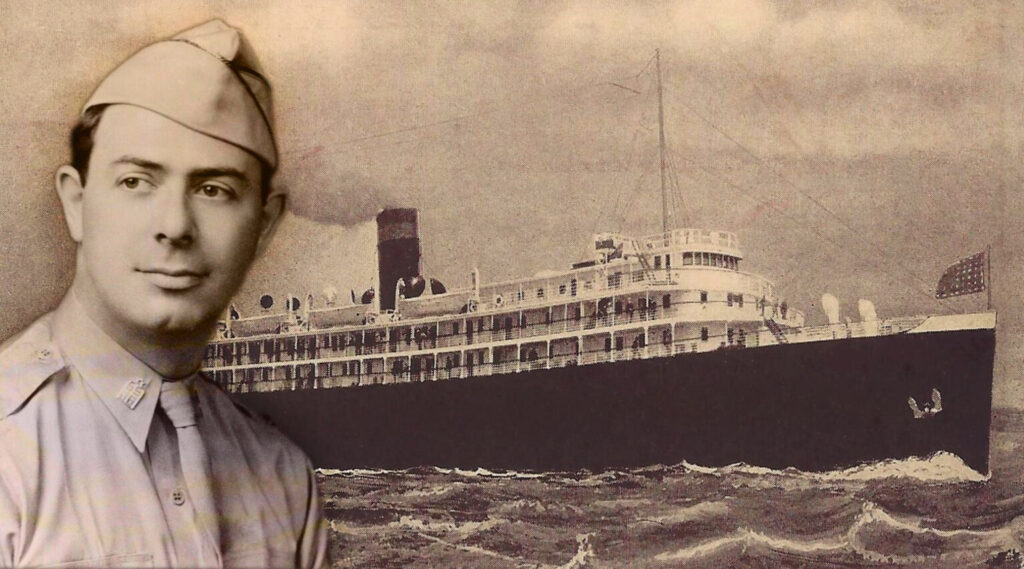
It’s a promise Auerbach, now 75, took to heart. He’s made it his life’s mission to keep alive the story of the “Four Chaplains” — Auerbach’s third cousin, Rabbi Alexander David Goode, 31, Rev. George Lansing Fox, 42, Rev. Clark Vandersall Poling, 32, and Father John Patrick Washington, 34.

Eighty years ago, on Feb. 3, 1943, they made the ultimate sacrifice when their American troop ship, the SS Dorchester, was torpedoed and sunk by a German submarine in the North Atlantic in pre-dawn hours.
Over the decades, Auerbach, a resident of Passaic, New Jersey, amassed a trove of photos, clippings and memorabilia dedicated to the four clergymen, including copies of that three-cent stamp issued in 1948.
“It’s an amazing story,” said Auerbach of the chaplains’ heroism. “It just happens to be my family.”
Act of Selflessness
The sinking of the Dorchester is considered one of the worst sea disasters during World War II. Of the 902 men on board, only 203 survived. As survivors and historians attest, the four clergy — all relatively new soldiers who befriended each another at Army Chaplains School at Harvard University — stood out for their calming presence during the 18 minutes it took for the ship to capsize.
As the tragedy rapidly unfolded, survivors reported the chaplains offered prayers, helped distribute lifejackets and, once those ran out, gave up their own.
“The altruistic action of the four chaplains constitutes one of the purest spiritual and ethical acts a person can make,” reads materials from the Four Chaplains Memorial Foundation, whose mission is “to promote Interfaith Cooperation and Selfless Service,” according to their web site. “When giving their life jackets, Rabbi Goode did not call out for a Jew; Father Washington did not call out for a Catholic; nor did the Reverends Fox and Poling call out for a Protestant. They simply gave their life jackets to the next man in line.”
As the ship went down, survivors saw the four chaplains on deck, linked arm in arm together in prayer. “I could hear men crying, pleading, praying,” said Private William B. Bednar, who was floating among the bodies of his shipmates in the freezing water. “I could also hear the chaplains preaching courage. Their voices were the only thing that kept me going.”
According to Rabbi Dov Peretz Elkins, author of the recently published “Rabbi Alexander Goode: The Story of the Rabbi and His Three Fellow Chaplains Who Went Down with the USAT Dorchester” (Mazo Publishers), the clergy were heard saying their respective prayers as the ship sank: Goode chanted the Shema; Washington the Ave Maria, while Fox and Poling recited The Lord’s Prayer.
Born in Brooklyn in 1911 and raised in Washington D.C., Goode was the son of Rabbi Hyman Goodekowitz. He graduated from the University of Cincinnati in 1934 and Hebrew Union College three years later. In 1940, he earned a Ph.D. in Middle Eastern languages from Johns Hopkins University in Baltimore.
As a rabbi, his first assignment was at a synagogue in Marion, Indiana. In 1937, he transferred to Beth Israel in York, Pennsylvania, where he remained until enlisting in July 1942. (At the time of his death, Goode was married for eight years to Theresa Flax, niece of entertainer Al Jolson, and had a 3-year-old daughter, Rosalie.)
“He excelled in ecumenicalism,” Rabbi Elkins said. “He had a wonderful reputation as a scholar, a beloved rabbi and ecumenical person. … He was an extraordinary person, [in addition to] what he did on the Dorchester.”
In his book, Rabbi Elkins writes, “In his new community, Alex made great efforts to spread interfaith understanding. He presented a regular radio program on religious matters. When one of the local churches burned down, he offered to host the congregation’s religious services.”
Source of Inspiration
During the post-war era, the story of the Four Chaplains was widely known. In addition to laudatory articles and the commemorative stamp — plus assorted memorabilia designed to draw the attention of children — memorials were constructed “in nearly every state,” according to Rabbi Elkins. Stained-glass tributes can be found at the Pentagon, the National Cathedral and elsewhere.
On Dec. 19, 1944, each of the chaplains was posthumously awarded the Purple Heart and the Distinguished Service Cross. In 1998, the 55th anniversary of the Dorchester disaster, Feb. 3 was deemed “Four Chaplains Day” by Congress.
But as the war fades into memory, few people today seem to be familiar with the Four Chaplains. “It’s such an important story, such an inspiring story, it needs to be better known,” said Rabbi Elkins.
Last Sunday, Feb. 5, Auerbach and family members of the chaplains will attend a memorial mass at St. Stephen’s Roman Catholic Church in Kearny, New Jersey, where he’ll also display his collection of photographs and memorabilia.
“The story is so ecumenical that it crosses all kinds of barriers,” Auerbach said. “It’s the ‘Golden Rule’ in reality. Every clergy person worth their salt … is preaching, ‘Be kind to your brother, your sister.’ Everyone talks about it, few know about it. This is something for people to grab onto.”
Lisa Keys wrote this article for the JTA global Jewish news source. Jmore staff contributed to this report.
The BCO, founded in 1984, will perform the works of Frank Zappa, Beethoven, Mason Bates and Karena Ingram.

For more than 130 years, Sol Levinson & Bros. has been woven into the fabric of Baltimore’s Jewish community.


A former college campus activist, Veksler will speak at Chizuk Amuno on June 8 at the Ruth and Jay Lenrow Visiting Scholar-in-Residence for Combating Antisemitism.