
By Rabbi Isaiah Rothstein
Rereading the Book of Exodus this month in synagogue reminds me of when I first learned about Moses’ role in freeing the Children of Israel who had been enslaved to Pharaoh.
I grew up in Monsey, New York. My mother was Black and my father was white; my family identified with the Chabad-Lubavitch movement. I discovered the Passover story through ultra-Orthodox coloring books that depicted the liberation of the ancient Israelites from bondage in Egypt.
One illustration depicted Moses as an 18th-century Chasidic Jew clad in a shtreimel (fur hat) and long kapote (robe), with abundant sidelocks flowing down to his shoulders.
I brought home my masterpiece, fully crayoned in purple, and showed it proudly to my mother. She gave me a puzzled look and said, “You know, Moses didn’t look like this. He had brown skin like mine.”
It was an enlightening idea that hit me like a thunderbolt. Seeing Moses as a Black person changed my whole idea of Jewish history and religion in one fell swoop — it made me feel my Black and Jewish roots even more profoundly, and that I was a descendant of great Jewish and African men and women who founded our tradition.
As time went on, though, and I went “all in” and studied to become a rabbi, I realized that Moses’ skin color mattered much less than his role as a liberator. Although many Jews do see in color, Judaism does not. The way to follow in his footsteps, I grasped, was to become an educator, a leader and a champion for freedom.
I’ve devoted my career to empowering Jewish communities across the continent to become more welcoming and inclusive, to overcome racism and prejudice, and to create a more just, equitable and loving society.
The Biblical narrative of the Exodus is a call to stand for freedom and against tyranny in every generation. It says, in effect, “You are able to speak, and to be carried away on the wings of words from millennia ago, bound to no Pharaoh’s story, but liberated by your own.”
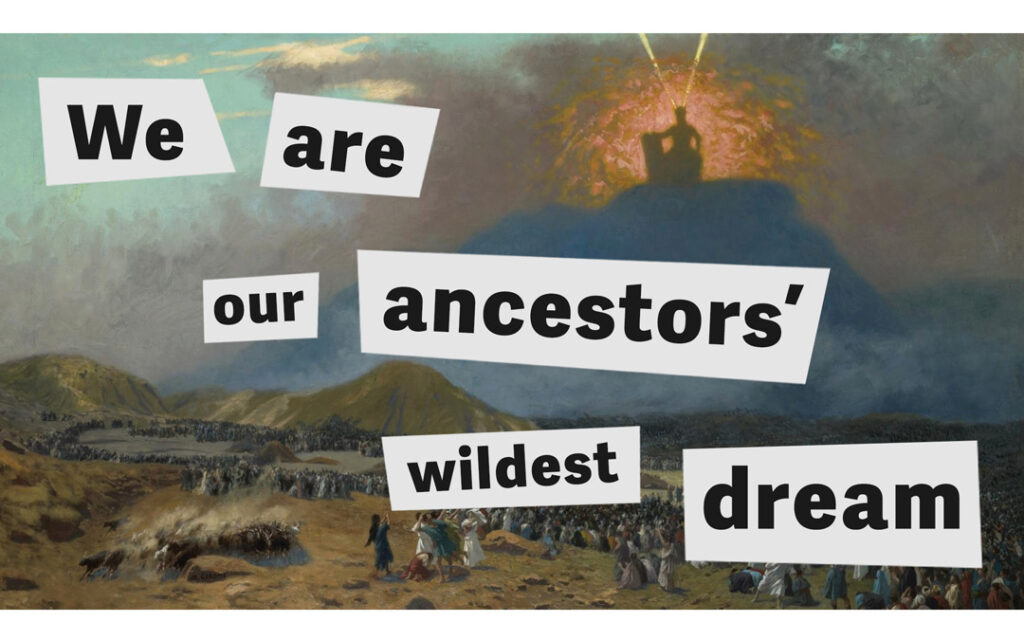
Neither my Black nor Jewish forebears could have imagined how far their descendants would come in terms of participation and even leadership in our society. As the Black visual artist Brandon Odums has reflected, “We are our ancestors’ wildest dreams.”
But there is, alas, still so far to go, as last month’s brutal killing of Tyre Nichols at the hands of the police in Memphis reminds us. Both Black History Month and the Book of Exodus teach that we can only fulfill our destiny if we fight for the liberation of all peoples.
Earlier this month, we celebrated Shabbat Shira, in which we read about the Children of Israel’s miraculous escape from Egypt by crossing the Red Sea. I was reminded of what the late 20th-century Slonimer Rebbe, Rabbi Sholom Noach Berezovsky, said about the ancient Hebrews wading into the water because they had faith not just in their hearts and minds, but in their bodies — in their very bones, he said.
What does it mean to believe with your bones? The Prophet Jeremiah declared that the word of God was like “fire shut up in his bones” (20:9). Dr. Martin Luther King Jr. quoted Jeremiah in his last speech, “I’ve Been to the Mountaintop,” saying, “Somehow the preacher must have a kind of fire shut up in his bones. And whenever injustice is around, he tell it.”
King gave that speech on April 3, 1968 — in Memphis — on the night before he was assassinated.
Early in the speech, King imagined “God’s children in their magnificent trek from the dark dungeons of Egypt through, or rather across, the Red Sea, through the wilderness on toward the Promised Land.”
He concluded with these uncannily prescient words: “I want you to know tonight that we as a people will get to the Promised Land. So, I’m happy tonight, I’m not worried about anything, I’m not fearing any man. Mine eyes have seen the glory of the coming of the Lord.”
Our commitment to creating a better world — making it to the Promised Land — must always be so much more than merely skin deep. Only when we believe in our bones that change is possible, and that we can be agents of that change, will fear melt away and we will be able to defeat the Pharaohs who seek to deprive us of our dignity, whether in Memphis or anywhere in our land.
We shall reach the Promised Land — someday. We shall recognize that we are all God’s children — someday. We shall overcome — someday.
May that day be very soon and may we all unite in joy, peace and celebration to usher it in.
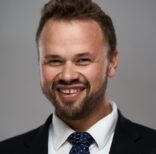
An author and musician based in Brooklyn, New York, Rabbi Isaiah Rothstein is the rabbinic scholar and public affairs advisor for the Jewish Federations of North America.
This article was provided by the JTA global Jewish news source.
Michael Olesker pays tribute to WJZ’s retiring Marty Bass, a longtime fixture on local TV screens.
The Orioles' weak defense plays a major role in the nightly carnage, writes Michael Olesker.

Jmore Publisher Scott Rifkin, M.D., reacts to President Donald Trump's latest poll numbers and the real force behind the growing decline of the Trump movement.

For 35 years, the late Deborah Brodie, aka Bubbie Cookie, amassed a collection of over 200 Jewish ritual objects, which she used to teach her Hebrew school students with special needs.