

By Deborah Danan and Gabe Friedman
At a gathering of faith leaders at Buckingham Palace the day after Queen Elizabeth’s death on Sept. 8, 2022, King Charles pulled aide Britain’s chief rabbi, Sir Ephraim Mirvis.
Because it fell on a Friday, the reception was pushed earlier in the day than originally planned to accommodate Rabbi Mirvis. But the start of Shabbat was quickly approaching. According to Rabbi Nicky Liss of London’s Highgate Synagogue, the king asked Rabbi Mirvis why he was sticking around — didn’t he have to get home by Shabbat?
The protocol, Rabbi Mirvis responded, is that no one is allowed to leave the room before the king does. Charles then promptly told him to go home.
Both men are expected to bring that spirit of mutual respect to Charles’ coronation day on Saturday, May 6, as the new king will include a range of faith leaders who never before have been featured in a royal ceremony of this magnitude.

While much of the ceremony is still rooted in Christian rituals, representatives of Jewish, Muslim, Sikh, Buddhist, Hindu, Jain, Bahai and Zoroastrian communities will be incorporated into the proceedings. In fact, non-Christian faith representatives will enter Westminster Abbey before Anglican clerics.
Jewish, Muslim, Hindu and Sikh members of the House of Lords will hand Charles objects of the royal regalia. And in a notable cross-cultural mash-up, British Prime Minister Rishi Sunak, who is Hindu, will read a passage from St. Paul’s letter to the Colossians, which includes language on the “loving rule of Christ over all people and all things.”
There is one large obstacle for observant Jewish participants and onlookers: The ceremony falls on Shabbat. But Charles has invited Rabbi Mirvis to sleep in his home on Friday night — Clarence House, located a 15-minute walk from Westminster Abbey, the site of the coronation — so he can easily get to the event without using electricity (he will attend an early morning Shabbat service on his way).
And when religious leaders recite a “spoken greeting in unison” to Charles at the end of the ceremony, Rabbi Mirvis will not use a microphone.
While many Orthodox interpretations of Jewish law hold that Jews should not enter churches, London’s top rabbinical court ruled in the 1970s that chief rabbis may do so if their presence is requested by the monarch. Coronations have been held at Westminster Abbey since 1066; the last time one was held on Shabbat was in 1902.
Some Jews around London this week were not pleased about the coronation’s Shabbat timing. And like many other Britons, they were still mourning Queen Elizabeth, Charles’ mother whose 70-year reign guided the kingdom through the second half of the 20th century and the upheaval of the early 21st.
“It’s a shame that we can’t fully participate in it, but we do need to acknowledge that we’re such a minority and I don’t expect them to take us into account,” said Naomi Joseph, who was walking around Golders Green, a heavily Jewish neighborhood, last Tuesday. “But it does make me feel less enthusiastic. It’s like not being invited to a party.”
Said Keren Rechtschaffen, who researches Judeo-English, a local dialect: “The queen’s funeral did feel more poignant than the coronation. People seemed more invested in it. We haven’t had a chance to see how Charles is going to reign, although I’m sure he’s going to be great.”
But many Jewish congregations and families for weeks have been immersed in the royal spirit, which engulfs England in an excited frenzy — and creates a huge market of monarch-themed merchandise. Some congregations will close off the roads near their synagogues to have celebrations on the street. Others will hold ceremonies and services of their own to honor the king, but a week later so their members can watch the coronation live on TV on the actual day.
Musical celebration and tribute is a recurring theme. United Synagogue, the union of British Orthodox synagogues, commissioned a new children’s choir recording of “Adon Olam,” a prayer most recognizable as the conclusion of Shabbat services, and dedicated it to the new monarch.
The Shabbaton Choir, a London-based group that frequently records for radio and television shows, created a new musical version of the Prayer for the Royal Family that is recited by British Jewish congregations every week.
“We’ve waited a long time for this coronation. It’s exciting,” said Sahar Dadon, an Israeli who has lived in London for 20 years and operates a pita restaurant. “We bless the king with shem malchut [of God’s name]. It’s a divine thing.”
He added, “My wife feels it more. She’s English and goes to all the ceremonies. The kids are very excited, too.”
The Jewish connection to the coronation ceremony will get literal, too. The king and the soldiers involved will wear at least some pieces stitched by Kashket & Partners, a Jewish family-owned tailoring company that is the main supplier for Britain’s armed forces.
British politician Gillian Merron, also known as Baroness Merron of Lincoln, a former chief executive of the Board of Deputies of British Jews, will hand Charles the long Imperial Mantle robe, which was first made for George IV in 1821.
“We’ve got our day-to-day business going on, too, but obviously the coronation takes priority over everything else,” Cheryl Kashket of Kashket & Partners told the London Jewish Chronicle. “There is nothing more important than what is going on. It is very exciting, and we realize how fortunate we are to be a part of history.”
Israeli President Isaac Herzog will be in attendance on Saturday, too A kosher caterer will provide food for him and Rabbi Mirvis.
Ivan Binstock, a longtime senior leader for multiple London Jewish communities, said the actual coronation ritual, which involves anointing the new king with oil consecrated in Jerusalem, is especially resonant for the Jewish community.
“The most significant part of the coronation, [which] is shielded from public view, is in fact biblical,” he said, noting that the ritual has its roots in the anointing of high priests in the ancient Temple in Jerusalem. “It’s a source of great pride.”
Deborah Danan and Gabe Friedman wrote this article for the JTA global Jewish news source.
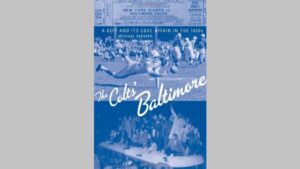
The former Colt, who passed away on May 25 at age 93, achieved immortality during a cold December day in 1958, writes Michael Olesker.

The Jerusalem Orchestra East & West, which arranged the program for young musicians, blends Western orchestral music with Middle Eastern traditions.
The BCO, founded in 1984, will perform the works of Frank Zappa, Beethoven, Mason Bates and Karena Ingram.

For more than 130 years, Sol Levinson & Bros. has been woven into the fabric of Baltimore’s Jewish community.