
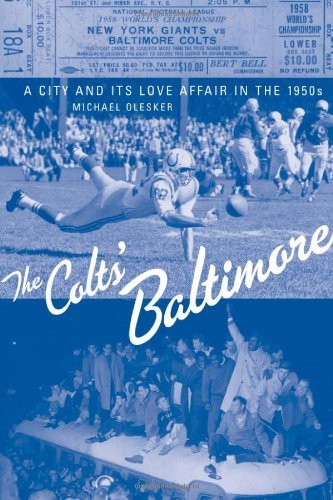
Raymond Berry leaves us, at age 93, and takes with him an entire generation’s memories of Dec. 28, 1958, the day the Colts turned Baltimore from a city with a mass inferiority complex into America’s darlings.
How memorable was it?
Fifty years after that legendary Sudden Death championship game, Berry came to Baltimore and had dinner one evening at Sabatino’s in Little Italy. The restaurant was packed and noisy. One table over, a dozen people sang a loud “Happy Birthday” to a teenage girl.
Then, somebody asked Berry about the final moments of regulation play in the contest that became known as “the Greatest Game Ever Played.”
“We were down to a little more than a minute left to play,” Berry said in his soft Southern drawl.
And suddenly, the whole restaurant seemed to go quiet. In Baltimore, we had long since memorialized that game and its final moments. But here was Berry, who caught a remarkable 12 passes for 178 yards that day, and everybody in the place seemed to strain to hear him.
It was as if Moses himself might have explained how he’d somehow caught those tablets he was lugging into the desert end zone, and nobody wanted to miss a word of his sermon.
How memorable was that day?
At dinner another night, John Unitas and Berry were reliving that moment. The two of them, 60 years after the fact, still couldn’t quite get over it.
“You kept throwing me the ball,” Berry said, sounding awed.
“Well, you kept catching it,” replied Unitas. He sounded typically laconic about it, but his eyes were a little welled up, too.
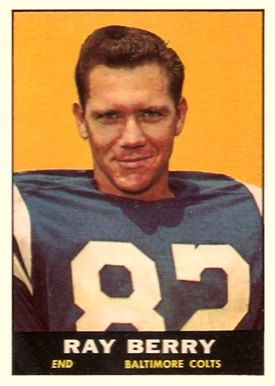
By the time Berry retired from football, he’d caught more passes than anyone in pro football history. The ’58 championship game was just a piece of it.
But, what a piece!
Here was Berry, always regarded as a football freak, nobody’s best bet for stardom, catching pass after pass. He was supposed to be too skinny for pro ball. His vision was so bad, he had trouble reading an eye chart. One leg was shorter than the other.
In a game played by brawny, angry men, Berry always seemed cut from different cloth. In a long-ago conversation, I told Berry that sportswriter John Steadman used to say, “When Raymond was in the room, the other players acted as if a priest had just walked in.”
“Well, then, John didn’t know me very well,” Berry said.
“He meant it as a compliment.”
“Or else,” said Berry, “he never heard me after I dropped a pass in practice. It wasn’t exactly the king’s English, I can tell you that.”
He said it with a hint of pride in his voice, like a schoolboy saying, “Hey, I know some pretty good cuss words, too, don’t you worry.”
“The only thing wrong with Raymond,” Colts Hall of Famer Art Donovan once said, “is he won’t drink. He had a few beers, till Shinnick got hold of him.” Don Shinnick was the linebacker who led team prayers.
“Shinnick told Raymond, ‘Don’t drink that stuff, it’s the devil’s brew.’” Donovan said. “Ah, but I loved Raymond.”
“Everybody did,” said Alan “The Horse” Ameche, who was sitting next to Donovan.
Berry and Unitas were the premier pitch-and-catch pro football duo in the game’s post-war years, setting records that lasted for years. Each wound up in the NFL Hall of Fame.
And that championship game of 1958, with a national TV audience of 60 million people who couldn’t believe what they were watching, was the very heart of their careers.
The game’s impact changed America’s sporting culture overnight from baseball as the longtime national pastime to football as the dominant game.
And there was another night that stirred the memories. Berry was in town for a dinner honoring his old teammate, Lenny Moore. I was working on a book, “The Colts’ Baltimore: A City and Its Love Affair in the 1950s” (Hopkins Press).
Late at night in his hotel room, Berry and I talked about the game and its heartbeat moments. The Colts trailed, 17-14, with under two minutes to play. Unitas threw incomplete two straight plays. On third-and-ten from their own 14-yard, he hit Moore for 11 yards and first down.
With little more than one minute left, Unitas called for a 10-yard square-in to Berry. But when they got to the line of scrimmage, the Giants’ outside linebacker, Harland Svare, who outweighed Berry by 35 pounds, was positioned practically on top of Raymond.
“He was there to knock my head off,” Berry remembered.
But he remembered something else. Months earlier, he and Unitas had discussed what to do facing such a confrontation. With pressure mounting, and Yankee Stadium erupting, Berry looked down the line toward Unitas, who was bent over center.
“The clock’s running, we have no time-outs left, so we can’t talk about it,” Berry said. “And I’m wondering if John remembers that conversation we had a few months earlier.
“I’m looking for John, and he’s looking back at me. And I’m thinking, ‘I hope he remembers what we agreed we’d do in this kind of situation.’ And, turns out, John’s thinking, ‘I wonder if Raymond remembers that conversation we had …’”
They both remembered. Berry ducked under Svare, caught Unitas’ pass and went for 25 yards to midfield.
Then quickly, with time ticking away, two more passes to Berry. With seven seconds left on the clock, Steve Myhra kicked a tying field goal.
In Sudden Death overtime, Unitas hit Berry twice more. Ameche bolted through the Giants’ line for 23 yards. Unitas hit Jim Mutscheller at the Giants’ one-yard line, and then Ameche scored the winning touchdown, 23-17.
There were 30,000 people at the old Friendship Airport when the Colts’ plane arrived that night from New York. Nobody told them to show up, they just did.
It was arguably the greatest moment in all of modern Baltimore sports history. And Raymond Berry was there at the heart of it all.
A former Baltimore Sun columnist and WJZ-TV commentator, Michael Olesker is the author of six books, including “Journeys to the Heart of Baltimore” (Johns Hopkins University Press) and “Michael Olesker’s Baltimore: If You Live Here, You’re Home” (Johns Hopkins University)
A new biography on the creator of "Doonesbury" misses the mark, writes Michael Olesker.
What does it mean to be fully present with each other and the sacred, asks Maryland-born cultural anthropologist Alanna E. Cooper.
As millions mourn the passing of Stephen Colbert from the airwaves, Michael Olesker looks back on the "institution" of late-night TV.

As he gets ready to leave for California, Rabbi Daniel Cotzin Burg looks back on his time in Baltimore and his 10 years writing for Jmore.