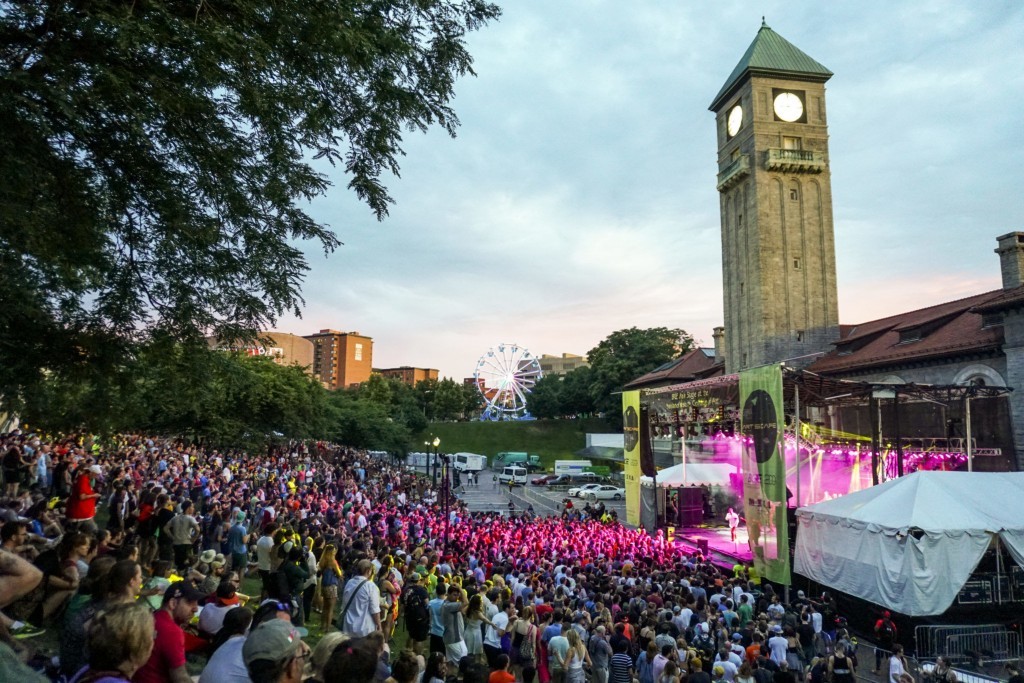
Maybe you noticed the alarm bells going off the other day over this year’s Artscape plans. Four of Baltimore’s prestige institutions decided to worry out loud about plans for this year’s affair, which is always described as America’s biggest free outdoor public arts festival.
It used to be, anyway.
We lost Artscape to COVID for three years, but now it’s scheduled to return in a little over two months. That is, if the people running it get their act together.
But the people who run four of Baltimore’s prestige institutions — which happen to anchor the Artscape area — are worried that this isn’t happening the way it should.
The four are the Baltimore Symphony Orchestra, The Lyric Baltimore, the Maryland Institute College of Art and the University of Baltimore.
With barely two months to go until the festival opens, they declared last week in an open letter to The Sun, “None of us has received a detailed Artscape schedule nor a feasible operational plan,” which is unsettling for an event which has drawn throngs up to 350,000 people over its four-decade run, and takes months of hard work.
The letter expresses alarm about “potentially crippling immediate and long-term impacts.”
As I see it, the potential impact is even greater than the letter indicates.
The city of Baltimore needs a reason to feel good about itself. And the history of our biggest outdoor gatherings has always given us reasons to believe we’re a lot more than the latest homicide statistics, or the latest hints that nobody’s in charge down at City Hall.
We’re a people who want to feel good about living with each other.
Half a century ago, our modern history of these festivals started with the first Baltimore City Fair, a weekend downtown gathering aimed at letting neighborhoods and various civic institutions set up exhibits to show their municipal pride.
“Don’t do it,” said the naysayers. This was 1970. We were still living in the shadow of the 1968 riots. There were widespread warnings that any big downtown gathering would result in renewed racial hostilities.
But there were some, including then-City Council President William Donald Schaefer, and a bunch of people floating around the city’s housing department (Bob Embry, Hope Quackenbush, Bob and Sandy Hillman, Dick Davis) and a newspaper editor named Chris Hartman, who said otherwise.
They said the city needed something to bring it back from the dead.
So what happened? The fair became the emotional centerpiece of the thing we used to call the city’s great renaissance. It went on for 20 years of feel-good weekends.
Hundreds of thousands of people showed up on the first day of the first fair — and, as the city held its breath, a wonderful thing happened. Nature threw in a minor hurricane.
The storm blew over scores of neighborhood exhibits. But instead of killing people’s enthusiasm, it brought them together. Strangers from different parts of town helped each other put their booths back in order.
And in the process, the gestures showed them they had more that bound them together than tore them apart. Instant friendships were created.
That first fair was so powerful that it helped energize years of terrific ethnic festivals around town and brought additional life to the annual Fells Point Festival.
And then, four decades ago, the start of Artscape.
My favorite memory of Artscape? A blistering summer day in 1990 when the sky opened up and brought torrential rain. At Mount Royal and Dolphin, about a dozen Black kids had just begun dancing to music with a Caribbean beat.
The music picked up, and so did the rain. Nobody ran for cover. Within moments, people were coming out of the Mount Royal Tavern and the Maryland Institute and the food tents and crafts booths, and they ringed the dancers in a big circle.
Some of them started dancing with the kids. Dozens of people from every background, a few of them on rollerskates, some in costumes, young and old, and as the rain came down and everybody’s clothes got soaking wet, it looked like a dance troupe composed of all of Western civilization.
At that moment, the rain seemed a kind of metaphor for a city always struggling to find its way, asking its suburban neighbors to love it in spite of its storms, and coaxing its own residents to dance with each other through the tough times.
Those folks running this year’s Artscape had better get their act together. There’s a whole history of such events bringing the best out in the city of Baltimore. And, man, do we need it now.
Michael Olesker’s latest book, “Boogie: Life on A Merry-Go-Round,” was recently published by Apprentice House. It’s the life story of Baltimore legend Leonard “Boogie” Weinglass, an original “Diner” guy who grew up to create the Merry-Go-Round clothing chain and contribute millions to charity.
As millions mourn the passing of Stephen Colbert from the airwaves, Michael Olesker looks back on the "institution" of late-night TV.
The BCO, founded in 1984, will perform the works of Frank Zappa, Beethoven, Mason Bates and Karena Ingram.
As he gets ready to leave for California, Rabbi Daniel Cotzin Burg looks back on his time in Baltimore and his 10 years writing for Jmore.