
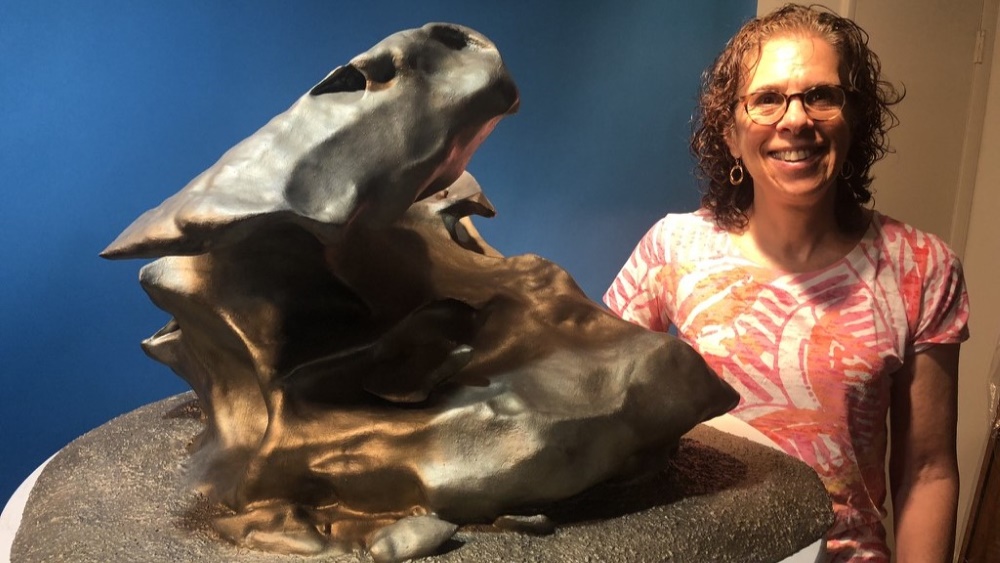
Over the past decade, Helen Glazer has photographed everything from cloud formations over Baltimore to glaciers in Antarctica, and from trees in Los Angeles to civilization encroaching upon nature in Greenland.
A 68-year-old Owings Mills resident, Glazer’s artistic journey has taken her all over the planet, and from drawing and painting to photography and sculpture. “Art helps build awareness,” she says.
A native of the Bronx, New York, Glazer has a master’s degree in fine arts from the Maryland Institute College of Art. She also has a bachelor’s degree from Yale University.
Jmore recently caught up with Glazer, who has worked as an independent artist since her 20s and whose work has been exhibited at Goucher College, the Maryland Art Place and the Nevada Museum of Art.
Jmore: Are you interested in images from nature simply for their own sake or is there more than that?
Glazer: A larger theme of all my projects over the past 20 years or so has been the search for a deeper understanding of what natural forms tell us about the particular conditions of the moment. Jacques Cousteau showed us coral reefs and whales, and suddenly we cared. ‘This is beautiful,’ we said. ‘This is fragile, we have to protect it.’
Art makes the world more real to people, the beauty, the change over time. We get facts from reading, but pictures feel so much more real. We understand them in a way we often don’t with words. Photographs can show various interactions. Changes in Antarctica aren’t obvious from the pictures, but we can see the variety of forms that ice can take in response to natural forces. By contrast, changes in the Arctic as a result of climate change are absolutely apparent.
What drew you to Antarctica?
I’m drawn to natural formations as subject matter for my art — fractal forms that repeat on different scales; clouds, rivers and so much more that are visual manifestations of fluid dynamics. I wondered what accounted for the consistencies in some cases and the variations in others.
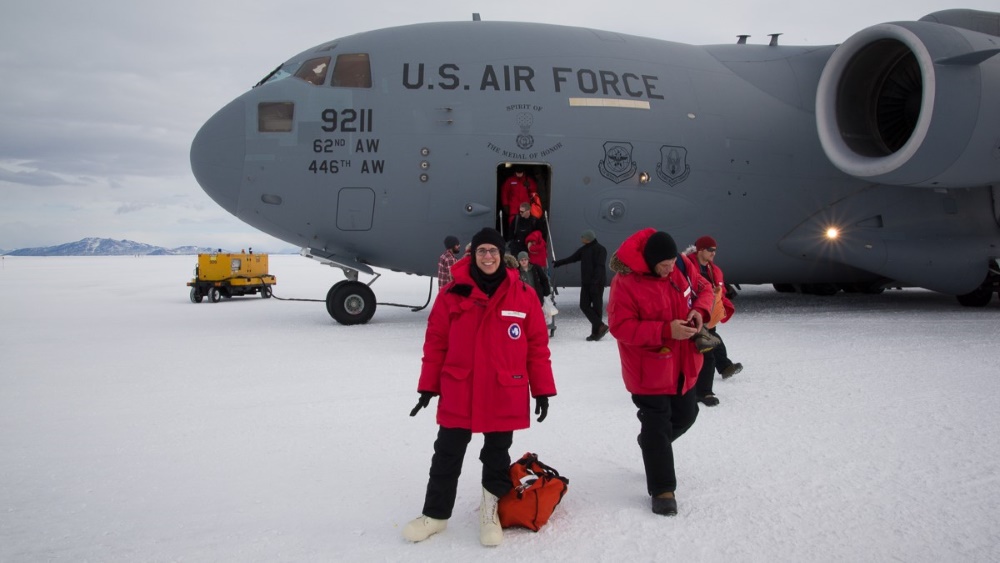
So I started reading about those things. Nothing very technical; more the NPR ‘Science Friday’ versions. And I saw how formations exist within systems: forces interacting, creating predictable patterns.
I was hand-coloring photographs of clouds to show the movement. Then, several years ago, I saw some pictures of Antarctica and recognized those same forms and movement patterns. I knew I had to go there and try to capture them. When I was preparing to apply to the National Science Foundation for a grant to take photographs and create photo-based sculptures of Antarctica, I needed to show I could do what I said I wanted to do.
How did you demonstrate that?
That winter whenever it snowed, I drove around Owings Mills and Pikesville looking for interesting snow forms. I finally found what I was looking for in the Franklin Middle School parking lot. I took several pictures of a snow pile, snowplow tread marks and all, with my 2D camera. What I wanted to do was create a 3D version of it, which I did using photogrammetry program called Modo. Then, I needed to figure out the back and the bottom of what would be the final 3D image. The software didn’t deal with that. I finally Skyped with some frizzy white-haired guy in Germany who came up with a solution.
How do you decide what tools to use?
I’m always looking for the right tools to achieve my artistic goal. As an artist, I ask myself, ‘How can I solve this problem?’ I took a computer programming course in college in the early ‘70s, so I’m certainly not afraid of digital technology but neither am I enamored of it.
Part of the Antarctica and Greenland trips was knowing I’d be carrying a 25-pound backpack full of camera equipment for fairly long distances, often up hills. So I started working with a trainer to increase my strength and stamina, and managed just fine.
In the case of Antarctica and Greenland, two of the tools I needed were pretty sophisticated computer-imaging technology, and also the capabilities of my body. To me, it’s all the same.
What are you working on now?
Greenland. Everyone in Greenland lives on the coast. Virtually no one lives inland on the ice cap, which is essentially a non-moving glacier. I was there in 2018. You’re driving past a golf course, through gorgeous, grassy hills, and then 19 miles in, the road just ends at the ice cap.

That boundary is a place where you can actually see climate change happening. You can see the differences, comparing pictures from 25 to 50 years ago and now. I’m fascinated by ways that interacting forces affect ecosystems and shape landscapes, as well as the impact of human activity and decisions on those ecosystems.
I thought, ‘This would be a really cool photo project,’ and got a grant to go back in 2020. Then, COVID happened. When Greenland reopened in 2021, I went for a month. I met the director of the museum in the village of Kangerlussuaq, and we got a grant from the U.S. Embassy in Copenhagen to create a photographic exhibit that opens this fall. It juxtaposes archival and new photographs of the same subjects, showing changes that have taken place to the ice and overall environment.
Where do your courage and confidence to try new things come from?
I like to be on the growing edge, and if it’s an exciting place to be, even if I don’t know if I can do it, I want to see if I can pull it off. I would always rather try it and find out it didn’t work than 10 or 20 years later look back and say, ‘I didn’t even try.’
For information, visit helenglazer.com.
Jonathan Shorr is a local freelance writer
One of the most competitive local races for public office this political season is for Baltimore County Executive. Jmore recently spoke with four of the candidates about their views on how they hope to enhance life in the county.
The Pikesville resident's latest offering "There's a Dragon in the Tree House and He Won't Come out!" was co-written with her grandsons.
A new biography captures the intensity and magic of the musical theater giant, writes Michael Olesker.
A native of Poland who lived in Baltimore since 2010, Pancerman passed away a day after her birthday.