

By Jon Kalish
A little-known chapter of local history of a Jewish-born immigrant in East Baltimore who encouraged Jews to convert to Christianity serves as the unlikely jumping-off point for a new Yiddish-language play on off-off Broadway.
“The Gospel According to Chaim (Di Psure Loyt Khaim)” is based on the life of Christian missionary Chaim “Henry” Einspruch, who was born into a Sanzer Chasidic family in the Polish city of Tarnow, studied in yeshivot and “found” Christianity before immigrating to the United States in 1913. He became a pioneering figure in the Hebrew-Christian, or Messianic Judaism, movement.
The world premiere was held last Sunday night, Dec. 24, at Theater for the New City , at 155 First Avenue in Manhattan’s East Village. There will be a total of 21 performances through Sunday, Jan. 7, at Theater for the New City, an award-winning theatrical complex founded in 1971 and known for radical political plays and community commitment.
In 1920, Einspruch relocated to Baltimore to study at Johns Hopkins University. Three years later, he founded the Salem Hebrew Lutheran Mission at the intersection of South Caroline and East Baltimore streets, not far from what became known by locals as “Jewtown” and later “Corned Beef Row.”
The church building’s red-brick facade still features an inlaid Star of David with a monogram of the Greek letters iota eta sigma (IHS), a contracted version of Jesus’ name.
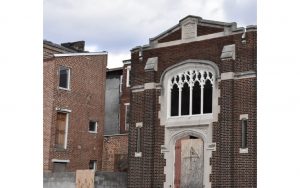
On Saturdays, Einspruch was known to regularly stand on a soapbox in front of various East Baltimore shuls and proselytize, delivering Christian sermons in Yiddish and drawing the ire of observant Jews leaving Shabbat services.
Einspruch, who died in 1977 at the age of 84, eventually founded the now Clarksville, Md.-based Lederer/Messianic Jewish Publishers & Resources, which became the largest publisher of Messianic literature in the world.
Most famously, Einspruch translated the New Testament into Yiddish and self-published “Der Bris Khodeshe” in East Baltimore in 1941 after a local Yiddish print shop turned down the job.
A production of the New Yiddish Rep, a New York-based theater company dedicated to the preservation of Yiddish-language theater, “The Gospel According to Chaim” is billed as the first new, full-length Yiddish drama written in the United States in seven decades.
According to David Mandelbaum, the company’s artistic director, the last original Yiddish drama in this country was written in the 1950s by famed Yiddish writer Leivick Halpern, author of the dramatic poem “The Golem.”
“The Gospel According to Chaim” is also the first full-length Yiddish play by Mikhl Yashinsky, a 33-year-old New Yorker who has made a name for himself as a Yiddish writer, actor, teacher and translator.
A Singular Individual
In 2016, Yashinsky stumbled on Einspruch’s story while serving as a fellow at the National Yiddish Book Center in Amherst, Massachusetts. Fellows are required to conduct tours of the center, and Yashinsky become familiar with the Yiddish printing type donated by Einspruch’s widow Marie to the institution, which is on display in a recreated but non-functional Yiddish print shop. Some of Einspruch’s printing type will be used as props in the play.
“It got me thinking about the irony inherent in this singular individual,” Yashinsky said. “He was a Christian who believed in the divinity of Jesus but was also a very proud Jew culturally. It made me want to look further into this person.”
Yashinsky wrote the first act of “The Gospel According to Chaim” while living n Amherst. He completed the play in 2020 in Charleston, South Carolina, where he lived for a time during the pandemic before returning to New York more than a year ago.
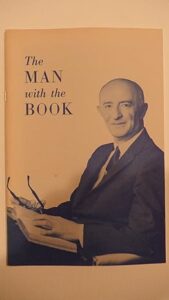
In addition to his translation of the New Testament, Einspruch translated 100 Christian hymns into Yiddish in a collection titled “Hymns of Faith (Lider fun Gloybn).”
Many Jews view efforts to encourage Jews to embrace Christianity as offensive and even antisemitic, with Jews for Jesus and other contemporary Messianic movements drawing particular scorn. But Yashinsky said he felt none of that emotion while striving to bring Einspruch to life.
“I wasn’t interested in just portraying him as a villain and having the play be a piece of propaganda against missionaries,” Yashinsky said. “I really tried to understand why he was doing it. I don’t think Einspruch felt he was being malevolent in anything he did.”
Interestingly, Einspruch never formally converted to Christianity, “deeming his allegiance to evangelical Lutheranism a true fulfillment of his Judaism rather than apostasy or betrayal,” writes Naomi Seidman, a Yiddish and Hebrew scholar and humanities professor at the University of Toronto, whose scholarly article on Yiddish translations of the New Testament was published in 2018 in the Berkeley Journal of Religion and Theology.
After Einspruch immigrated to the United States, he earned a doctor of divinity degree at Gettysburg College in Pennsylvania. “His native language was Yiddish and he enjoyed Yiddish literature,” Yashinsky said. “His innovation was writing [a New Testament translation] in a truly refined, literary, poetic, idiomatic Yiddish. It reads beautifully.”
Yashinsky plays Einspruch in the production, but that was not his original intent. A would-be actor who grew up as a Lubavitcher was in rehearsals to play Einspruch in a reading conducted last March but wasn’t up to the task, Yashinsky said. So the playwright decided to take the part himself.
“The role felt good to me,” he said.
The other two characters in the play are Gabe, a printer Einspruch approaches to print the Yiddish New Testament, and Sadie, a friend of Gabe’s and an anti-fascist activist alerting Jews about the atrocities of the Holocaust.
During the course of the play, Sadie, whose own father converted to Christianity, urges Gabe to turn down the New Testament job. But Gabe needs the business, even though he is reflexively repulsed by the idea of Jews converting to Christianity.
The role of Gabe will be shared by actors Sruli Rosenberg and Joshua Horowitz. Rosenberg, 30, grew up as a Satmar Chasid in Brooklyn and now lives in Monsey, New York. He describes himself as “reformed Chasidische” and said most of the time he doesn’t he doesn’t wear a kippah but continues to observe Shabbat — meaning that Horowitz will play the printer during the sabbath.

Sadie is played by New York-based actress, writer, producer and podcaster Melissa Weisz. In the play, Sadie asks Einspruch on Christmas, “And what are you going to give him as a gift, your messiah, huh? It’s his birthday after all. Maybe a barrel of Jewish blood? A fitting gift. Maybe the extermination of another shtetl of Jews in Europe? His followers have been giving him such gifts for thousands of years, and it seems he never gets tired of it.”
Weisz also grew up as a Satmar Chasid in Borough Park, New York, and made her acting debut in 2010 playing Juliet in the feature film “Romeo and Juliet in Yiddish,” which set the Shakespearean tale in Chasidic Brooklyn. She also had one of the leads in a 2016 New Yiddish Rep production of “God of Vengeance,” the 1906 play by Yiddish writer Sholem Asch that explores religious hypocrisy, prostitution and lesbianism.
Of the link between Sadie and Einspruch, Weisz said, “These two characters come from very different places, but they’re both trying to figure out how to save people.”
Starting a Renaissance?
Despite the production’s niche topic and language, Yashinsky said he sees a wide audience for “The Gospel According to Chaim.”
“Many will come who are attracted to Yiddish and to the various dramas and emotions and curious personalities that are part of its tumultuous 20th-century history,” he said. “But I hope anyone also comes who may have ever wondered about the entanglements of opposing religions, the holiday wars in America, the confluence of ethnicity and faith and identity and human ambition.”
The recent Yiddish-language version of “Fiddler on the Roof” — which had a revival last year after an initial run interrupted by the pandemic — introduced mainstream audiences to “supertitles,” English-language translations projected behind the actors. Supertitles will be used for “The Gospel According to Chaim,” but Yashinsky said even people who do not speak or understand Yiddish will benefit from hearing the mamaloshen on stage.
“The language should not hold anyone back,” he said. “On the contrary, I hope it draws them in.”
Well aware of the Yiddish music revival that’s going strong in New York and abroad, New Yiddish Rep’s David Mandelbaum conceded that Yiddish theater itself has not yet enjoyed that same kind of renaissance.
“If Yiddish theater is to really have a life, then it is essential that there be people who are going to write Yiddish plays,” he said “Yiddish theater ought to be more than re-staging things from the past. We need to have young Yiddish writers writing plays. … May there be many Yashinskys.”
For information about “The Gospel According to Chaim,” visit theaterforthenewcity.net/.
Jon Kalish wrote this article for the New York Jewish Week. It originally ran in that publication and was provided by the JTA global Jewish news source.
Jmore Editor-in-Chief Alan Feiler contributed to this report.

A Baltimore native, Sweren was a collector of artists' books whose own works were displayed in national galleries.

The BCO, founded in 1984, will perform the works of Frank Zappa, Beethoven, Mason Bates and Karena Ingram.

For more than 130 years, Sol Levinson & Bros. has been woven into the fabric of Baltimore’s Jewish community.

Led by local Israel-American cellist Amit Peled, the Mount Vernon Virtuosi aims to inspire people beyond musical enjoyment.