

By Vered Guttman
Looking for a Shabbat dinner centerpiece or a hearty midweek meal? Picture cubes of eggplant, zucchini, bell peppers, tomatoes and potatoes cooked together to create that special harmony only veggies that grew together in the sun achieve. You’re thinking of ratatouille, right? But what I have in mind is a heartier dish from Romania and Bulgaria called ghiveci or guvech.
Romanian ghiveci and Bulgarian guvech are indeed very similar to the famous ratatouille, but being peasant’s food, they’re more rustic and substantial. The veggies for guvech are cut into large, uneven chunks, and can be cooked all together at once, while for ratatouille, each component is fried separately before they are combined. This makes guvech preparation much easier, and allows for creative improvisations; you can easily add any vegetables in season. Besides the mandatory eggplant, zucchini, peppers, tomatoes and potatoes, green beans or okra are common. Guvech is seasoned very simply with salt, black pepper and occasionally paprika, to let the produce shine. The Bulgarian version is cooked with fatty meat, while most Romanian versions are vegan.
“In Bulgaria, guvech used to be cooked in a clay pot called gyuveche,” Etti Ben Yosef, a Bulgarian Jew who lives in Israel, told me. “The stew was cooked in the oven for many hours at low temperature.”
But these days, when Ben Yosef makes guvech for Shabbat dinner, she uses a pressure cooker to precook the beef short ribs before adding them to the vegetables. Then, she cooks the entire stew on the stove for a long time, putting it in the oven for the final hour to give it a nice crust. She feels lucky to share the recipe with her adult children. “I keep the tradition so the kids will remember,” she said.
Guvech’s origins can be traced to the Ottoman Empire that ruled the Balkan region for hundreds of years. The original Turkish dish, called güveç, is cooked in a wide, clay dish by the same name. It’s very similar to the Bulgarian guvech and includes chicken, lamb or beef. There are many other variations of the dish throughout the Balkans. Bosnian Duvec or djuvec is the name of a clay pot as well as a veggie casserole that’s cooked with rice; Greek giouvetsi is also cooked with rice. In Romania, the eggplant-tomato version is considered summer ghiveci, while winter ghiveci is prepared with carrots, cabbage, cauliflower and mushrooms.
Bulgarian Sephardi Jews and Romanian Ashkenazi Jews brought guvech to Israel (where it’s pronounced “ghe-vech”) and made the dish widely popular. No wonder, given that eggplant and tomatoes are so beloved in Israel and are of such high quality. Early Israeli versions can be found in Molly Bar David’s “Folkloric Cookbook” from 1964. The first version includes 14 different vegetables (including celery root and cauliflower) and meat. The second version is for Romanian ghiveci that’s baked with a whole fish on top.
The vegetarian Romanian version is probably most common in Israel nowadays. And although it is traditionally served over rice, I like to serve it on another Romanian staple, mamaliga. It’s the definition of comfort food.
This recipe is the Bulgarian version of guvech that includes meat. You can make the recipe vegetarian by simply omitting the meat. The rest of the ingredients and instructions stay the same.
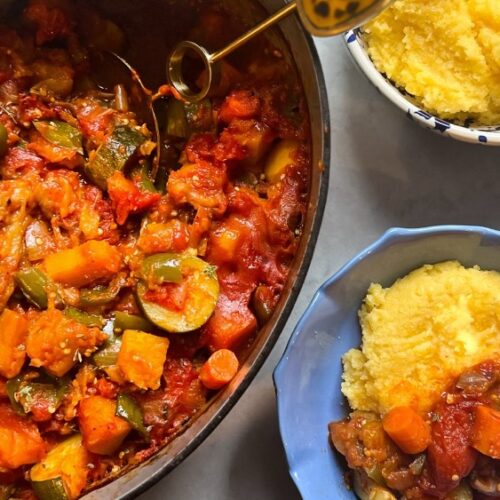
Guvech (Balkan Vegetable Stew)

Ingredients
For the meat (optional):
- 2 lb boneless beef short ribs, shoulder or stew meat
- kosher salt
- freshly ground black pepper
- 1 Tablespoon olive oil
- 6 cups water
- 2 bay leaves
For the vegetable stew:
- 2 eggplants
- kosher salt
- 1/4 cup olive oil
- 1 yellow onion, chopped to 1/4 inch dice
- 2 Tablespoons tomato paste
- 2 red or green peppers, seeded and sliced
- 3 carrots, peeled and cut into 1/2-inch rounds
- 3 Yukon Gold potatoes, peeled and cut into ½-inch dice
- 2 zucchini, cut into 1/2-inch rounds
- 4 garlic cloves, sliced
- 1 (28 oz) can whole tomatoes
- 1 teaspoon paprika, or to taste
- freshly ground black pepper
- cooked rice, for serving (optional)
Instructions
- Start by cooking the meat, if using. Cut beef into 1-inch cubes and sprinkle generously with salt and pepper. Heat 1 Tbsp oil in a medium pot over medium-high heat and brown beef cubes on all sides, about 6 minutes total. Add water to cover (about 6 cups) and bring to boil. Use a large spoon to skim off any foam. Add bay leaves, reduce heat to low, cover pot and cook for 1½ hours. Set aside.
- Peel eggplant, cut into quarters lengthwise and then to ¾-inch pieces. Put in a colander and salt generously. Let stand for 30 minutes and up to 2 hours, then wash with cold water and pat dry.
- Heat a large, heavy bottomed pot (preferably ovenproof, since it’s nice to finish the dish in the oven) over medium-high heat. Add ¼ cup olive oil and onion, and sauté until the onion is transparent. Add eggplant and cook for another 8 minutes, stirring occasionally. Add tomato paste and cook for 1 minute longer.
- Now add the rest of the vegetables you’re using and stir gently. Add the cooked beef and mix it in very gently.
- Roughly chop the canned tomatoes (you can do it with a large knife inside the can) and add to the pot together with their liquid. Add paprika, 2 tsp salt, and ground black pepper to taste. Stir, bring to boil, reduce the heat to low, cover and cook for 1½ hours, or until the veggies are very tender.
- Check the stew after about 15 minutes to see that the vegetables have released enough liquid. You want to have enough liquid to reach about ¼ of the way up the vegetables. The stew does not need to be very wet, but you don’t want the veggies to burn either. If the liquid does not reach the desired height, add a little boiling water.
- This step is optional, but adds an extra layer of taste: After the stew has cooked on the stove for 45 minutes, preheat your oven to 375°F. After an hour on the stove top, remove the lid from the pot, add salt to taste, transfer to the oven and cook for 1 extra hour uncovered, to create a nice crust.
- Serve guvech hot or warm, with rice (optional).
Notes
For more articles like this, visit MyJewishLearning.com/The-Nosher/

Stuffed vegetables invite creativity, but there are some "rules" when it comes to cooking. Vered Guttman shares six veggie-stuffing tips.

On this episode of "The Food Enthusiast," Dara Bunjon talks with Anne-Marie Bonneau, author of "The Zero-Waste Chef."
This roasted eggplant recipe from Elite Jakob is easy, quick and delicious, perfect as a side dish, for brunch or next to fish or chicken or meat dishes.

Dara Bunjon talks with wine aficionado Zena Polin, proprietor of Beauty Champagne and Sugar Boutique and co-host of the "When You Just Want a Glass of Wine" podcast.