
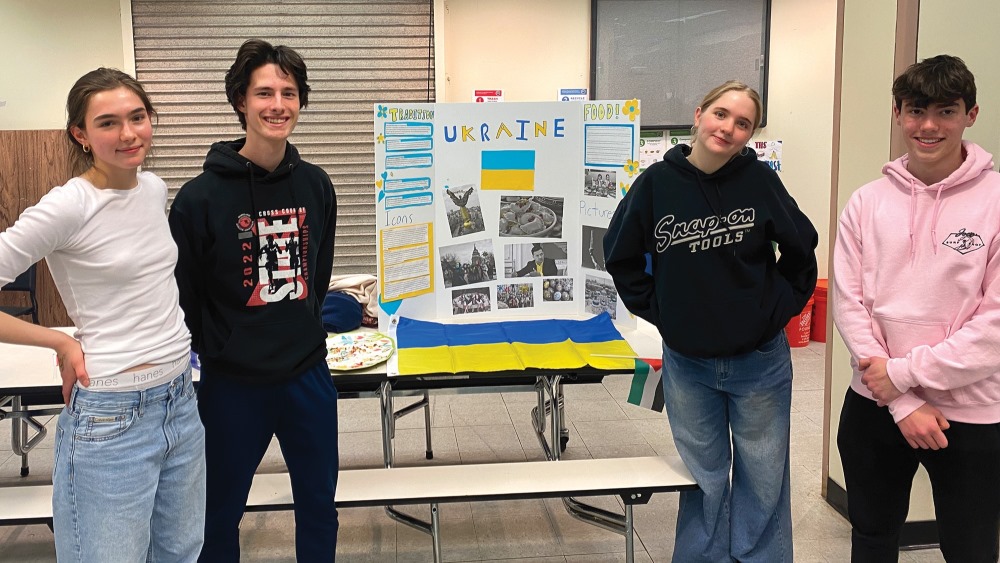
How do four American high school students turn a few hours of their precious personal time into more than $1,000 for an important cause?
The Ukrainian Outreach Club at Towson High School is dedicated to helping those displaced by the Russian-Ukrainian war, while simultaneously emphasizing Ukraine’s unique cultural identity to students.
At the beginning of this school year, a group of Towson students created the UOC after Oliver Holman-Nall, one of the group’s co-presidents, reached out to me over the summer asking if I wanted to start the club.
“Every day, I would read articles detailing the merciless missile strikes on civilian and military targets alike by Russia, and the constant war crimes perpetrated by Russia in occupied towns,” said Oliver. “By the time the late summer came along and the counteroffensive had largely stagnated, I knew I wanted to help out somehow.”
At the UOC, we host fundraisers to generate donations for organizations that support Ukrainian refugees. But as a new club, it was difficult at the start of the school year to know where to begin organizing a fundraiser. So our co-president, Camille Bull, took the initiative and communicated with Atwater’s Belvedere Square Market, where she works, to set up an event. The process of setting up a fundraiser was difficult due to the lack of precedent on which to base the event. We never expected to make more than a few hundred dollars.
However, due to our commitment to publicizing the fundraiser around the school, many people showed up to show their support.
“Many people not only asked for more information about the conflict in Ukraine but mentioned how proud they were that something — no matter how seemingly small — was being done to help those affected,” said Camille. “There were many smiles, mine included, that appeared when customers were checking out. … Having friends and family show up made me confident that a difference was being made.”
For our first fundraiser, we decided we wanted to direct our donations to the Jewish Community Center in the Polish city of Kraków. I volunteered there last summer for a month, packaging food items and making sandwiches for Ukrainian refugees, and I saw how the JCC put donations to good use. Through their variety of programs, the JCC has assisted and supported more than 300,000 Ukrainians, Jewish and non-Jewish, with operations in Kraków and within Ukraine.
As a high school student who isn’t Jewish, I was nervous I would feel a bit isolated during the month I volunteered at the JCC. But everyone there made me feel extremely welcome and supported.
During my time there, I learned that Jewish culture focuses heavily on inclusion, helping others and unity. I knew that by giving our donations to the JCC, we would not only help provide refugees with the materials they need but also help provide them with a place and culture where they can feel like they belong after losing their homes.
Jack Blanchfield, co-president of UOC, offered this advice to people wanting to help: “It’s important that they should start by finding people who have the same goals as themselves. Having even a few friends can greatly increase the impact of what you are doing.”
As the year progresses, Camille hopes our club can continue to grow and thrive.
“I hope to possibly see the club’s impact more directly [and] see where the money goes and who it helps,” she said.
For information about the Ukrainian Appeal at the JCC in Krakow, visit friendsofjcckrakow.org/ukraine.
Isabel Reed is Jmore’s editorial staff intern.

Israeli-Americans Rachel Goldberg-Polin and Jon Polin talked about the pain of losing their 23-year-old son, who was kidnapped and later murdered in the Oct. 7th tragedy.

A committed philanthropist and community leader, Russel was president of R&H Motors.
The mother of four was a native of Winchester, Virginia, who spent most of her life in Northwest Baltimore.

The Columbia resident worked on the Gemini and Apollo space missions.