
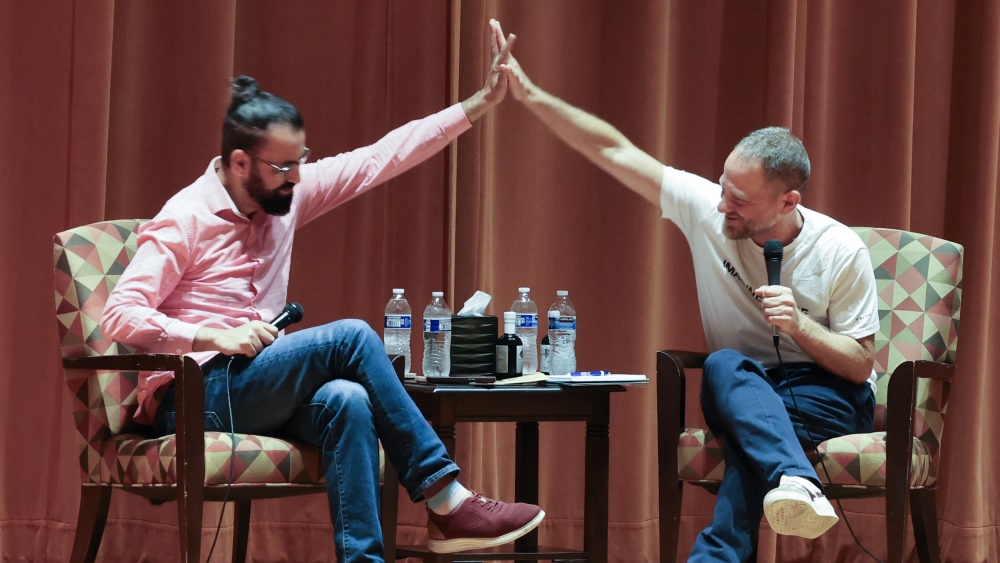
One morning while driving through Jerusalem years ago, Aziz Abu Sarah noticed traffic had come to a standstill. Motorists stepped out of their vehicles and stood at attention while an air raid siren blared.
A Palestinian living in East Jerusalem, Abu Sarah didn’t know what was happening.
“It was terrifying. I thought we were being attacked by aliens,” he recalled. “No one was talking at all.”
Abu Sarah later learned this was an annual Israeli custom on Holocaust Remembrance Day. But the episode demonstrated to him how little Palestinians and Israelis know about each other.
“There’s a lack of communication and a lot of misinformation,” he said. “That’s what fuels this conflict. We build this idea of ‘the other’ when it’s not accurate.”
Abu Sarah spoke Sunday morning, July 14, with Maoz Inon, his Israeli friend and fellow peace activist, at Baltimore Hebrew Congregation.
The program, which attracted approximately 300 audience members, was presented by BHC, the Baltimore Jewish Council, Beth El Congregation, Bolton Street Synagogue, Chizuk Amuno Congregation, Har Sinai-Oheb Shalom Congregation and the Institute for Islamic-Christian-Jewish Studies.
Both Abu Sarah and Inon spoke about the personal pain they have suffered during the Middle East conflict. While Inon’s parents were killed by Hamas on Oct. 7 in their home in the southern Israeli moshav of Netiv HaAsarah, Abu Sarah’s brother died from internal injuries after released from an Israeli prison during the Second Intifada.
“I lost my brother when I was 10 and he was 19,” said Abu Sarah, now 44. “I was devastated. For the next eight years, the only thing that mattered to me was revenge.”
Taking a Hebrew immersion class and meeting Jews there changed his perspective.
“I realized I have the ability to make my own choices,” Abu Sarah said. “By choosing hate, I was taking the path of my brother’s killers. Since then, I’ve worked to bring down those barriers.”
An Israeli tourism entrepreneur, Inon, 49, also advocates for reconciliation and forgiveness.
“I never dreamed my parents would pay the ultimate price,” he said. “But I was so overwhelmed and touched by Palestinians who reached out to me and understood my pain. I wanted to recognize their pain, too. That’s our only way of moving forward.”
In recent months, Abu Sarah and Inon have spoken at conferences and religious institutions throughout the world about their blueprint for peace. They also spoke on a TED talk and met with Pope Francis last May.
Their plan is to have a blueprint developed by peacemakers and various institutions next year and to have it in effect by 2030.
“We need to grow our movement as quickly as possible,” said Inon. “My father always said, ‘We cannot predict the future, but we can change it.’ We must all work together to create a shared society. We have a dream and need to build a coalition.”
Abu Sarah described the last 10 months in Israel and Gaza as “a never-ending nightmare” where he has lost many friends and associates on both sides of the conflict.
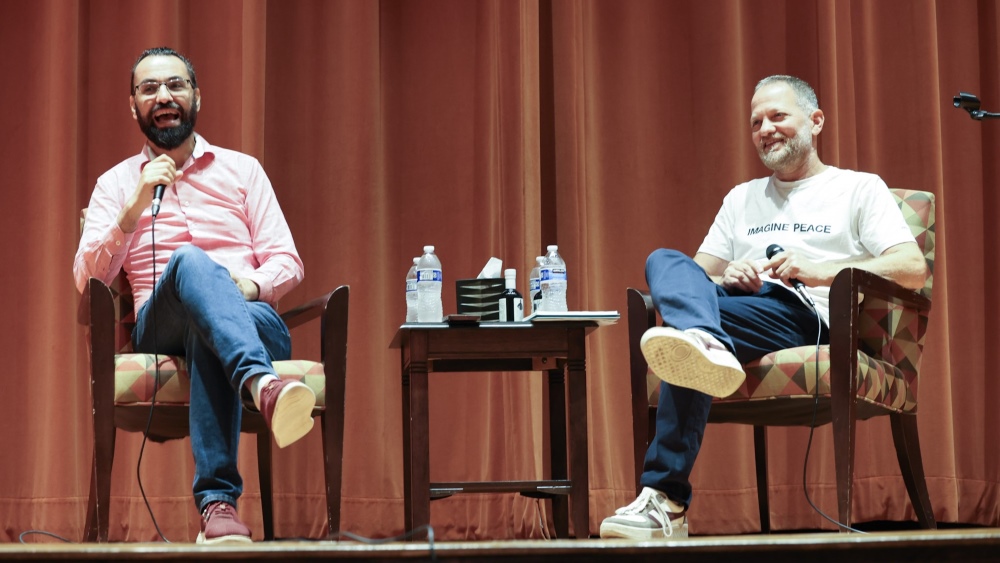
(Photo by Robyn Stevens Brody)
“We are all angry,” he said. “Anger is normal in this situation. But we can take that anger to make a better future. We want to use our anger, pain and sorrow to make sure no one goes through what the two of us have gone through.”
Said Inon: “We’re here to create hope. You can’t create hope by yourself. You have to make it together. … This has been going on for so long. My mission is to break this cycle.”
Forgiveness is overwhelmingly difficult but essential in creating a peaceful solution, he said.
“Who took my parents? Hamas. But I decided to forgive Hamas,” said Inon. “I also wanted to seek revenge with those who didn’t protect my parents — the Israeli government. But I had stopped functioning as a husband, father and friend. So I decided to forgive the government and focus on the future.”
Abu Sarah admitted that extremists and cynics on both sides are a major impediment to future coexistence.
“The answer is us. We have to be the alternative,” he said. “We can offer a different future and model. Since Oct. 7th, we have seen a lot of people get radicalized. But we’ve also seen others who have joined our movement.”
Inon said he and Abu Sarah are aware that some observers might consider their visions for peace as naïve and futile.
“But there is no other way,” Inon said. “Israel’s borders are as insecure as ever. We’ve lost our safety and security. People who think bombs and war will create safety are being naïve. We are the voice of reason. The only way to create safety for Israel is to provide security for the people of Palestine.
“Peace is not impossible,” he said. “It is inevitable.”
Both Inon and Abu Sarah called on listeners for their support through social media and word-of-mouth activities about the peace movement.
“People think talking about peace is naïve, but war and hate are a defeat,” Abu Sarah said. “Peacemakers are looking for an antidote for this disease. We don’t want your thoughts and prayers. We need you to join this global movement.”
Said Inon: “We need you to help and support us. We need policy change and reconciliation right now. There is a path to hope, a future. Help people know about us and make us legitimate.”
For information, visit x.com/AzizAbuSarah/status/1783308583523828078.
The Jillian and Lindsay Wiener Short-Term Rental Safety Act requires rental companies to conduct annual fire inspections in Baltimore City and every Maryland county.
Reproductions of the murals, previously believed to have been lost, are now part of the Jewish Museum of Maryland's new permanent exhibition.
The donation will be directed to help foster research conducted by faculty at the University of Maryland School of Medicine and to advance innovative treatments.
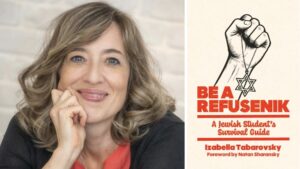
Scholar Izabella Tabarovsky will speak at the “Generations of Courage” program on Apr. 26 at The Associated's Goldsmith campus.