
I’ve been mildly obsessed with the Camino de Santiago since seeing Martin Sheen and Emilio Estevez’s film “The Way” about a decade ago.
So when a friend and I were out for a hike and she mentioned she and some friends were going to “do this walk in Spain called the Camino de Santiago,” I squealed out “Yes!” before she’d even formally invited me.
She casually noted we would be walking approximately 150 miles of the trail, including a 62-mile portion of the Camino Ingles starting in the city of Ferrol in northern Spain and ending up in the Galician capital of Santiago de Compostela. Then, we would be undertaking a second, shorter walk to Cape Finisterre (aka, Fisterra — the end of the earth).
No problem!
One thing you should know: I don’t vacation lightly. This year’s other big getaway was to all five of Utah’s national parks. Last year, I explored much of Washington State. I am way more prone to adventuring than relaxing on a beach somewhere. But on each of those trips, I was able to get to my next destination by car, not by foot.
So there was actually one problem. I was scheduled for foot surgery in February, which means I needed to accelerate my recovery if I was going to be walking long distances — on two feet — by May.
Luckily, my amazing doctor from the Foot Center at Mercy Medical Center was more than up to the challenge. About four weeks after the surgery, he had me taking extended walks averaging four miles. Once I got up to 11, I thought I was properly prepared. I didn’t even balk when discovering we would be walking 15-20 miles a day for nine days.
It sounded like a nice, meandering stroll through some Spanish woods and maybe on some sand along the coast.
I was mistaken.
Stamps, Stamps, Stamps!
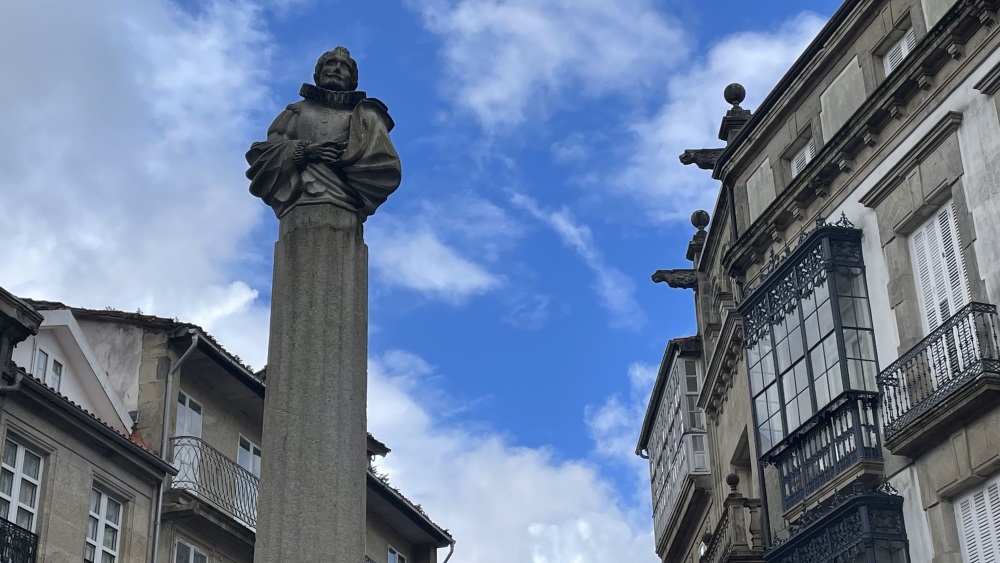
We spent our first night in Santiago de Compostela in an apartment overlooking a courtyard that got really raucous around midnight. Santiago is the mecca to this pilgrimage. There are tons of seafood-forward outdoor cafes, souvenir shops, medieval structures and even a square dedicated to Miguel de Cervantes of “Don Quixote” fame. There are street buskers and bagpipers. This is where the big cathedral is and where all pilgrims pass through to get their Camino passports and come back for their credential certificates.
Because I went on this trip with very little knowledge, expectations or preconceived notions, I didn’t know about any of this. However, I would come to believe the Camino passport was the best thing ever.
You have to get a minimum of two stamps a day to qualify for the certificate of completion. You can get stamps from hotels, bars, cafes and churches. This is both an ingenious marketing tool and the most expansive scavenger hunt I’ve ever been on.
My journal-loving, stationery-obsessed, ephemera-collecting self fully leaned into the task. One day, I proudly collected five stamps!
The next morning, we were shuttled by our tour booker to Ferrol, where we started the walk the following day.
This is a hard walk. It did not help my resolve that the three women I was accompanying were all in their 60s and I couldn’t keep up with any of them. I think I spent the first three days of the walk swearing to myself and groaning. It also rained for most of those first three days — and for much of the trip.
By that third day, I was waterlogged, blistered, swollen and starved for conversation and interaction, in any language. The most anyone said to me was “Buen Camino,” which is the standard greeting for those you meet on the trail.
On the afternoon of the third day, we made a wrong turn down a long, steep hill. (The trail boasts conspicuous and plentiful yellow arrows and clamshells on waymarkers. We all just looked the other way on this one.)
I got to the bottom, realized we needed to go back up that same long, steep hill and very nearly crumbled. I tried to get a local resident to call me a taxi. She either didn’t understand or didn’t want me to miss an afternoon of stamp collecting.
I turned around and very grudgingly went back up said hill. I made it to a bus stop outside of a church (that wasn’t open — no stamp) and plopped down fully intending to die there.
Instead, another pilgrim, who spoke Spanish, called me a taxi to our next stop. Fortunately, that was the day we headed to a beautiful villa in Bruma that looked like the original source for Anthropologie’s buyers.
When I got there, I went straight to my room, got out of my soaked clothes, took a hot shower and crawled into bed to convalesce for what I hoped would be two weeks. (It was more like two hours, but I used the time to ice and elevate my foot and start a multi-pronged medication schedule that took my swelling down almost immediately.)
Beauty and the Blur
After some rehab and a pep talk from my wonderfully supportive doctor, I continued my sojourn. We walked from Neda to Pontedeume to Betanzos to Bruma to Sigueiro. I think. It is an actual pain-laced blur.
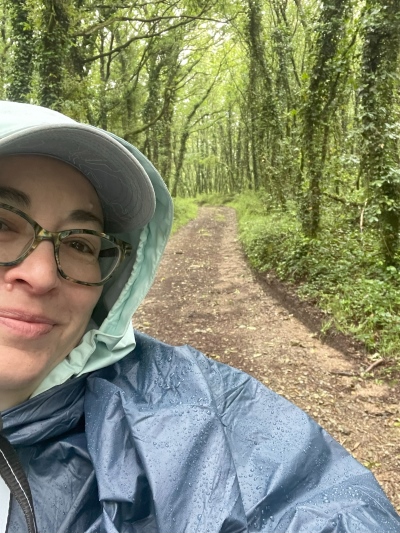
Parts of the walk were beautiful. We went through eucalyptus-fringed forests, fields of fennel and wildflowers, stinky cow pastures and quaint medieval villages.
Other parts of the walk passed through industrial towns or along highways used by drivers who clearly had no concern for the life expectancy of a modern pilgrim. I preferred the forestry part and the daily goal of getting to the next auberge — restaurants or bars along the trail where you could get a café con leche, a bocadillo (sandwich) and a stamp!
We found several of these rest stops, but three specifically stood out.
One was an open campground-looking area of free-standing kiosks and picnic tables with a cozy interior kitchen/dining area where you ordered. That just had a really great vibe. Another felt like a ski lodge. It was at the top of a long incline and was set up like a cafeteria. I had an amazing sandwich there with an egg, white asparagus, tuna and cheese. I also had some churros there. Their stamp situation was self-serve.
The most epic stop was at the top of a mountain at the end of a very hard day. Exactly when I needed him, this trail angel appeared with outdoor tables, chairs and umbrellas and offered sodas, beer and chips for donation. He was like a mirage in the desert. I miss him.
A Hard Rain (and Aching Feet)
It was raining pretty hard as we made our descent into Santiago, where the first thing we spotted was a McDonald’s — per international road trip rule, we used the facilities. (They did not have a stamp.)
Then, as we were walking into the town center, a nun beckoned to us with the promise of a stamp. I couldn’t believe it. Music to my ears. Naturally, we stopped everything and visited her church.
Once we got into town, we found our home for the next two nights: a former 16th century monastery turned into a waystation for tired pilgrims. They had an excellent and well-merched gift shop (only open at strange and unpredictable intervals, like most businesses in Spain), a bar, reading nooks and, best of all, hot showers with heated towel racks (so we could dry our soaked underthings).
I should pause here to explain the accommodations. Some people stay in hostels, some just stay where they land that night. We booked through Camino Ways, a tour company that transported our luggage daily and organized all the hotel accommodations, most of which included breakfast and dinner.
Some of the hotels were posh and delightfully aspirational like the 250-year-old villa in which I crash-landed in Bruma. Some had hot tubs exactly when warranted. Others had filthy, unfilled swimming pools and strange “Shining”-esque hallways. The only thing that mattered was we had fully operational bathrooms and showers with hot water.
Most evenings, we barely made it through dinner (they eat late there) before hitting the pillow hard. (There wasn’t a lot of all-night partying or extracurriculars on this trip.)
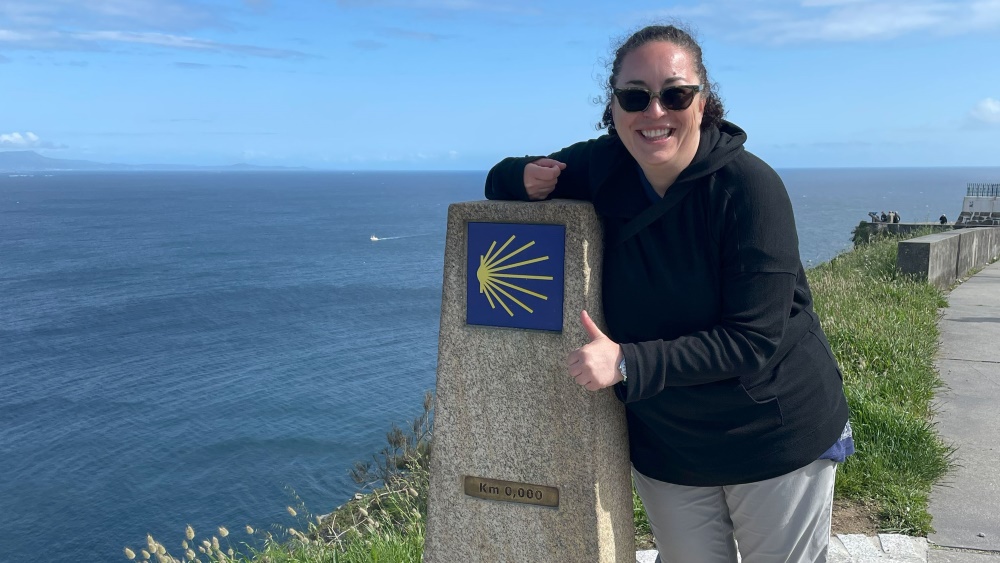
After collecting our credential certificates (I had more than enough stamps to qualify, despite a couple small breaks) and posing with the 0-mile marker, we spent two delightful rest days in Santiago just eating yummy Spanish treats (paella, empanadas, octopus) and being tourists (the public market appealed to all my tastebuds and, yes, I even visited the cathedral).
Just as each of my toe blisters healed and I was experiencing a pretty serene (or smug) sense of accomplishment, it was time to set out on another trek: this time, to the end of the world.
Before departing, I came to realize there was no shame in my taxi-taking game. I witnessed multiple groups of walkers piling out of taxis with equipment in hand. Even on the days I didn’t “walk,” I managed a good four miles and two stamps just exploring the towns (mission accomplished).
This second journey was the most memorable and scenic. I started in Negreira, which featured picturesque Roman architecture, a bridge and arches. The next day, I took a bus (more of a luxury coach) for approximately $3 Euro for a 45-minute ride to the seaside tourist town of Cee.
End of the World (As They Knew It)
On this last leg, we walked along white sand beaches with crystal clear water, experienced some incredible cliff views and reached the end of the world — the lighthouse in Finisterre. This was by far my preferred camino.
We cooled our aching feet in the chilly ocean and reflected on how far we’d come; hunted for seashells and sea glass; encountered an entrepreneur selling paella on the beach; ate delectable nibbles like pimientos de Padron (a Galician specialty and my absolute favorite dish of the trip), giant prawns and even barnacles (which I regrettably did not try); and made it all the way to what early explorers myopically assumed was the end of the world. And it was breathtaking.
Not to be too irreverent but I should note that by no means was I a pilgrim on a camino. There are all sorts of people on the trail. I’m an “all sort” and I was there. I even saw a group of Buddhists on a vow of silence, met a fellow Jewish woman in Finisterre and spotted a group of pals in drag — unless I was hallucinating. I also appreciated that the trail seemed to skew older — like you have to have lived long enough to amass enough baggage to have something to work out on a long walk.
Did I come to any epiphanies? Eh.
But I did learn that age really is just a number. I also gained some humility about my strengths, weaknesses, limitations and possibilities.
Do I need to do it again? Nah, I’m good. However, I would consider another walking vacation if they also transported my luggage, and I could stick to 10 miles a day max.
Should you decide this sounds like the right trip for you, I wish you a Buen Camino!
Amanda Krotki is a Baltimore area freelance writer.

The remaining 6,000 members of the community are expected to immigrate by 2030.
Rabbi David Wolpe looks at the recent interest in Hollywood productions about King David and why the story is resonating now.
Israel is increasingly reliant on foreign workers, hundreds of whom moved into the dilapidated building during the Iran war.
Colorectal cancer rates are climbing among young people and Ashkenazi Jews.