
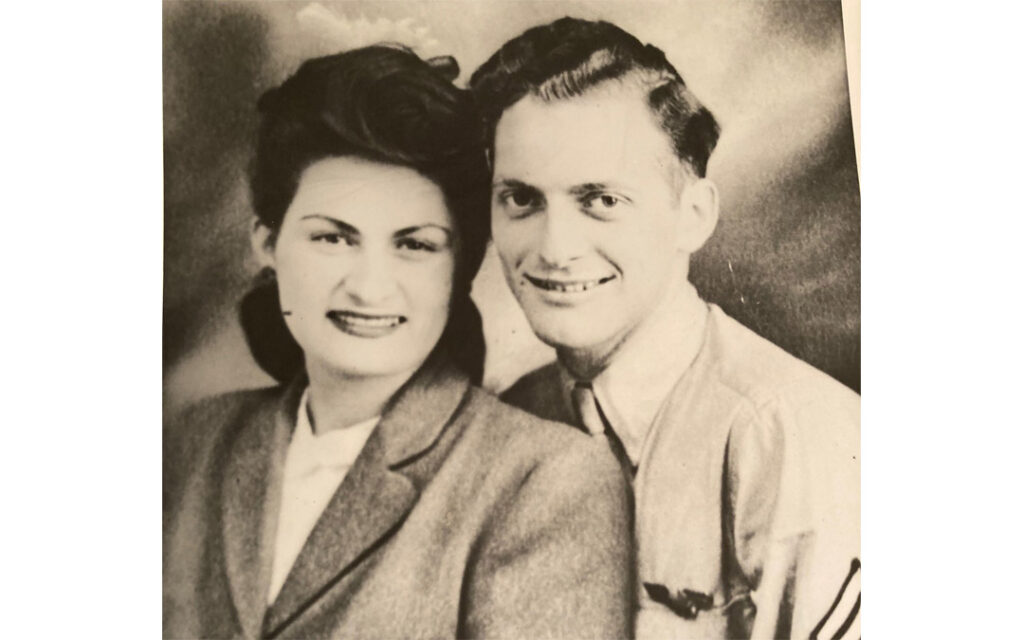
One sunny afternoon while in her 80s, sitting in her little kitchen at Pickwick Apartments, my mother got a twinkle in her eye and expressed an unanticipated inspiration.
“I think I’ll try being charming,” she said. “Do you think I could pull that off?”
I thought about that for a heartbeat or two and said,
“For a while.”
I knew my mother too well to ask for more. We both laughed aloud for a while, and then she went off to try out her new charm. It lasted for a while, and then it went away.
That was my mother. She could be sunny and bright, but then came electrical storms. When she was good, she was the warmest, most loving person in any room. When she was ticked off about something, you wanted to look for shelter.
I never understood the dramatic mood swings, but I’m thinking about her now because she would have been 100 years old as I write these words on July 25, 2024.
She got a bad break early in her life. Selma Loebman was four years old — and her brother, Richard, four weeks old — when their father died. A kidney infection got him, at 29, just as the Great Depression was about to kick in and made my grandmother the head of a welfare family.
Growing up in The Bronx, my mother described herself as a tomboy. She would rollerskate on the bustling Grand Concourse, and hook her hands onto the back of some municipal bus and hold on. She liked to play stickball with the guys in the neighborhood. When one of them insulted her, she threw a right fist and blackened the boy’s eye. She always said he had it coming.
She was the new kid on Findlay Avenue when 11-year-old Liney Olesker spotted her across the street one winter afternoon and introduced himself by hitting her in the face with a snowball.
“What did you do then?” I asked her many years later.
“Threw a snowball back at him,” she said. “I wasn’t gonna just stand there.”
They were still sweethearts when Liney entered New York University. He signed up for the Army Air Force the day after Pearl Harbor was bombed. My mother was still living in an apartment in The Bronx.
“When you heard about the attack,” I asked her once, “had you ever even heard of Pearl Harbor?”
“No,” she said. “In our building, there was a Pearl Schwartz. But that was the only Pearl I knew.”
She could be unconsciously funny that way. She and my father married while he was in the Air Force, and a year later he shipped out for the fighting in Europe without knowing she was pregnant with me.
On the night she gave birth, her mother was tied up with her job and couldn’t take her to the hospital. My grandmother turned to her son, Richard, and said, “You’ve got to get your sister to a hospital.”
The two of them stood there terrified in the middle of The Bronx, trying to get a cab. My uncle was 16. My mother was 20. By the time the war was over, and my father could come home and meet his son, I was six months old. He was 22.
In the autumn of 1949, we moved to Baltimore so my father could resume his schooling. We lived on the G.I. Bill for the next four years until my father graduated and went into real estate work.
My mother was the classic post-war housewife. It’s what a lot of women did back then. Sometimes, this worked for her and sometimes it frustrated the hell out of her. She had a mind she felt she was wasting.
With two sons, she treasured family togetherness and expressed herself when she felt it was lacking. Those were not her “charming” moments.
She was a student of politics and religion and art. I was a student of my mother. My whole life, I’ve tried understanding her highs and lows. In my head, she and I are still trying to work things out.
A former Baltimore Sun columnist and WJZ-TV commentator, Michael Olesker is the author of six books, including “Journeys to the Heart of Baltimore” (Johns Hopkins University Press) and “Michael Olesker’s Baltimore: If You Live Here, You’re Home” (Johns Hopkins University).
At a time when many Jews fear appearing Jewish in public, seeing Judaism depicted correctly onscreen is reassuring, writes Jewish content creator Rabbi Yael Buechler.

Cruel, inappropriate, egomanical, outrageous and bullying are all attributes that pass for presidential these days, writes Michael Olesker.

Commemorations of the Holocaust must transcend the past to include concerns about the present and future, writes Menachem Z. Rosensaft.