
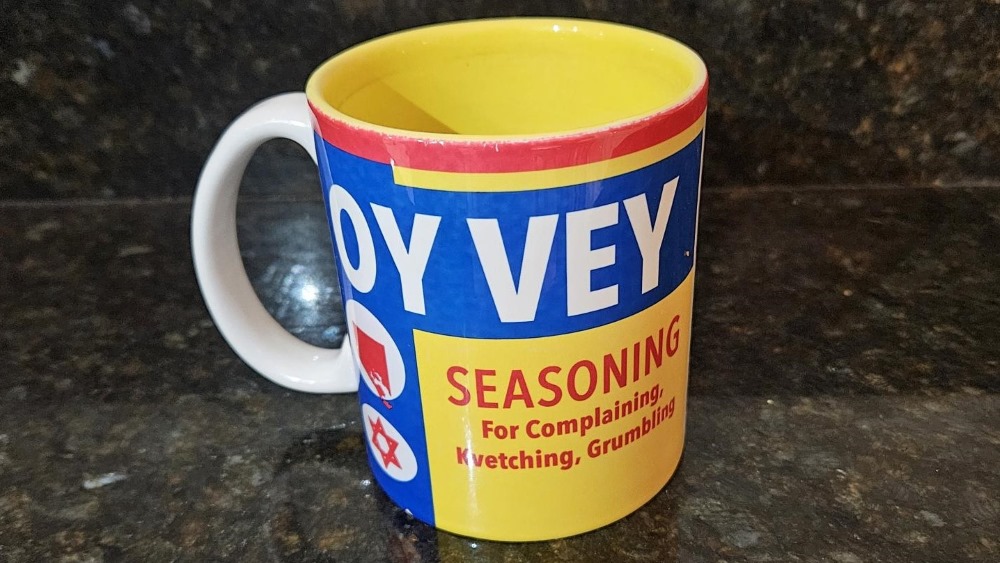
Among the coffee mugs I keep stored in my kitchen cupboard is one that my wife purchased a few years ago. It’s from the Jewish Museum of Maryland gift store once known as “Esther’s Place,” in honor of my old friend and longtime shop manager Esther Weiner.
The yellow, blue and red mug was produced as an homage to the iconic Old Bay Seasoning can. But instead of promoting the popular spice created in Charm City in the early 1940s by German-Jewish immigrant Gustav Brunn — which is traditionally used for treife delicacies — the mug reads, “Oy Vey Seasoning.” It features a Star of David and the map outline of Baltimore, as well as the faux catchphrase, “For Complaining, Kvetching, Grumbling.”
Quite familiar with my penchant for kitsch — especially with a Jewish or Baltimore-centric twist — my wife knew this mug would be right up my alley. I immediately showed it to my son as a badge of local Jewish pride, not to mention a token of his mom’s thoughtfulness.
“Nice,” he said, shrugging his shoulders. “But kinda corny, don’t you think?”
Well of course, and that’s the whole point of such a tchotchke. But it’s also intended to be irreverent, an inside joke of sorts, to inspire something akin to a sense of community and fellowship — with a knowing wink.
I thought of my cherished “Oy Vey” mug recently when undertaking my first pilgrimage to the Weitzman National Museum of American Jewish History in Philadelphia’s historic district. If you haven’t been there, by all means take the two-hour drive to check out “The Weitzman.” (By the way, I no longer consider Philly “the City of Brotherly Love” after one of its motorists, for no apparent reason, honked and flipped me the bird while I innocently walked down a street.)
The first thing you notice at The Weitzman is the outdoor installation, “Oy/Yo.” The bright yellow aluminum sculpture employs whimsical wordplay with the ubiquitous Yiddish expression for concern or dismay, while also invoking the classic Philly phrase that roughly translates as “Hey!”
But it also has a deeper meaning, according to Brooklyn-based artist Deborah Kass. “I created ‘OY/YO’ thinking about the American promise of equality and fairness and our responsibilities to make the country a better place for all,” she says on the museum’s website. “With hate and division now on the rise, it is urgent to see our commonalities, what we share, and what brings us together.” (Tell that to my cantankerous Philly motorist pal.)
Inside The Weitzman are four floors that superbly chronicle and celebrate the American Jewish experience, from the earliest Sephardic settlers to the New World, through the waves of immigration, military conflicts, depressions, migrations and movements, to the present day when we strive to fashion a 21st-century Jewish communal version of faith, innovation and resilience.
That doesn’t mean The Weitzman is all business. There’s plenty of material, items and footage of cultural and entertainment notables such as Barbra Streisand, Sandy Koufax, the Three Stooges and Bob Dylan. But the museum’s overall emphasis is about where we come from and where we’re going.
Over the years, the Weitzman has experienced its share of challenges, including budgetary, attendance and staffing woes. But the museum appears to be on solid footing now, and the House of Representatives recently unanimously approved a bill to study bringing The Weitzman into the Smithsonian Institution umbrella, which would provide prestige and federal funding opportunities.
In an era of escalating antisemitism and pervasive anti-Israel hatred, this development simply couldn’t come at a better time.
Sincerely,
Alan Feiler, Editor-in-Chief
A new biography captures the intensity and magic of the musical theater giant, writes Michael Olesker.

Melinda Michel pays tribute to the longtime Jewish community leader and volunteer who passed away on June 8 at age 68.

Jmore Editor-in-Chief Alan Feiler remembers Temple Emanuel's longtime spiritual leader, who passed away earlier this week at age 91.

Camp and youth group experiences have the ingredients for true, deep, lifelong transformation, writes Rabbi Jessy Dressin.