
This story was sponsored by and produced in partnership with The Charles Bronfman Prize, an annual prize presented to a humanitarian whose innovative work fueled by their Jewish values has significantly improved the world. This article was produced by JTA’s native content team.
By Larry Luxner
Youssef, a Syrian emigre living in Stockholm, is in the unique position of having a job where he helps other refugees. He works at Randstad, a Swedish recruitment agency, guiding refugees through job applications, translations from Swedish, and interview prep work.
“I have gone through many difficulties as a refugee,” said Youssef. “Now I try to find solutions for other refugees. My goal is simply to encourage employers to create space for skilled people who have come to this country.”
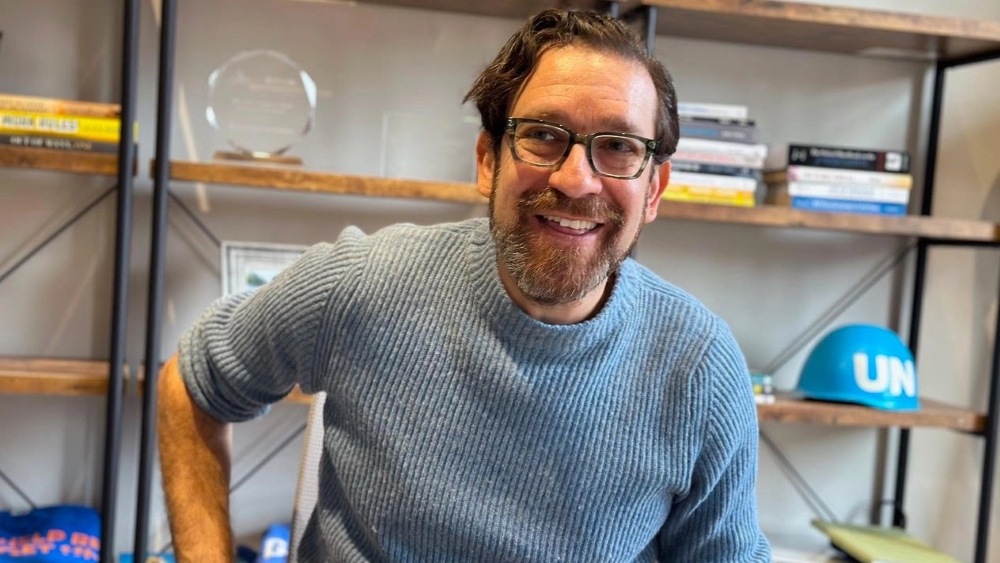
Youssef is one of tens of thousands of work-authorized refugees who have found jobs with major companies thanks to the Tent Partnership for Refugees. The organization is led by Gideon Maltz, a South African native whose Jewish grandparents were refugees from Lithuania.
Maltz joined Tent in 2017, a year after its founding by Hamdi Ulukaya, the Kurdish founder of the yogurt brand Chobani. Maltz has since expanded Tent’s network to more than 400 major companies in 11 countries.
“Our mission is to help refugees get jobs fast,” Maltz said at his office at Chobani headquarters in New York, just after the announcement that he received this year’s Charles Bronfman Prize. The prize is a $100,000 award given annually to a Jewish humanitarian under 50 whose innovative work has significantly improved the world.
“What we see across Europe and the Americas is that countries are hosting hundreds of thousands of refugees who universally struggle to get jobs, even though they’re legally authorized to work,” Maltz said. “It’s unsustainable not only for refugees but also host countries, since they use public benefits but don’t pay taxes.”
On the flip side, hiring refugees makes sense from a business point of view, according to Maltz: Refugees tend to work hard, are loyal to their employers and more willing to relocate.
Much of Tent’s work is about making that case for refugees to prospective employers, and Maltz has helped mobilize some of the world’s largest companies, including Adidas, American Airlines, FedEx, Pfizer, L’Oréal, Marriott International, McDonald’s, Starbucks, Unilever and Verizon.
Once a company agrees to hire refugees, Tent helps connect them with job candidates who are refugees. Tent introduces the companies to nonprofits that work with refugees directly and are located where the company has hiring needs, and assists the company around best practices for integrating their new refugee hires.
“It takes a long time for refugees to find work,” Maltz said. “It’s not so much prejudice, but ways in which the typical company’s hiring process unintentionally excludes refugees. For example, a gap of several years in a resume, or being overqualified.”
In June 2023, Tent announced that 41 more companies had committed to hiring, training and mentoring at least 250,000 refugees across Europe over the following three years — ranging from Amazon, which committed to hire 5,000 refugees, to Menzies Aviation, which pledged to hire 150 refugees. Tent works in the United States, Canada, Colombia, France, Germany, Mexico, Poland, Spain, Sweden, the Netherlands and the United Kingdom.
In 2024, Tent won a place on TIME’s list of 100 Most Influential Companies. With just 50 employees, Tent was one of the smallest-ever organizations, and the first focused on refugees, to earn this honor.
When Maltz was named the 2025 laureate for the Charles Bronfman Prize — created 20 years ago by the children of businessman and philanthropist Charles Bronfman — Bronfman cited the Jewish element of Maltz’s work.
“Gideon’s groundbreaking work exemplifies the Jewish imperative to ‘welcome the stranger’ and demonstrates the power of business to drive meaningful social change,” Bronfman said. “By forging strategic partnerships with global corporations, he has created real pathways for refugees to rebuild their lives with dignity and economic security.”
Maltz, 47, was born and raised in Durban, South Africa, and came to the U.S. in 1996 to study at Yale.
“Our community prospered in South Africa but was also at the forefront of the anti-apartheid movement,” he said of Jews in the country. “Many of the top lawyers defending Nelson Mandela were Jewish, and I was 12 years old when Mandela was released. That totally formed my worldview.”
Maltz said he’s very conscious that his grandparents and great-grandparents were refugees.
“That’s the quintessential Jewish experience of being forced to flee and start new lives, and the countries that gave them opportunities to do so were the ones that benefitted the most,” Maltz said. “That’s why I’m so proud to be awarded the Charles Bronfman Prize. It connects the work I do at Tent with my family’s experience, and the experience of so many Jewish families.”
One of Tent’s closest U.S. partners is the Hebrew Immigrant Aid Society. On Feb. 10, HIAS and two other charities sued the Trump administration over an executive order that indefinitely suspends refugee resettlement.
“Categorically cutting off the U.S. to vetted refugees is not something most Americans support,” Maltz said. “And over time, I think it will backfire.”
This story was sponsored by and produced in partnership with The Charles Bronfman Prize, an annual prize presented to a humanitarian whose innovative work fueled by their Jewish values has significantly improved the world. This article was produced by JTA’s native content team.

The remaining 6,000 members of the community are expected to immigrate by 2030.

Israel is increasingly reliant on foreign workers, hundreds of whom moved into the dilapidated building during the Iran war.

Colorectal cancer rates are climbing among young people and Ashkenazi Jews.
In "The Future is Peace," Aziz Abu Sarah and Maoz Inon say there is still hope for coexistence between Arabs and Jews.