
On the evening of Jan. 18, 2013, Earl Weaver had dinner aboard the Celebrity Silhouette cruise ship for the “Original Baltimore Baseball Cruise,” comforted to have a bunch of his old ballplayers with him.
They were there to reminisce, make a little extra cash and socialize with fans. Also, as it turned out, he was there to bid farewell.
Rising from the dinner table, Weaver told his old lefty pitching ace Scott McGregor he didn’t feel well and was heading for bed.
“Tell the boys I love ‘em,” he told McGregor.
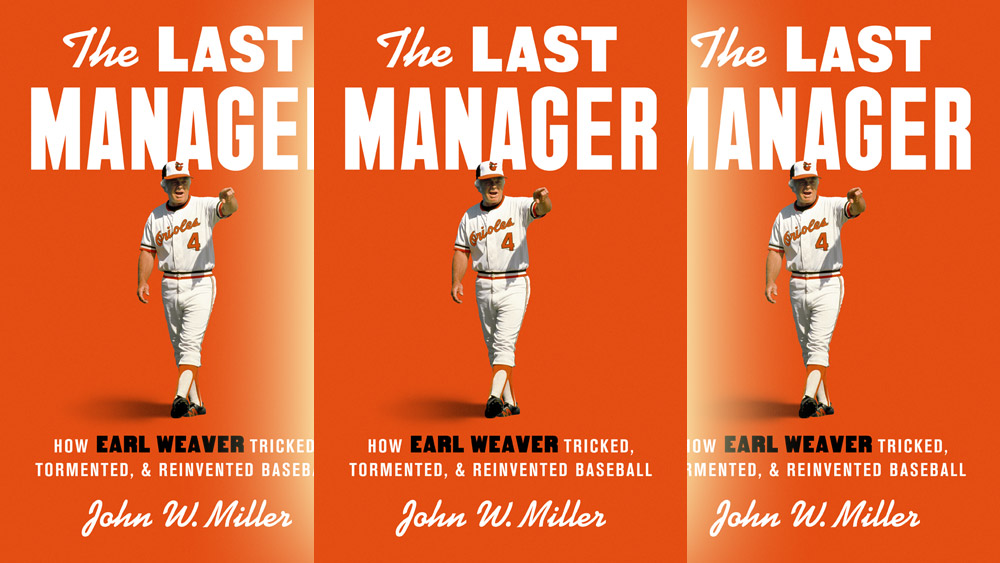
Those final words will leave longtime Orioles fans a little surprised while reading John Miller’s terrific new book, “The Last Manager: How Earl Weaver Tricked, Tormented and Reinvented Baseball” (Avid Reader Press).
(Note: the author is John Miller, not Jon Miller, the superb Orioles broadcaster for many summers. John Miller is a former Wall Street Journal reporter.)
Weaver’s declaration of “love” is jarring since the common picture of the former Orioles manager is one of volcanic rage. There’s Weaver, roaring against any umpire he believes has unfairly harmed his team. There’s Weaver, across roughly 15 seasons, refusing to get close to any of his players because he knows that ultimately, as their skills fade, he’s the one who will have to cut them loose.
But “The Last Manager” lifts Weaver beyond all the old stereotypes. He’s tough here, and he’s raw. But he’s also smart, far ahead of his time on baseball strategy and sensitive beneath his horsehide cover.
And he’s a bigger man and a better jock than his players want to admit. Many of them mock him when he isn’t looking. It’s their defense against Weaver’s hooting and hollering. But some of it’s also the playground instinct of jocks to feel superior to non-jocks.
Some of his players like to say, “The only thing Earl knew about pitching was that he couldn’t hit it.”
As it happens, that’s a lie. The common belief was that Weaver never played Major League Baseball because he wasn’t good enough. The truth, as Miller tells it, is that he got cheated.
He’d had four solid seasons of minor league ball in the St. Louis Cardinals minor league system and was set to make the big-league club coming out of spring training. But Eddie Stanky stood in his way.
Stanky was the Cardinals’ player-manager, and it was his decision on who was going to make the club: the hotshot kid Weaver or the aging Stanky himself, trying to hold onto the tattered threads of his big-league playing career.
When Stanky chose himself to make the club, it broke Weaver’s spirit. He never got another shot at the big leagues but instead commenced his long, Vesuvian career as a manager.
He labored in the minors from the early 1950s until the Orioles took a shot with him in the mid-‘60s. He coached under Hank Bauer, who’d led the O’s to the 1966 World Series Championship but then seemed to lose control of the team.
Weaver took over in 1968, won pennants in four of the next six years and contributed mightily to a 20-year run in which Baltimore had a better won-loss record than any team in Major League Baseball.
But with Weaver, it was always about more than wins and losses. Earl was an entertainment unto himself. When he went one-on-one with some overmatched ump, he could transform a sleepy ballpark into mass hysteria.
He lasted across baseball generations, from Brooks and Frank and Palmer to Eddie and Cal. Players came and went, and Earl stayed. He became such a fixture — not only of the Orioles, but of Bawlamer pop culture — that on that final 1982 afternoon when the O’s lost the pennant to the Milwaukee Brewers and Earl went into temporary retirement, Memorial Stadium refused to empty out.
An entire crowd stayed to cheer on Earl and thank him for all the years of first-class baseball. If you’ve forgotten that afternoon, you can find it on YouTube with Howard Cosell’s heart-lifting coverage.
Or better yet, pick up “The Last Manager.” It’s a winner.

A former Baltimore Sun columnist and WJZ-TV commentator, Michael Olesker is the author of six books, including “Journeys to the Heart of Baltimore” (Johns Hopkins University Press) and “Michael Olesker’s Baltimore: If You Live Here, You’re Home” (Johns Hopkins University).

Jmore Publisher Scott Rifkin, M.D., reacts to President Donald Trump's latest poll numbers and the real force behind the growing decline of the Trump movement.

Last weekend's Flower Mart once again demonstrated that there's nothing to fear about downtown Baltimore, writes Michael Olesker.

A junior at Roland Park Country School, Katie Grossman writes about a recent experience that spurred her to take action to fight antisemitism.

At a time when many Jews fear appearing Jewish in public, seeing Judaism depicted correctly onscreen is reassuring, writes Jewish content creator Rabbi Yael Buechler.