
By Rabbi Noam E. Marans
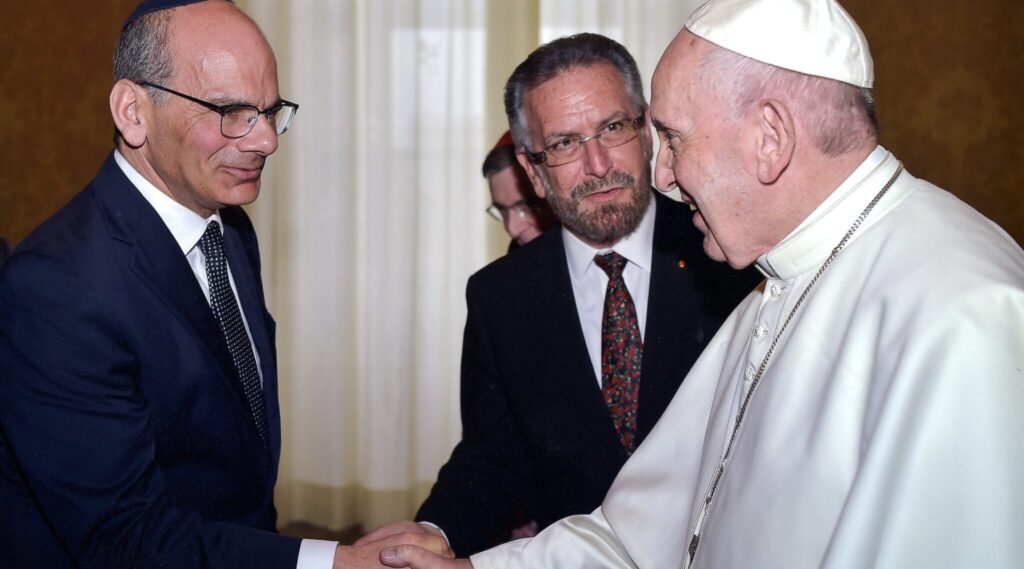
I vividly remember each of the many times I was fortunate enough to meet with Pope Francis. The initial meeting was in June of 2013 when the pontiff welcomed a group of Jewish organizations to the Vatican.
We were expecting a large, ornate hall, with the new pope seated on a royal chair atop a riser. But Francis had not yet given in to the reality of his position.
Instead, we met in an intimate room and he greeted us with his inimitable pastoral warmth. It was then when he said, referencing Nostra Aetate, the Second Vatican Council document that transformed Catholic-Jewish relations: “The Council recalls the teaching of Saint Paul, who wrote ‘the gifts and the call of God are irrevocable’ and who also firmly condemned hatred, persecution, and all forms of antisemitism. Due to our common roots, a Christian cannot be antisemitic!”
Francis continued to share words dozens of times during his tenure, even as recently as Easter during his final public appearance on Apr. 20, only hours before his passing. He did not mean there was no antisemitism in the Christian world. Rather, he argued, it makes no sense to be an antisemite if you have internalized the teaching of Nostra Aetate.
The pope had been among the first to implement the mandates of Nostra Aetate in his exemplary relationship with the Jewish community in his native Argentina.
That’s the way it mostly was with Francis: a Catholic-Jewish lovefest in which he not only did what modern popes since Pope John Paul II did and had never done before — visit synagogues, make pilgrimages to Auschwitz and go on official state visits to Israel — but also had innumerable Jewish friendships.
But there was also sometimes a fly in the ointment. Francis, a folksy shepherd of his people, was not always as careful as a pope needs to be in adhering to the new post-Nostra Aetate language.
Never was there any concern about what was in Francis’s heart, but sometimes his language revealed he did not always understand that his words could be misused by others
For example, all the positive, empathetic things Francis did since the Hamas attacks Oct. 7, 2023, were not enough to allay the concerns regarding his seemingly harsh judgmental-of-Israel, post-Oct. 7 approach, which he manifested on many occasions in different ways.
I believe history will be kind to Francis in its evaluation of his Catholic-Jewish relations track record. He guaranteed that the achievements of the last 60 years were sustained and expanded, and that his voice was among the loudest and most influential in its condemnation of antisemitism.
We do not know for sure what will follow in Catholic-Jewish relations. There are possible popes who are like recent popes in their commitment to Catholic-Jewish comity.
But there are also potential successors to Francis for whom that will not come naturally, not because they are ideologically opposed to the cause but rather because the Church has expanded to regions where there are few Jews and few Catholic-Jewish relationships.
The latter does not preclude a continuation of the golden age in Catholic-Jewish relations, but vigilance will be required from both Catholics and Jews to make that happen.
I am optimistic, but optimism is only the beginning of a plan. There is a lot at stake for the Jewish people. There can be no going back to a darker era.
Rabbi Noam E. Marans is director of Interreligious Affairs at the American Jewish Committee.
Allow me a few paragraphs of time travel, and let’s go back to Johnny Carson’s monologue the night after Neil Armstrong became the first man to set foot on the moon. I’m paraphrasing here, but I think the joke still works 57 years after Carson first delivered it. “The good Read more
As he gets ready to leave for California, Rabbi Daniel Cotzin Burg looks back on his time in Baltimore and his 10 years writing for Jmore.
Michael Olesker pays tribute to WJZ’s retiring Marty Bass, a longtime fixture on local TV screens.