

This article — provided by the JTA global Jewish news source — was sponsored by and produced in partnership with Congregation Rodeph Sholom, a Reform synagogue in Manhattan that promotes community, social responsibility, and growth of mind, body, and soul.
By Debra Rubin
When fifth-grader Shayna Osterweil disagrees with someone, she tries to keep in mind what she learned at religious school about the Talmudic sages Hillel and Shammai, who were known for their civil discourse.
If something is bothering third-grader Aliza Schumer, she searches for ways to be shalem, Hebrew for a sense of peace and wholeness.
If eighth-grader Theo Bonin finds someone annoying, he endeavors to keep in mind that the other person was created b’tzelem Elohim, in God’s image.
These three youngsters are all students at Congregation Rodeph Sholom, a Reform synagogue in New York City that has reimagined its religious school to transform it into a place where Jewish values, family involvement, fun and flexibility are integral to the curriculum of the once-weekly after-school program.
Just don’t call it Hebrew school.
“We shifted away from ‘We’re going to teach you Torah and about holidays, so you know them,’ to ‘We’re going to help you lead a purposeful and meaningful life,’” said Kerith Braunfeld, Rodeph Sholom’s director of religious education and youth. “We use the tools of Judaism to help them do so.”
The curriculum for the after-school program (not be confused with Rodeph Sholom School, a full-time K-8 Reform Jewish day school nearby) starts with pre-K and continues through the teen years to 12th-grade graduation. It covers Torah, Hebrew and Jewish holidays while instilling such Jewish values as tzedakah (justice), tikkun olam (repairing the world) and resilience.
The kids meet outside of class, too.
Friday evening Shabbat Together services and dinners take place regularly, with an option for parents and children to learn together. There are teens-only events, including monthly hangouts, paid internships and a local chapter of BBYO, the Jewish youth movement.
At the synagogue, many of the programs are built around flexibility for families. Children can start as young as ages 2-4 with Sholom Adventures, a weekly class of one-two hours, depending on parents’ preferences.
Sholom Discoveries, the program for kids in the third to seventh grades, is a once-weekly, in-person Jewish studies class plus a one-on-one online Hebrew session on another day of the week that suits each child’s schedule. Both Sholom Adventures and Discoveries are offered on multiple days so parents can choose when suits them.
Families interested in Sholom Adventures, which runs through second grade, don’t need to be members of the congregation to enroll their children.
B’nai mitzvah families can choose among the four Shabbat services held at different times for the child’s big day.
“Everything is very grounded in what’s age-appropriate for the children,” said Julie Chelouch, a mother with two kids in the after-school program.
Jonathan Sanders, who teaches fifth and sixth graders, said Sholom Discoveries “challenges the students to think critically and have conversations that I don’t know they would get in their day-to-day lives.”
Jennifer Osterweil, Shayna’s mother, said that she wanted Jewish education for her daughter that wouldn’t feel like the punishment of school after her regular school day.
At Rodeph Sholom, she said, fifth-grader Shayna and her second-grade brother, Myer, “are so excited to go to Hebrew school. They feel really connected to the other children who are there and look forward to seeing them.”
Shayna says she particularly enjoys being in the choir, which performs at the Shabbat Together service.
Theo Bonin, who is in eighth grade, does an internship in the synagogue’s programming department in addition to attending teen programming.
“It’s not your everyday Hebrew school,” Theo said. “At Rodeph Sholom, conversations are based on the teachers asking us our opinions.”
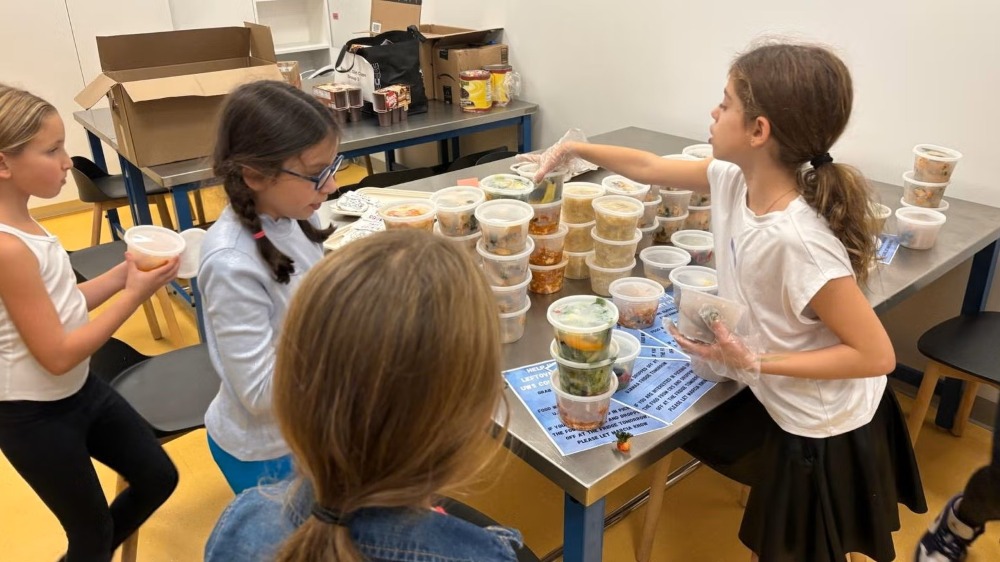
Students point to various ways the school’s values come into play in their lives. Citing the Jewish value of tzedakah, Shayna explained how she forgoes gifts at her own birthday parties, instead asking friends to make donations to charity.
For her 11th birthday, she raised funds for New York’s West Side Campaign Against Hunger. She also bugs her mother to bring leftover food to the Community Fridge on the Upper East Side.
“I already have enough things; if anything, I already have too much,” Shayna said. “And a lot of people don’t have very much.”
Unlike some Hebrew schools, Rodeph Sholom’s program doesn’t end with the age of b’nai mitzvah. Post-b’nai mitzvah programs include internships, 10th-grade confirmation with regular lessons with Rodeph Sholom’s rabbis, and trips in grades 8-12 ranging from Berlin to Washington, D.C.
Braunfeld said that Rodeph Sholom’s educational program works hard to instill in its students the value of b’tzelem elohim: that everyone is deserving of kindness and respect.
“The important part of Hillel and Shammai’s famous dispute on which way to light the Hanukkiah wasn’t just whose opinion we chose,” Braunfeld said, but “the value of the debate itself.”
This article — provided by the JTA global Jewish news source — was sponsored by and produced in partnership with Congregation Rodeph Sholom, a Reform synagogue in Manhattan that promotes community, social responsibility, and growth of mind, body, and soul.
A former college campus activist, Veksler will speak at Chizuk Amuno on June 8 at the Ruth and Jay Lenrow Visiting Scholar-in-Residence for Combating Antisemitism.
Why not honor your mom by making a donation to a nonprofit that supports women and children?
CCBC Honors scholars are discovering a level of academic rigor and opportunity typically associated with elite four-year institutions.

For 35 years, the late Deborah Brodie, aka Bubbie Cookie, amassed a collection of over 200 Jewish ritual objects, which she used to teach her Hebrew school students with special needs.