
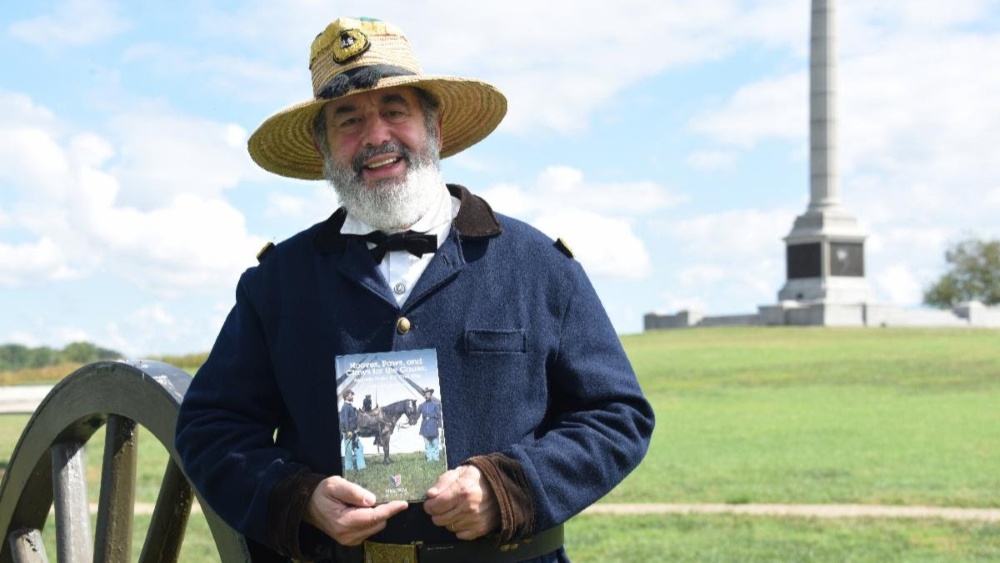
Ever hear about the wartime exploits of Douglas the camel or Old Abe the bald eagle? Nellie the chicken or Jeff Davis the pig?
When Civil War buffs contemplate the bloody conflict that claimed more than 640,000 lives between 1861 and 1865 — and continues to impact American society to this day — they rarely think of horses, birds, dogs and mules.
But Bradford Wind Stone contends that animals played a critical and heroic role in the war that frequently gets swept into the dustbin of history.
A Jewish volunteer docent at the National Museum of Civil War Medicine in Frederick, Stone recently wrote the book, “Hooves, Paws and Claws for the Cause: Animals in the U.S. Civil War” (NMCWM).
“We are excited to bring attention to the animals whose contributions during the Civil War too often go unrecognized,” said David Price, executive director of the museum. “Their labor, loyalty, and courage were integral to the war effort — and their stories deserve a place in the historical record.”
Stone, 68, is a retired press spokesman for the U.S. Food & Drug Administration and the Substance Abuse and Mental Health Services Administration.
Jmore recently spoke with Stone, who lives in Montgomery County community of Darnestown, about the book and the crucial role and contributions of critters in the conflict.
How did the concept for this book come about?
I have always been drawn to the Civil War and to animals. During my life, I have had the pleasure of a wide assortment of animals including turtles, dogs, cats, chickens, sheep, pot-bellied pigs and ferrets.
I have also found that my interest in the Civil War has often led me to examine unique aspects of it that are important but often underappreciated — such as the role of certain religious and ethnic communities, foreign powers and cultural celebrations in influencing the war.
The more I learned about the Civil War the more it dawned on me that one could not really understand the magnitude of the struggle without comprehending how dependent both the Union and Confederacy were on millions of animals for providing food, materials, transport, protection and companionship.
In fact, during the 1860s Americans, both at home and on the battlefield, depended on animals for everyday survival. Every major aspect of a person’s life relied on a service performed by, or a product derived from, a wide range of animals.
Since animals did not have the ability to tell the stories of their service and sacrifice during this existential chapter in our history, I thought I would try to do something to draw greater attention to their noble efforts.
Did animals truly play a major role in the war?
Yes, the war could not have been conducted by either side without material provided from and services performed by millions of animals of all types.
Americans, even in this age of growing industrialization, depended on horses and mules to power plows and harvesting equipment which produced the crops to feed the armies.
In this age before electric lighting, the ability to see at night on the homefront and battlefront came largely from beef tallow or bees wax candles, or whale oil lamps. Military clothing on both sides came from the wool produced by millions of sheep, and leather footwear from millions of cattle. Leather was so indispensable to the war effort and civilian life the leather industry employed 12.7 percent of the nation’s manufacturing sector, more than any other industry.
Although the railroads began to play a significant role in the transport of soldiers and materials during the Civil War, millions of horses and mules bore the brunt of supplying both the Union and Confederate armies.
And of course, tens of thousands of horses were used as cavalry — the 19th century’s most effective way of launching lightning attacks against an enemy, engaging in sabotage or gathering intelligence.
These are just some of the key roles that animals played during the Civil War. The book outlines many others.
Has this subject ever been chronicled in other books or articles?
Other books (some very scholarly) have focused on different aspects of what animals did during the Civil War. For example, some focus on the cavalry. Other books have been devoted to the stories of mascots of the Civil War. Many of these books do an excellent, detailed job in covering their chosen areas, and I referenced them in my book.
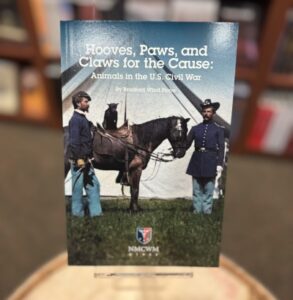
What makes my book different is that it attempts to give a far broader view of the range of services that animals performed during the Civil War and a far broader perspective on all the different types of animals involved in the war. I include a wide array of species not often associated with the Civil War, everything from maggots to whales.
And although the Civil War is a somber topic, whenever appropriate I try to add a little humor to make the book a bit more enjoyable.
What’s the most unusual animal that participated in the Civil War?
Many unusual animals were used in the Civil War, particularly as regimental mascots, including pigs, sheep, badgers and even a bear. However, the strangest in my opinion was Douglas the camel, the mascot of the Confederate Army’s 43rd Mississippi Regiment.
Douglas was a remnant of an experimental American camel corps that Secretary of War (later Confederate) President Jefferson Davis tried to establish shortly before the war. The program disbanded once the Civil War erupted, and many of the camels were sold to private parties or just set loose into the wilds of the American Southwest.

Douglas, through circumstance, found himself adopted as the mascot of this Confederate regiment and carried its musical instruments. He dutifully followed them into many of the major engagements they fought in the Western sector of the war. There is a monument honoring his service in Mississippi.
Who’s the target audience for this book?
Honestly, I hope the book attracts people from all walks of life, both in terms of ages and interests. I freely admit that this is not the most scholarly, ‘deep-dive’ Civil War book ever written. Instead, it is a book that both Civil War and animal enthusiasts will like, and beyond that people who just have an interest in unusual or largely unexamined aspects of history.
How was the National Museum of Civil War Medicine involved in the actualization of this book?
Because of the critical role that animals played in the Civil War — including Civil War medicine, such as the reliance on horse- and mule-drawn ambulances – the museum has always maintained an exhibit on the birth of the field of veterinary medicine during the war. Like its human medicine counterpart, veterinary medicine became far more established and made substantial advances during the war.
As a long-term volunteer at the museum, I approached its leadership with the idea of a book that would cover this topic as well as other ways in which animals were involved in the war, including Civil War medicine. One chapter of the book details the many ways that animal-derived products were used to advance medicine.
Fortunately, the museum liked the idea and kindly published the book and is promoting its sale.
What’s your favorite story in the book?
My favorite story is a mystery involving a black cat that supposedly served aboard the USS Monitor, the ship that fought the CSS Virginia (widely known as the Merrimac) at the Battle of Hampton Roads. A short time after the battle, the Monitor sank in a terrible storm off the coast of North Carolina.
According to Francis Butts, one of the sailors who survived the sinking, he tried to help the cat by stuffing it in a gun barrel and then plugging the barrel with clothing and other material.
His account became controversial because it did not really make any sense and because his shipmates thought that Butts was an inveterate liar. This controversy over the cat raged for over 100 years until 2022 when the raised turret of the Monitor was examined by experts at the Mariners Museum and Park in Newport News, Virginia. The researchers carefully bored out the ship’s cannons, in part to see if the cat was there.
The exciting conclusion is featured in my book.
Did the North or the South utilize animals more regularly during the conflict?
Both sides used animals extensively for a wide range of things. For example, even though the Union had a far more extensive and effective railroad system, it relied mainly on horses and mules to supply its army. At the beginning of Grant’s Overland Campaign in 1864, it is estimated that Gen. [Ulysses S.] Grant’s mule- and horse-drawn supply line would have measured 64 miles end to end.
That said, the Union had an enormous advantage in the number of animals it had compared to the Confederacy. Overall, it had far more livestock. Moreover, it had far more horses than the Confederacy and it developed centralized systems for maintaining the health and abundance of its horses. The Confederacy, to the contrary, had a harder and harder time adequately supplying its army with horses and mules and taking proper care of the ones it did have in the field.
Another major factor was the Union’s ability to couple its industrial and agricultural might in ways that gave it an enormous advantage in producing essential military supplies like canned rations, textiles and leather goods, as well as medicinal products like silk thread sutures.
How long did it to research the book?
About two years. I read a lot of books, articles, museum archive records and conversed with quite a few experts. It was fun and very informative.
What do you hope readers get out of your book?
I hope they find it interesting and enjoyable to read. I also hope that the book makes more people aware of the indispensable role that millions of animals played in the Civil War and at other times in our nation’s history.
Many of these animals knowingly and loyally performed heroic acts alongside their human comrades, valor that would be repeated in later wars and all the way up to today. I hope the book spurs more interest and appreciation of these animal heroes and their contributions to our freedom.
“Hooves, Paws and Claws for the Cause: Animals in the U.S. Civil War” can be purchased at the gift shop at the National Museum of Civil War Medine, 48 E. Patrick Street in Frederick, or online at civilwarmed.org/shop/merchandise/our-publications/hooves-paws-and-claws-for-the-cause/.

Steve Hofstetter, who will perform at Soundstage next week, recently made headlines for his social media post ridiculing some fans' warnings about Charm City's safety.

Israeli-Americans Rachel Goldberg-Polin and Jon Polin talked about the pain of losing their 23-year-old son, who was kidnapped and later murdered in the Oct. 7th tragedy.
Rabbi David Wolpe looks at the recent interest in Hollywood productions about King David and why the story is resonating now.

Directed by Johanna Gruenhut, the production is based on of the 1998 novel and 2003 film of the same name.