
In this awful hour in the history of journalism, Charles Foster Kane should reach through the years and smack some sense of conscience into Jeff Bezos before the multi-billionaire drains all remaining life out of the formerly great Washington Post.
Kane’s the newspaper publisher played by Orson Welles in that classic film “Citizen Kane.” His paper’s losing lots of money, but Kane stands there in the middle of his newsroom and shows everybody that he knows how to count.
Are you listening, Jeff Bezos?
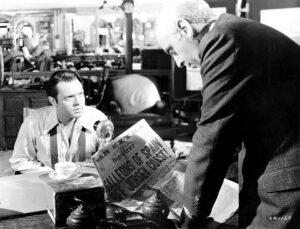
“You’re right,” Kane tells his worried accountant named Thatcher, “I did lose a million dollars last year. I expect to lose a million dollars this year. I expect to lose a million dollars next year.
“You know, Mr. Thatcher, at the rate of a million dollars a year, I’ll have to close this place in … 60 years.”
Good for Charles Foster Kane. He didn’t have the kind of money Jeff Bezos has, but who does?
Bezos is reportedly worth roughly $240 billion.
He owns Amazon. He owns Blue Origin, an aerospace manufacturer, and he’s launching Royal Prometheus, one of the futuristic artificial intelligence outfits, and he owns Whole Foods and …
Oh, yeah.
He also owns The Washington Post, which reportedly lost $100 million a year ago. And because of this, The Post is going to lay off about 30 percent of its employees, including about 300 of its current 800 newsroom journalists.
So, to review …
The Post is losing $100 million a year.
And Jeff Bezos, all by himself, is worth $240 billion.
Which means that in how many years would Bezos have to “close the place up”?
2,400.
That’s 2,400 years, unless Bezos continues making a living out of some of his other ventures. Amazon, for example, reported $155.7 billion in sales last year. That’s $240 billion, versus $100 million.
Is The Post having major troubles? Absolutely. For one thing, Bezos has ostentatiously sucked up to President Trump, who is loathed by subscribers in much of Washington and the D.C. suburbs.
Or haven’t you heard about Bezos killing The Post’s endorsement of Kamala Harris for president, and a reported quarter of a million cancelled subscriptions in response?
Or haven’t you heard about Bezos’s backing of the critically mocked “Melania” vanity documentary?
Not to blame all The Post’s troubles on Bezos, though. We live in a time when newspapers are struggling to hold onto their readers, and print editions all over the country are shrinking while websites try to hold back the tide.
Ironically, on the same day The Post’s cutbacks were announced, The New York Times reported its website added 1.4 million readers last year and now has nearly 13 million subscribers.
(Yes, that’s the same paper that Donald Trump used to refer to as “the failing New York Times.” Its numbers have especially ballooned in the years since it started digging into the ugliness of the Trump White House.)
Are you listening, Jeff Bezos?
Among the most shocking of all The Post’s cutbacks, the paper’s doing away with its sports section. This was the section that once boasted Shirley Povich, Tom Boswell, Bob Addie, John Feinstein, Dave Kindred, Bill Gildea, Sally Jenkins, Michael Wilbon, Tony Kornheiser and Jane Leavy.
Heavy staff cuts are also coming to the paper’s Local News section. How good was The Post’s local news coverage? Let’s not forget, it was a couple of young guys off the local desk, Bob Woodward and Carl Bernstein, who uncovered the darkest secrets of the Watergate scandal.
In “Citizen Kane,” there’s another scene worth recalling. Kane tells his worried accountant, “I don’t know how to run a newspaper, Mr. Thatcher. I just try everything I can think of.”
Memo to Jeff Bezos: Why can’t you try at least something other than cutting the heart out of one of the last remaining treasures of American journalism?

A former Baltimore Sun columnist and WJZ-TV commentator, Michael Olesker is the author of six books, including “Journeys to the Heart of Baltimore” (Johns Hopkins University Press) and “Michael Olesker’s Baltimore: If You Live Here, You’re Home” (Johns Hopkins University).

Jmore Publisher Scott Rifkin, M.D., reacts to President Donald Trump's latest poll numbers and the real force behind the growing decline of the Trump movement.

Last weekend's Flower Mart once again demonstrated that there's nothing to fear about downtown Baltimore, writes Michael Olesker.

A junior at Roland Park Country School, Katie Grossman writes about a recent experience that spurred her to take action to fight antisemitism.

At a time when many Jews fear appearing Jewish in public, seeing Judaism depicted correctly onscreen is reassuring, writes Jewish content creator Rabbi Yael Buechler.