
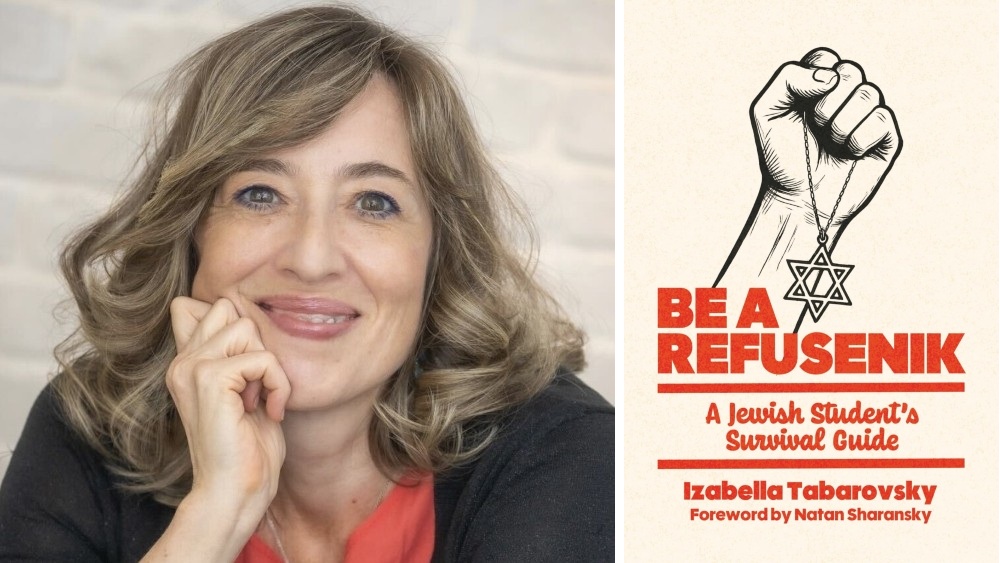
Between 1987 and 1997, more than 700,000 Jews immigrated to the United States from the former Soviet Union. One of them was Izabella Tabarovsky, a native of the Siberian city of Novosibirsk, who arrived in the U.S. with her family when she was 20.
Now an Israel-based activist and scholar of Soviet and contemporary antisemitism, Tabarovsky will speak on Sunday afternoon, Apr. 26, at the program “Generations of Courage: From Refuseniks to Today’s Campus Struggle” at The Associated’s Goldsmith Campus, 5700 Park Heights Avenue.
Tabarovsky will talk about her new book, “Be a Refusenik: A Jewish College Student’s Survival Guide” (Wicked Son). Featuring a forward by former Soviet dissident and Israeli politician Natan Sharansky, “Be a Refusenik” examines historical and contemporary antisemitism while offering practical advice for Jewish students navigating today’s college campuses.
Sponsored by the Baltimore Jewish Council and other community partners, “Generations of Courage” will also feature a panel discussion with former Soviet refusenik Aleksander Smukler and American Jewish activist/influencer Eyal Yakoby. The program will be moderated by Rabbi Moshe Schwartz, head of school at Pikesville’s Krieger Schechter Day School.
In a recent interview with Jmore, Tabarovsky said she sees striking parallels between the antisemitism she encountered growing up in the Soviet Union and the anti-Israel fervor prevalent on American college campuses today.
“At some point around a decade ago, I noticed that this language began appearing on American campuses equating Zionism with racism, fascism and Nazism,” she said. “I started asking myself, ‘Where did it come from? Why do I feel like I’m back in the USSR?’ Because that’s how Soviet antisemitism expressed itself — through this kind of language about Zionism and Israel, constantly demonizing Israel.”
Tabarovsky began researching the rise of antisemitism in the Soviet Union and revisited the history of the refuseniks, Soviet Jews who challenged the regime’s antisemitic and anti-Zionist policies from the late 1960s through the 1980s. By learning their stories, American Jews might better comprehend what they are confronting today, she said.
“American Jews don’t understand the danger of anti-Zionism,” Tabarovsky said. “They tend to think the primary threat comes from the right, and they don’t fully understand what can happen. I wrote about Soviet Jews who experienced this kind of anti-Zionism — being expelled from universities, shut out of professions and careers. I experienced that myself. Then came Oct. 7th.”
By the time of the Hamas terrorist attacks in 2023, Tabarovsky had moved from the U.S. to Israel. She said she was able to view the tragedy through both Israeli and American lenses.
Two weeks after Oct. 7, she traveled back to the U.S. to meet with her publishing house editor. That conversation led to the writing “Be a Refusenik.”
“We realized we needed something that wasn’t academic,” said Tabarovsky, who earned a master’s degree in Russian history from Harvard University. “We needed something that speaks directly to people in this moment and explains what happens when anti-Zionism becomes a dominant ideology. Instead of writing only about the refuseniks, I wanted to connect their stories to what’s happening now.”
To make those parallels compelling, Tabarovsky paired well-known former refuseniks with contemporary American Jewish activists. For example, Sharansky is paired in the book with Alexander “Shabbos” Kestenbaum, who sued Harvard University over its response to antisemitism following Oct. 7. Meanwhile, the Moscow-born Smukler is paired with Yakobi, a former University of Pennsylvania student who took legal action against his college for failure to protect Jewish students there.
Tabarovsky acknowledged there are strong differences between the experiences of refuseniks and those of contemporary American Jewish college students.
“America is not the USSR of the 1970s,” she said. “You’re not going to be sent to the gulag for being an activist on campus. But every society has its own system of rewards and punishments. In certain circles today, if you’re a Zionist, you can be excluded and marginalized. It can destroy your reputation, prevent you from getting a job you want and from being successful in school. In this society, that’s a very serious consequence and it is exactly what happened to Soviet Jews when I was growing up.”
Another parallel lies in the experience of young people suddenly confronting a hostile environment, she said
“No one in my book set out to become an activist,” said Tabarovsky. “They went to college to study, to build their lives. But at some point, they encounter something they can’t ignore. They could walk past it but they don’t because they understand that they’re seeing something important and they’re hearing something important, and they choose to take it on as a mission.”
Pikesville residents Jack Zager and his wife, Ellen Kahan Zager, were instrumental in bringing Tabarovsky, Smukler and Yakoby to Baltimore for “Generations of Courage.”
“We’ve been involved with [the lobbying organization] AIPAC, and I’ve worked with young people lobbying on Capitol Hill,” said Zager. “This program fits into that effort.”
After reading “Be a Refusenik,” Zager said he felt strongly that the local community — especially younger Jews — would benefit from hearing Tabarovsky’s perspective and message.
“Young Jewish people can take lessons from this book so they’re not ashamed or afraid to speak out,” he said. “The book is arming young people to be successful in this crazy world.”
For information about this program, visit baltjc.org/events.
A Baltimore native and Pikesville resident, Freedman had the distinction of being the longest-serving employee in the history of the State of Maryland.

House Bill 661 is the culmination of a collaborative effort led by Del. Sarah S. Wolek (D-16th), Del. Jared S. Solomon (D-18th) and Sen. Shelly L. Hettleman (D-11th).

More than 100 Broadmead residents and team members recently gathered to celebrate the festival of Passover with a meaningful seder dinner.

Journalists bear a responsibility to go beyond the headlines and social media posts to understand the past and present, writes New York University student Lucia Alonso.