
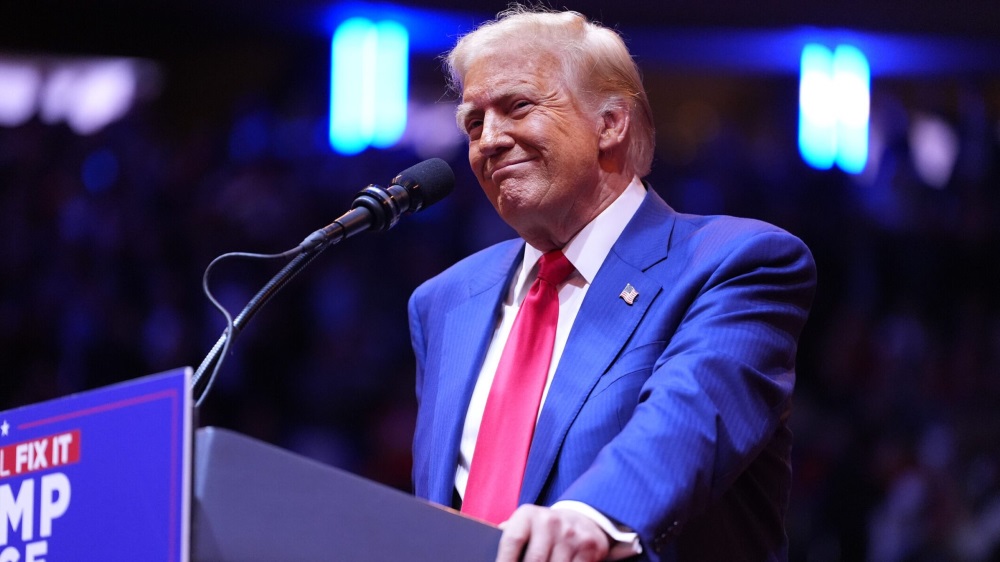
In the immediate aftermath of what could have been the bloodiest mass political attack in American history, President Donald Trump delivered what he apparently considered language of appropriate comfort and normalcy.
Whatever “normalcy” is.
He compared himself to Abraham Lincoln, John F. Kennedy and Ronald Reagan.
He defended the $400 million ballroom he’s building at the White House.
He said he’d been working with comedians on a speech roasting the press but said he might have to update his remarks if ever called upon to deliver them.
This was minutes after a man opened gunfire at Saturday night’s White House Correspondents Dinner, attended by Trump and some of the highest-ranking members of his administration, and hundreds of reporters.
The president was showing us he was calm, things were already returning to “normal,” and so he imagined he could ad-lib a few thoughts he considered timely and appropriate.
Just minutes after frantic Secret Service agents had rushed Trump, his wife, his FBI director and a bunch of cabinet members to safety, Trump brought up Lincoln and other assassination targets.
“I’ve studied assassinations,” he said. “The people that do the most, the people that made the biggest impact, they’re the ones that they go after. Just take a look at the names. They’re big names, and I hate to say that I’m honored by that, but I’ve done a lot. We’ve done a lot. We’ve taken this country, and we were a laughingstock for years, and now we’re the hottest country anywhere in the world.”
This is what he wants to boast about at such a moment?
As an anxious nation held its breath awaiting word of any possible injuries to high-ranking officials, Trump defended that bloated $400 million ballroom he’s building at the White House.
The Washington Hilton hotel, scene of Saturday’s shooting, is “not a particularly secure building,” Trump said. “I didn’t want to say this, but this is why we have to have all of the attributes of what we’re planning at the White House. It’s actually a larger room, and it’s much more secure. It’s drone-proof, it’s bulletproof glass. We need the ballroom. That’s why Secret Service, that’s why the military are demanding it. They’ve wanted the ballroom for 150 years for lots of different reasons. But today’s a little bit different.”
At such a moment, this is what he wants to talk about?
As a nation of TV watchers awaited details on the would-be assassin’s background, Trump talked about the speech he didn’t get a chance to deliver to the assembled journalists he’s sometimes referred to as “enemies of the people.”
“I was all set to really rip it,” he said. “I said to my people, ‘This would be the most inappropriate speech ever if I made it now.’ So I’ll have to save it. I don’t know if I could ever be as rough as I was going to be tonight. I think I’m going to be probably very nice. I’ll be boring next time.”
Boring, he never is.
Outrageous, inappropriate, cruel, bullying — all the time.
And that’s the problem. All of these Trumpian characteristics are what passes for “normal” in our time. That’s why he considered it “appropriate,” in the aftermath of what might have been a true Saturday night massacre, to follow a potential bloodbath with remarks about a ballroom, a comic monologue and a comparison of himself with some of our most revered former leaders.
This is what passes for “normal” now.
Declaring war without consulting Congress is normal now. Fracturing historic alliances with NATO is normal now. Lusting after Greenland is normal. Taking billions in bribes is normal now. Stocking a presidential cabinet with fools is normal now.
Attempted assassination is normal now.
So why wouldn’t it be “normal,” in the immediate aftermath of what could have been catastrophe, for this president to compare himself to Lincoln, to defend a boondoggle ballroom, to joke about his newest plans for journalists, those pesky “enemies of the people.”
A former Baltimore Sun columnist and WJZ-TV commentator, Michael Olesker is the author of six books, including “Journeys to the Heart of Baltimore” (Johns Hopkins University Press) and “Michael Olesker’s Baltimore: If You Live Here, You’re Home” (Johns Hopkins University).

Commemorations of the Holocaust must transcend the past to include concerns about the present and future, writes Menachem Z. Rosensaft.

Someone needed to tell Donald Trump that his appearance at a UFC fight over the weekend was not a good look, writes Michael Olesker.

Journalists bear a responsibility to go beyond the headlines and social media posts to understand the past and present, writes New York University student Lucia Alonso.