
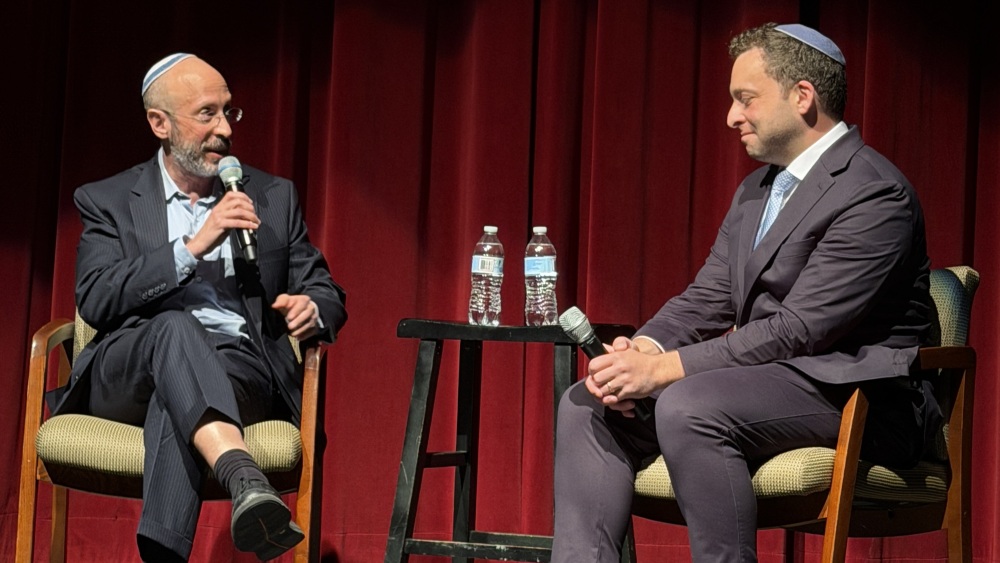
At a time when the scourge of antisemitism is skyrocketing around the world, Elisha Wiesel is contemplating the legacies of both his late father and the Jewish people.
An American businessman, activist and philanthropist, Wiesel, 53, is the only child of Holocaust survivor, author and Nobel laureate Elie Wiesel, who passed away in 2016. He recently spoke at Pikesville’s Beth Tfiloh Congregation following the screening of the 2024 documentary “Elie Wiesel: Soul on Fire.”
At the Holocaust Remembrance Day program at Beth Tfiloh, Elisha Wiesel, who serves as board chairman of the Elie Wiesel Foundation for Humanity, reflected on how his father might view today’s climate for Jews in the aftermath of the Oct. 7th terrorist attacks in Israel and the war in Gaza.
He said that antisemitism tends to adapt to new circumstances in different generations, whether coming from the political right or left.
Wiesel referenced historical precedents in the 1940s when Jewish groups were often pitted against each other by antisemites and others in a strategy of “divide and conquer.”
He said he sees echoes of that same tactic today, particularly in what he described as left-wing antisemitism embedded within ideological perspectives on the Middle East conflict.
Slogans such as “Zionism is Racism” are not new, he said, but have been repackaged for contemporary audiences, often gaining traction in academic settings where students are increasingly encouraged to “challenge facts.”
Wiesel said antisemitism frequently shifts forms, but its overall intent is to undermine and weaken Jewish unity and identity. He said the answer lies in cultivating joyfulness in Jewish settings “to ensure a better future. If you don’t see the joy, what’s the point?”
While Jewish schools, congregations and community organizations must play an essential role in conveying the inherent joy of the faith and community, Judaism must ultimately be lived and savored within the family and home, Wiesel said.
“Judaism cannot be delegated,” he said. “It’s personal.”
The tension between despair and the need for continuity was one that his father grappled with, Wiesel said. For decades, Elie Wiesel questioned openly whether it was just or appropriate to bring Jewish children into a post-Holocaust world. But his wife, and Elisha’s mother, the late Holocaust survivor Marion Wiesel, helped the writer overcome those concerns.
Elisha Wiesel’s response to today’s antisemitism is unequivocal: “We need to have more kids.” Both observant and assimilated Jews, he said, have a vital role to play in ensuring Jewish continuity, not just biologically but also culturally and spiritually.
Wiesel challenged what he views as a tendency in the Jewish community to respond to antisemitism primarily through intellectual means — by writing opinion pieces, issuing organizational statements or engaging in debates. He said that emotional connections and interpersonal engagement is crucial to interfaith outreach.
“Do we retreat to writing an op-ed instead of having tough conversations?” he asked.
Wiesel said he sees untapped potential in cross-community relationships. Opportunities for interfaith advocacy, action and dialogue rely on “heart and a little curiosity,” he said.
At both the individual and organizational levels, Wiesel said Jews need to not “check your identity at the door,” even when entering spaces that may feel awkward or uncomfortable. Meaningful progress, he said, requires having difficult conversations, ones that may provoke tension but ultimately build understanding and respect.
Wiesel said he hopes the new documentary about his father’s life and mission, directed by award-winning filmmaker Oren Rudavsky, will serve as a call to action for seekers of tolerance. He said Elie Wiesel’s message was not simply about fighting antisemitism but strengthening what it means to live as Jews with unity, courage, joy and dignity.
Harper Goldberg is a local freelance writer.

For 35 years, the late Deborah Brodie, aka Bubbie Cookie, amassed a collection of over 200 Jewish ritual objects, which she used to teach her Hebrew school students with special needs.
Conceived by Columbia resident Benjamin Kintisch, "Life Review: The Hospice Musical" offers a thought-provoking and occasionally amusing perspective on mortality.
A junior at Roland Park Country School, Katie Grossman writes about a recent experience that spurred her to take action to fight antisemitism.
Presented by Jews United for Justice and a consortium of local synagogues, "Beyond Welcoming the Stranger" offered a Jewish approach to helping immigrants.