
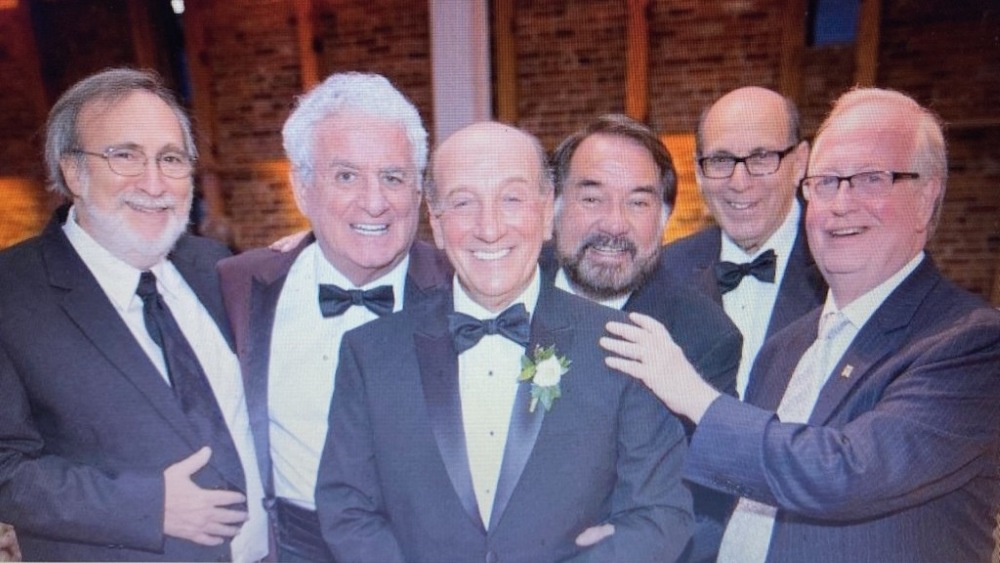
In the WJZ-TV newsroom one afternoon years ago, Marty Bass seemed slightly more wired than usual, meaning he was ready to bounce off any nearby wall at any given moment.
He had “infancy anticipation.” His wife, Sharon, was pregnant with the first of their two children, and the expectation was making Marty a wreck. Having experience in such matters, I attempted to pass on to him the joys of parenthood.
“Relax,” I said, “you’ll love being a father.”
“Oh, yeah?” he shot back in that native Kentucky drawl he’s never lost to the much more lilting Bawlamer patois. “How’d you like to raise another Marty Bass?”
He knew himself pretty well. Another Marty Bass? The world was barely big enough to contain even one.
Now, at 72, Bass is about to retire from broadcasting after roughly 47 years at WJZ’s “Eyewitness News.” In that time, he’s gone from such Bassian features as “Catchin’ Bass” and “Mondo Basso” to “Where’s Marty?”
Each was intended as a quirky smile and rarely to be confused with serious journalism — and each reflected personal Bass personas as court jester, rascal spirit and a man who left no opinion unspoken.
The other stations in town tried matching him and could not. He was the personification of the late Jerry Turner’s fundamental rule about television: Be yourself. If you fake it, viewers will spot it right away and turn the channel.
As they pioneered the early-morning time slot in Baltimore TV and kept it running for four decades, Bass and co-anchor Don Scott were the perfect combination of personas: the laid-back Scott, steady as a dad, and Marty with his machine-gun outbursts.
They dominated mornings. For years, they were drawing seven times the audience as the other local early morning news programs.
The show expanded from half an hour to three hours, starting at 5 a.m. With all that time to fill and with his low threshold for boredom, Bass started ad-libbing.
The ad-libs became rants, some comical and some not. When the ratings kept going up, so did the ad-libbing. Then, the control room started getting in on the fun, running sound effects as punctuation marks. For a while, the show ran photos of children on their birthdays. They had to stop because they were getting flooded with entries.
Bass was the powder keg, and Scott was the guy who kept the party from getting out of hand. He never lost his composure.
When he and Marty were first teamed, Don had already been at the station for more than a decade and covered a wide variety of stories. He knew the turf pretty well and gave you the story straight.
He also understood his steadiness was the important balance to Bass’s unpredictability.
Did Marty get himself in a jam (in his bachelor days) with an undercover cop posing as a hooker? Well, yeah, but he explained it away as a misunderstanding. Did he call his own news director a lot of bad names on the air one morning? Yeah, and he got hollered at afterwards, and it was allowed to pass. For talent, you make allowances.
The show was so popular, it made national news when Marty decided to ditch his flamboyant toupee. He was taking a brave step where few in TV news had ever gone, removing some of its contrived show biz artifice instead of adding to it.
Twenty years ago when I wrote a book titled “Tonight at Six: A Daily Show Masquerading as Local TV News” (Apprentice House), I asked Marty about the seriousness of early morning coverage.
“Hell,” he said, “ten minutes to six on a Monday morning, it ain’t gonna be Edward R. Murrow.”
Audiences obviously understood this. They also understood the mercurial Marty.
As did his wife Sharon. When that first child, Savannah, was born, Don Scott called the house to ask Sharon how she and the new daughter were doing.
With her dry sense of humor intact, Sharon said, “I cannot believe God would give me a colicky baby — and Marty Bass.”
She had love and laughter in her heart as she said it.

A former Baltimore Sun columnist and WJZ-TV commentator, Michael Olesker is the author of six books, including “Journeys to the Heart of Baltimore” (Johns Hopkins University Press) and “Michael Olesker’s Baltimore: If You Live Here, You’re Home” (Johns Hopkins University)
The Orioles' weak defense plays a major role in the nightly carnage, writes Michael Olesker.

Jmore Publisher Scott Rifkin, M.D., reacts to President Donald Trump's latest poll numbers and the real force behind the growing decline of the Trump movement.

Last weekend's Flower Mart once again demonstrated that there's nothing to fear about downtown Baltimore, writes Michael Olesker.

A junior at Roland Park Country School, Katie Grossman writes about a recent experience that spurred her to take action to fight antisemitism.